

Key facts
- NASA reports more than 6,000 confirmed exoplanets in its catalog, which is continually updated.
- The agency says 2025 marked 30 years since the discovery of exoplanets; 51 Pegasi b was identified in October 1995 around a Sun-like star.
- NASA estimates that billions of planets exist in the Milky Way and says most exoplanets discovered so far are in a relatively small region of the galaxy.
- The catalog classifies exoplanets as gas giants, Neptunian planets, super-Earths, and terrestrial planets, and allows filtering by discovery method or facility.
- NASA’s CoRoT mission profile states that the mission observed more than 160,000 stars over almost six years and searched for planets using transits, which require alignment among the star, planet, and observer.
- NASA describes the Habitable Worlds Observatory as a future mission conceived to find and observe Earth-like exoplanets and search for signs of life.
Related records
- Solar System Planetary system
- Sun Celestial body
- Mars Celestial body
- Jupiter Celestial body
- Saturn Celestial body
- NASA Space agency
- European Space Agency Space agency
- James Webb Space Telescope Telescope
- Milky Way Cosmic structure
- Earth Celestial body
- Mercury Celestial body
- Venus Celestial body
- Uranus Celestial body
- Neptune Celestial body
- Próxima Centauri Celestial body
- 51 Pegasi Celestial body
- Milky Way Cosmic structure
- Nancy Grace Roman Space Telescope Mission
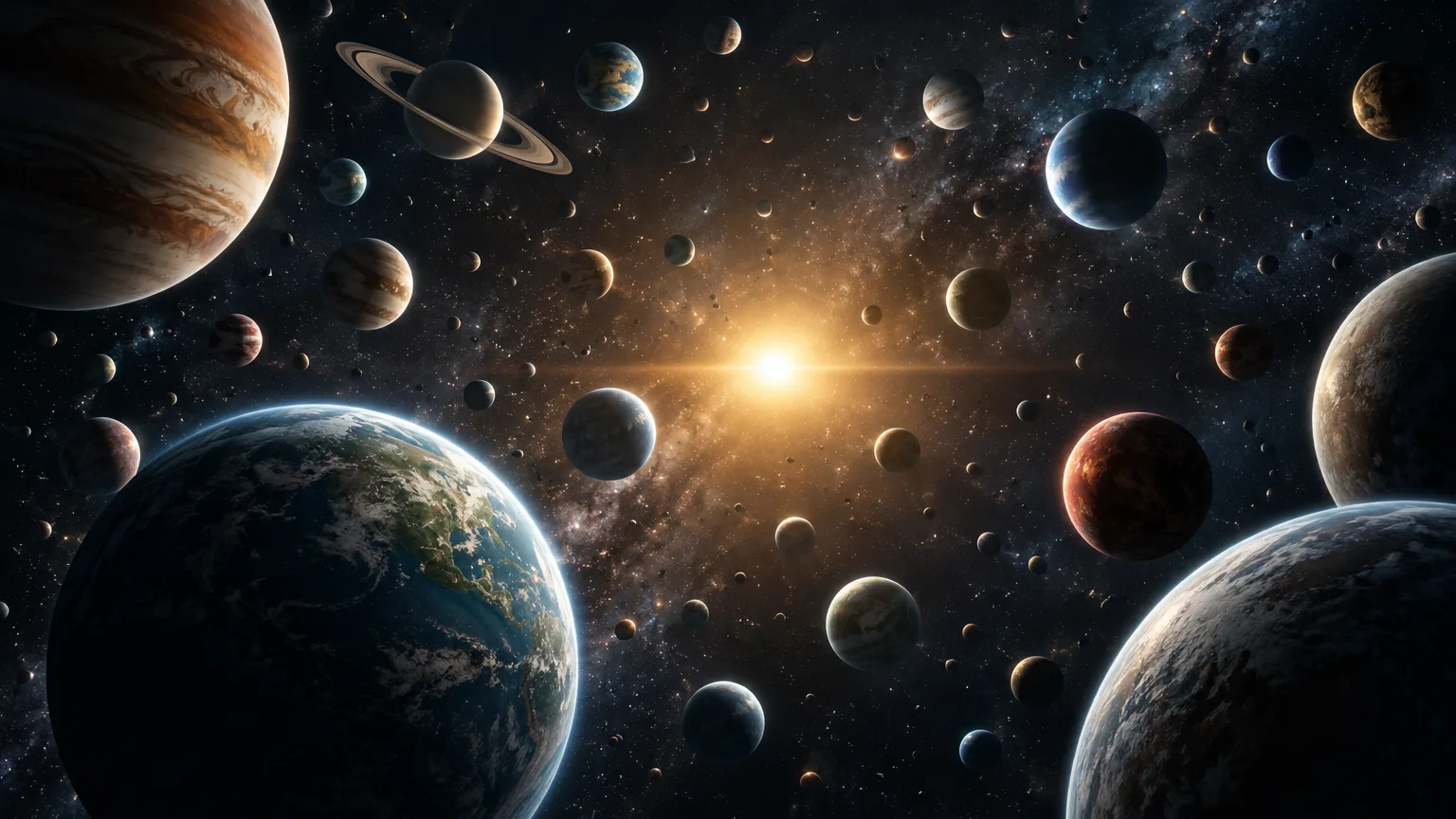
The search for planets beyond the solar system has confirmed more than 6,000 exoplanets, according to NASA’s science website. The agency estimates that billions exist in our galaxy, although most discovered so far are in a relatively small region of the Milky Way. This difference between the objects on record and the population thought to exist helps explain what the catalog represents: a collection of detected and confirmed worlds, not a complete list of all the galaxy’s planets.
NASA identifies 2025 as the 30th anniversary of exoplanet discoveries. The first planet identified around a Sun-like star, 51 Pegasi b, was detected in October 1995. Since then, the search for and study of these worlds have expanded through new detection methods and observations made from space and from ground-based observatories. The figure of more than 6,000 is a count presented on a page and in a catalog that the agency updates continuously.
What counts as an exoplanet
According to NASA’s definition, an exoplanet is any planet beyond our solar system. Most orbit other stars, although there are also rogue planets that are not bound to any star. For comparison, the agency recognizes eight planets in our solar system: Mercury, Venus, Earth, Mars, Jupiter, Saturn, Uranus, and Neptune.
NASA’s exoplanet catalog brings together confirmed objects and lets users browse them by type, discovery method, or the mission, observatory, or other facility involved in detecting them. The website describes the resource as an encyclopedia that combines interactive three-dimensional models with data on each world. Because it is continually updated, the number of entries can change as records are added.
A diverse population of worlds
Scientists group exoplanets into categories such as gas giants, Neptunian planets, super-Earths, and terrestrial planets. These groups include subcategories, among them mini-Neptunes. Such labels help organize a population that includes objects with very different sizes and characteristics; on their own, they do not describe every feature of a particular planet.
Measurements of diameter and mass make it possible to study the composition of these worlds. According to NASA, findings range from rocky planets, comparable in this respect to Earth and Venus, to others rich in gas, such as Jupiter and Saturn. Some may be dominated by water or ice, and others by iron or carbon. The agency also mentions worlds with seas of molten material and planets with very low density. These are examples of the diversity that can be investigated using measured properties.
These categories and measurements provide a way to compare known planetary systems. NASA’s website itself indicates that most exoplanets identified so far are concentrated in a relatively small region of the galaxy: “small” in this context means that it lies thousands of light-years from the solar system. At the same time, the agency notes that even the nearest known exoplanet to Earth, Proxima Centauri b, is about four light-years away. Distances and the distribution of discoveries are essential context for interpreting the catalog.
How distant planets are detected
One technique documented in NASA materials is the transit method. It involves observing changes in a star’s brightness when, from the observer’s point of view, a planet passes in front of it. The CoRoT space mission had, among other objectives, to measure changes in stellar brightness with great precision and search for small exoplanets using transits, as well as measure their sizes.
A transit can be observed only if the star, planet, and observer are aligned in a suitable way. Because of this geometric condition, not all planetary systems show transits visible from Earth. CoRoT observed more than 160,000 stars over almost six years, according to the mission profile hosted on NASA’s data portal. These figures describe CoRoT’s work; they are not a count of planets confirmed by the mission.
The profile also explains that CoRoT measured variations in stellar luminosity and that the changes could be caused by processes within the star itself or by external causes, such as orbiting bodies. In the observing mode intended to search for transits, many stars were monitored to detect these events, which are uncommon because of the alignment required. Thus, the exoplanet catalog brings together results obtained with different procedures and missions, and provides filters for exploring how each world was discovered.
What the catalog makes it possible to investigate
For NASA, every confirmed exoplanet contributes to the study of the conditions in which planets can form and to estimates of how common Earth-like worlds might be. Comparison requires knowledge of the objects’ properties and a broader set of observed systems. The catalog serves as a reference for examining data and visualizing worlds, while its filters make it possible to organize information by planetary type and detection method.
The search for habitable planets is among the future objectives described by the agency. NASA presents the Habitable Worlds Observatory as a future mission conceived specifically to find and observe Earth-like exoplanets and search for signs of life. The website also identifies a target-star catalog as a guide to nearby stars that astronomers want to study with future missions. This planning provides context for one of the research questions: how to select worlds and stars for subsequent observations.
The count of more than 6,000 confirmed exoplanets therefore offers a measure of the progress accumulated over three decades of discoveries and a gateway to a population far larger than the one recorded. Classifications, mass and diameter measurements, detection methods, and future observations address different but connected questions: what types of planets exist, how they form, and which worlds might merit closer study.
The catalog figures are dynamic because NASA’s resource is continually updated. The estimate of billions refers to the population researchers believe exists in the galaxy, while the more than 6,000 refers to confirmed exoplanets included in the catalog. The agency presents these two figures as different parts of the picture: what has been observed and recorded so far, and the much larger population estimated to inhabit the Milky Way.