space telescope

James Webb Space Telescope

NASA-led infrared space observatory with ESA and CSA partners, operating near the Sun–Earth second Lagrange point to study the early universe, cosmic formation and the Solar System.

Active Verified 2026-10-02
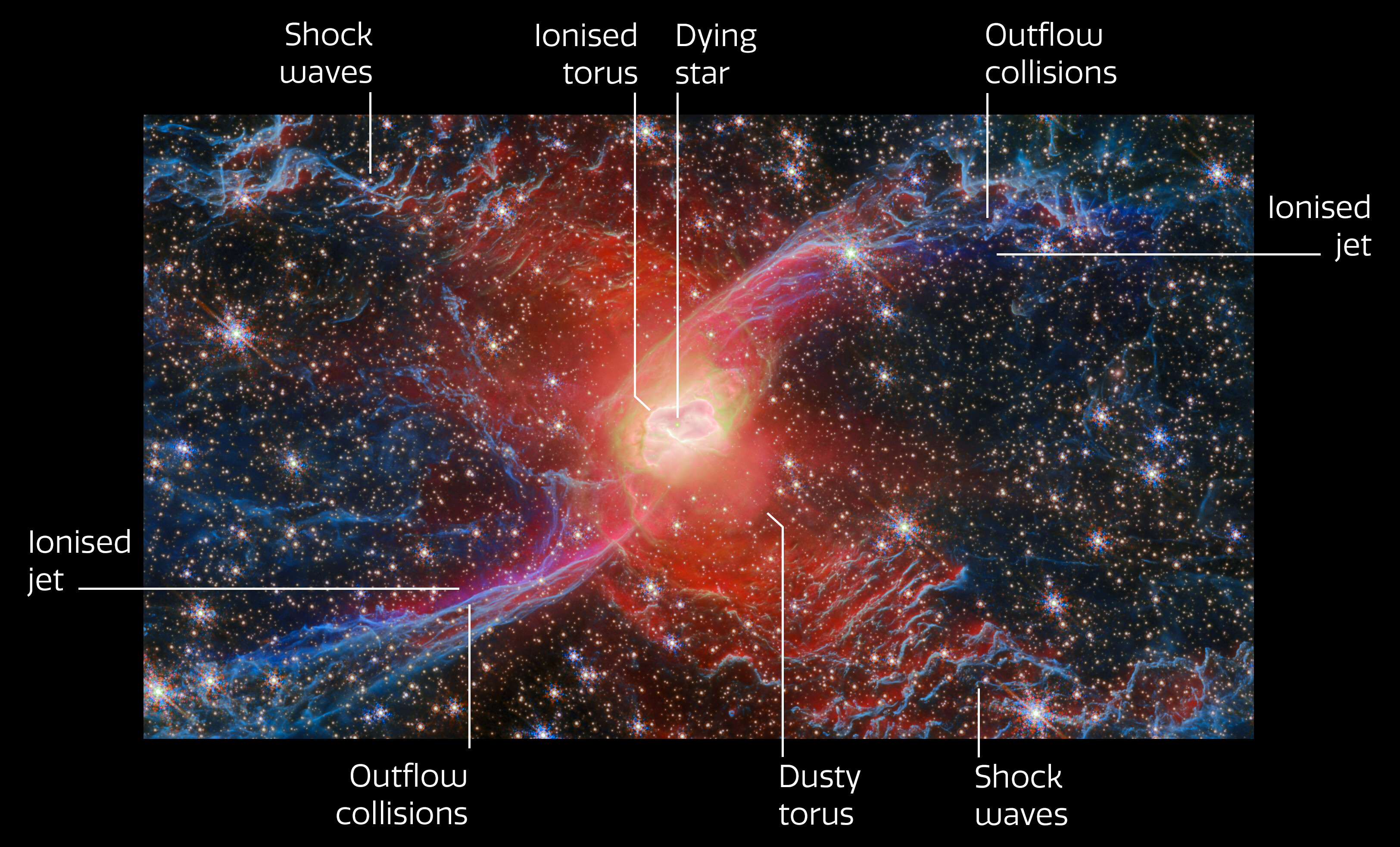
Red Spider Nebula, NGC 6537 (annotated)
Type: Image · real photograph Provider: ESA/Webb Author: ESA/Webb Credit: ESA/Webb, NASA & CSA, J. H. Kastner (Rochester Institute of Technology) · CC BY 4.0 Licence: CC BY 4.0 Colour treatment: original

Overview

The James Webb Space Telescope is an infrared space observatory led by NASA, with the European Space Agency (ESA) and the Canadian Space Agency (CSA) as international partners. It launched on 25 December 2021 and operates near the Sun–Earth second Lagrange point. Its design uses a segmented 6.5-metre primary mirror and four main scientific instruments. Its scientific work encompasses the early universe, the formation of galaxies and stars, planetary systems, and objects in the Solar System. These areas set out the observatory’s broad scientific purpose rather than restricting it to a single class of target or cosmic era. This profile is limited to its identity as an infrared observatory, its stated partners, launch date and operating setting, and the supplied design and research scope; it does not set out individual observation results or additional technical specifications.

Essential data

Key fact
NASA-led infrared space observatory with ESA and CSA partners.
Key fact
Launched on 25 December 2021; operates near Sun–Earth L2.
Key fact
Uses a segmented 6.5-metre primary mirror and four main instruments.
Key fact
Studies the early universe, cosmic formation and Solar System objects.

Sources and references

  1. James Webb Space Telescope NASA Science

Context