

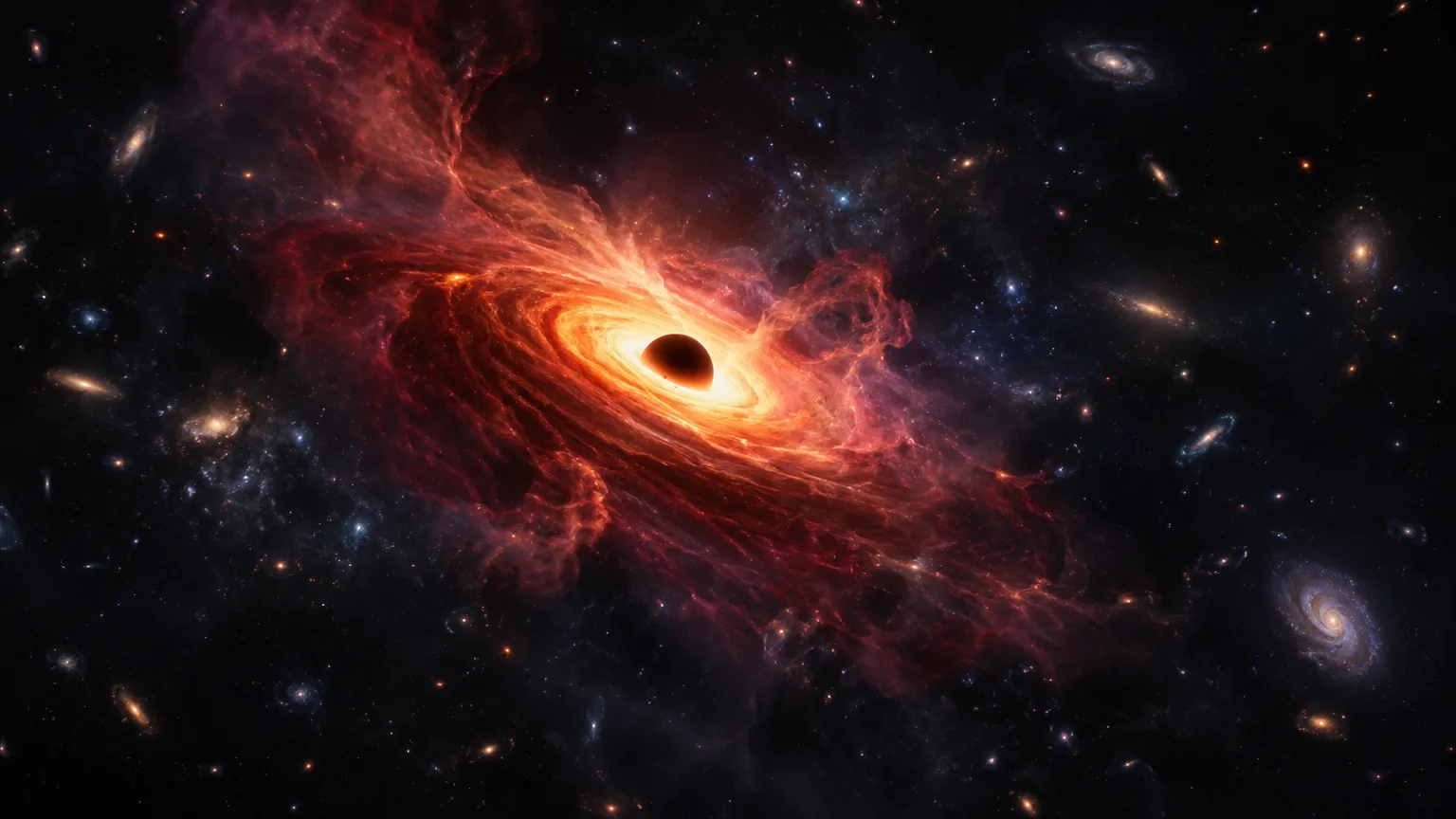
Key facts
- QSO1 is a “little red dot” observed when the universe was about 700 million years old; it is about 1,300 light-years in diameter.
- The team directly calculated a mass of about 50 million solar masses for the central black hole, using the Keplerian motion of hydrogen gas.
- The black hole accounts for at least two-thirds of QSO1’s estimated total mass.
- QSO1 lies behind the Abell 2744 cluster, whose gravitational lens magnifies and produces three apparent images of it.
- QSO1’s gas consists almost entirely of hydrogen and helium; its metallicity is below 0.5% of the Sun’s.
- The researchers propose two possibilities: a “heavy seed” formed during the first second after the Big Bang, or the later collapse of a large gas cloud.
Related records
Observations from the James Webb Space Telescope suggest that a supermassive black hole in the early universe may have formed before a substantial host galaxy existed around it. The object analyzed is Abell2744-QSO1, abbreviated QSO1, a “little red dot” whose light shows the universe when it was approximately 700 million years old. NASA announced these results on May 27, 2026, based on observations that made it possible to estimate the black hole’s mass from the motion of the gas surrounding it.
The team calculated a mass of about 50 million times the mass of the Sun. That figure is at least two-thirds of QSO1’s total mass. The researchers interpret this disproportion as consistent with a black hole that was born large and may have preceded the stellar processes of a developed galaxy. The observation therefore addresses a central question in astronomy: how supermassive black holes detected in the early universe could have grown so rapidly.
A red dot observed in the young universe
QSO1 is part of a class of compact, reddish objects Webb has found in the distant universe, known as “little red dots.” This example lies behind the galaxy cluster Abell 2744. The cluster’s gravity bends and magnifies the light from objects behind it, an effect called gravitational lensing. In this case, QSO1 appears magnified and in three apparent positions in the sky, making it easier to study.
The object is about 1,300 light-years in diameter, and its light traveled for more than 13 billion years before reaching us. Initial studies had suggested that it might consist largely of a bright cloud of hydrogen and helium orbiting a black hole of about 40 million solar masses. However, that earlier estimate was indirect and relied on assumptions derived from what is known about nearby black holes. The new analysis used the motion of the gas to calculate the black hole’s mass directly, according to NASA’s description.
How the central mass was estimated
To investigate the object, the team used the integral field unit of Webb’s NIRSpec spectrograph. According to NASA’s technical description, this unit combines imaging and spectra to map how a source’s properties vary across different regions of the observed field. In QSO1, the researchers traced the motion of hydrogen rotating around the center and compared the gas’s rotation speed with its distance from the center.
The measured pattern corresponds to Keplerian motion: the gas orbits a central point according to the same basic laws of gravity that describe, for example, planetary orbits around the Sun. According to the team, if the mass were distributed among many stars, the gas would not show such tightly ordered rotation around a center. Using the observed velocities to calculate the mass, the researchers obtained an estimate of about 50 million solar masses concentrated in the black hole. The minimum two-thirds fraction refers to QSO1’s estimated total mass, not to a proportion applicable to other galaxies.
Maps of chemical composition provided another line of information. QSO1’s gas consists almost entirely of hydrogen and helium, with very little of heavier elements such as oxygen. NASA says its metallicity is below 0.5% of the Sun’s. In astronomy, “metallicity” refers to the abundance of elements heavier than hydrogen and helium. The team considers this composition, together with the estimated central mass, consistent with an environment that has been little enriched by generations of stars and their remnants.
What it suggests about the origin of black holes
In the traditional scenario described by NASA, massive stars form inside galaxies, consume their fuel, and collapse to produce black holes. These can grow by drawing in material and merging with others. This process creates a difficulty in explaining objects that had already reached millions or billions of solar masses at very early times: they must have grown rapidly from smaller initial seeds.
In QSO1, the central mass makes up an extraordinarily large share of the observed total mass. Ignas Juodžbalis, one of the authors cited by NASA, said the object appears to lack a substantial host galaxy and that the black hole would have preceded the stellar processes. The team proposes two routes consistent with its having been born already massive: a “heavy seed” formed during the first second after the Big Bang, or the somewhat later collapse of an enormous gas cloud. The observation presented does not establish which of these origins occurred.
The result is also important for its method: according to NASA, it is a direct measurement of a black hole’s mass made when the universe was less than one billion years old. The gas’s motion makes it possible to check the central concentration more directly than estimates based solely on relationships inferred from objects in the nearby universe. The team considers the result consistent with earlier indirect measurements, supporting the assumptions used in those measurements.
Scope and open questions
QSO1 is the specific object analyzed in this study, and its light is magnified by Abell 2744. The authors propose primordial formation or the direct collapse of a large gas cloud as possible origins of a heavy seed. These are hypotheses for interpreting the observations, not a confirmed identification of the formation mechanism.
The team is analyzing similar objects to investigate whether supermassive black holes may have preceded the galaxies that host them today. The hypothesis that some black holes were born before their galaxies is therefore an interpretation the researchers want to test with more examples. NASA said the results are described in studies published in Nature and Monthly Notices of the Royal Astronomical Society.
QSO1 provides a mass measurement based on gas dynamics and shows that, in this early object, the black hole accounts for at least two-thirds of the estimated total mass. The authors interpret this proportion and the scarcity of heavy elements as signs consistent with a black hole that was born large and may have formed before a substantial galaxy. The precise history of its origin and the frequency of similar scenarios remain open questions.
Sources: NASA, QSO1 (2026-05-27); NASA, NIRSpec / IFU.