Identity and general characteristics
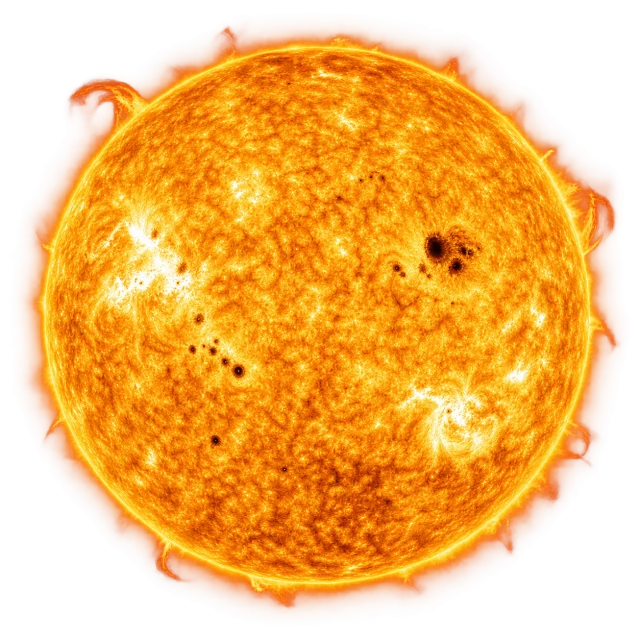
The Sun is a yellow dwarf star and the only star in the solar system. It is about 4.5 billion years old and is composed mainly of hydrogen and helium. From Earth, it appears to be a steady source of light and heat, but it is a dynamic star that changes and sends energy into space. Heliophysics—the study of the Sun and its influence throughout the solar system—investigates these processes.
It is the largest object in the solar system: its diameter is approximately 1.4 million kilometers and its radius about 700,000 kilometers. Its mass is more than 330,000 times Earth’s mass and accounts for about 99.8% of the solar system’s mass. It is about 150 million kilometers from Earth. The Sun’s gravity holds the system together and keeps planets, asteroids, comets, and other bodies orbiting around it.
Formation and evolution
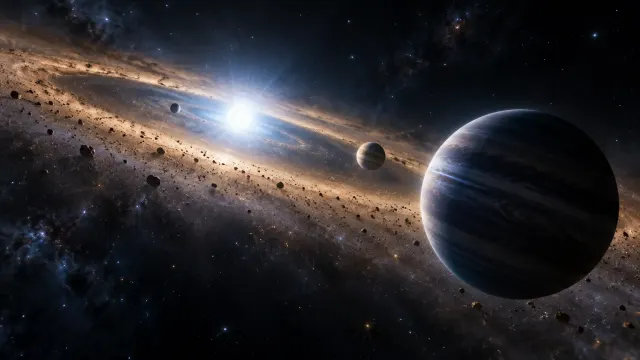
The Sun formed about 4.6 billion years ago from a large, rotating cloud of gas and dust called the solar nebula. As it contracted under its own gravity, the cloud spun faster and flattened into a disk. Most of the material gathered at the center and formed the Sun; much of the remaining material formed the planets and other objects that now orbit the star. The early solar wind expelled some of the leftover gas and dust.
In the core, pressure and temperature allow hydrogen to fuse into helium. These nuclear reactions produce the energy that powers the Sun’s light and heat. According to the estimates cited, the Sun has lived somewhat less than half its lifetime: in about 5 billion years, it will run out of energy, expand into a red giant, and eventually remain as a white dwarf. As it expands, it could engulf Mercury and Venus, and perhaps Earth as well.
Structure and activity
The Sun is a sphere of plasma—very hot gas with electrically charged particles—not a solid body. Its interior regions are the core, the radiative zone, and the convection zone. In the core, the temperature exceeds 15 million degrees Celsius. Energy moves outward through radiation, and in the convection zone, large bubbles of hot plasma rise toward the outer layers.
The region we see from Earth is the photosphere, considered its visible surface even though it is part of the solar atmosphere. It is about 250 miles thick—approximately 400 kilometers—and has a temperature of about 5,500 degrees Celsius. Above it are the chromosphere, a transition region, and the corona. The corona can reach about 2 million degrees Celsius, much hotter than the photosphere; the heating of this outer atmosphere is one of the solar mysteries noted by NASA.
Sunspots, coronal holes, and solar flares appear in the solar atmosphere. Sunspots are regions that are somewhat cooler than their surroundings; flares are bursts of light and particles associated with the release of magnetic energy. Coronal mass ejections are enormous clouds of magnetized particles expelled into space. Material that leaves the corona at supersonic speeds forms the solar wind and the heliosphere, a large magnetic bubble that extends beyond the orbits of the planets.
Rotation, orbit, and surroundings
The Sun rotates on its axis, but because it is plasma rather than a solid, different regions rotate at different speeds: it completes one rotation in about 25 Earth days at the equator and about 36 days at the poles. The solar equatorial plane is tilted 7.25 degrees relative to the ecliptic, the plane of Earth’s orbit.
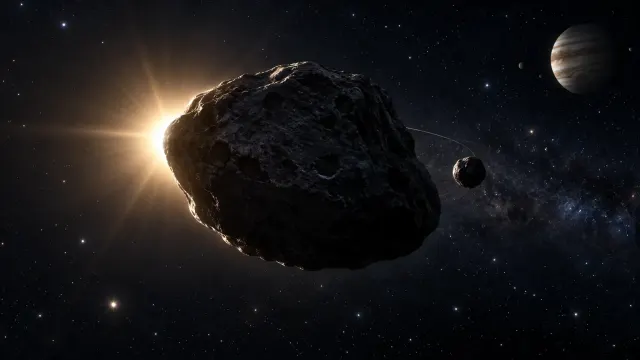
The Sun and the objects in the solar system orbit the center of the Milky Way. The system is in the Orion Arm or Spur, between the Sagittarius and Perseus regions. One complete orbit around the galactic center takes approximately 230 million years. In its early days, the Sun was surrounded by a disk of gas and dust; some of the dust persists in several rings that follow the planetary orbits, where the planets’ gravity concentrates it. The Sun has no moons.
Exploration and limitations
Spacecraft investigating the Sun include Parker Solar Probe, STEREO, Solar Orbiter, SOHO, Solar Dynamics Observatory, Hinode, IRIS, and Wind. SOHO, the Solar and Heliospheric Observatory mission, marked 25 years since its launch on December 2, 2020. Space-based observation makes it possible to study the star and phenomena such as flares and coronal mass ejections.
Extreme temperatures and radiation mean the Sun cannot host life as it is known. By contrast, solar energy is essential for most life on Earth. The photosphere is the visible layer, not a solid surface; therefore, the expression “surface of the Sun” should not be understood as referring to the surface of a rocky planet.
IAU Resolution B3 of 2015 defines a nominal solar radius of 695,700 km and a nominal effective temperature of 5,772 K. These are conversion constants, not new measurements or exact instantaneous properties of the Sun. Values in solar units are reference normalizations.