

Key facts
- On March 27, 2022, a stellar occultation campaign allowed the Lucy science team to identify a satellite of Polymele.
- The campaign brought together 26 professional and amateur teams; 14 reported observing the occultation, and two records showed a distinct signal.
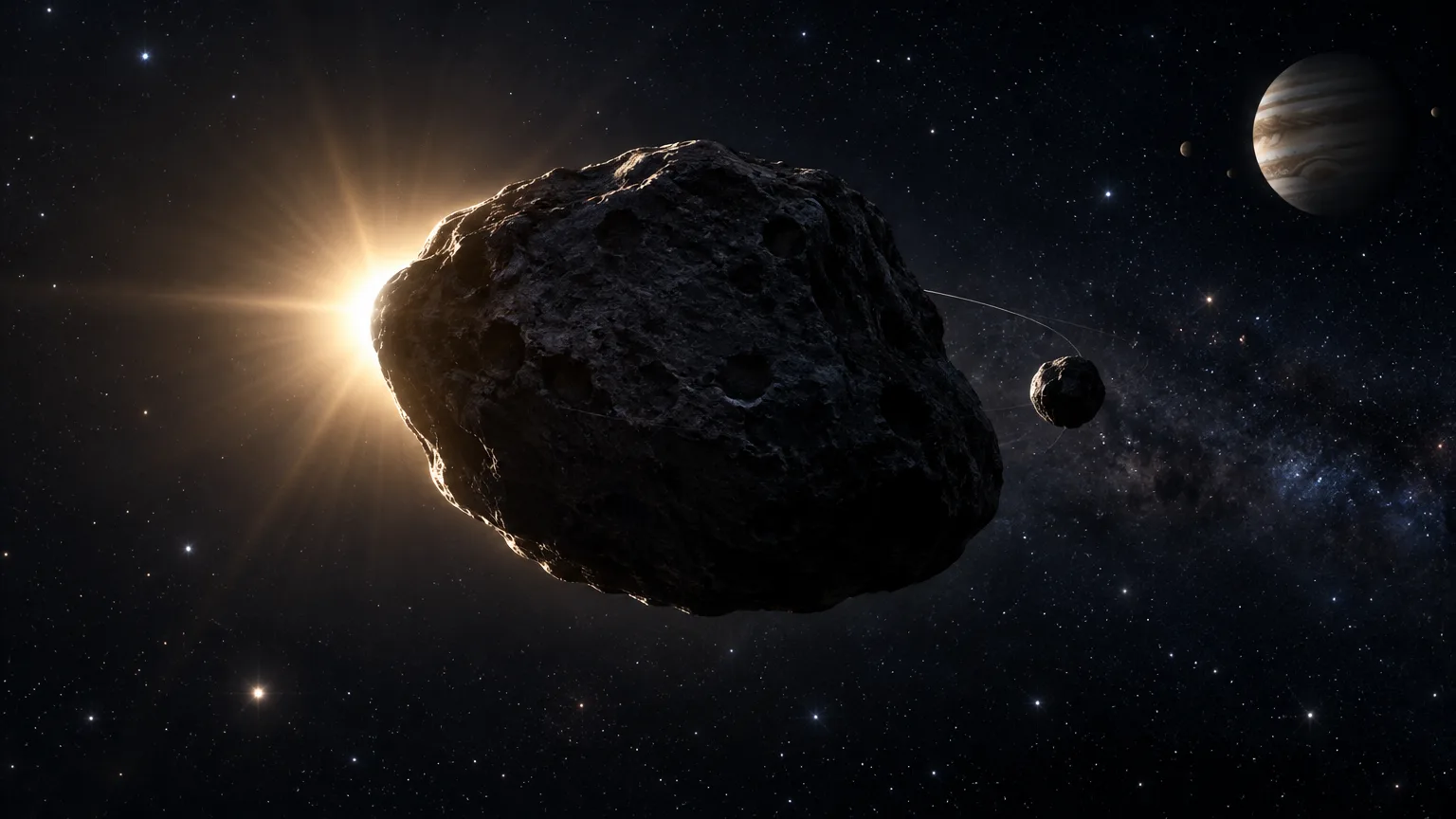
- The satellite was estimated to be about 5 km in diameter; Polymele measures about 27 km along its widest axis.
- The observed separation between Polymele and the satellite was approximately 200 km.
- NASA said the satellite’s orbit had to be determined; the team hoped to do so through future occultations or during Lucy’s approach in 2027.
Related records
A stellar occultation occurs when an object in the solar system passes in front of a distant star and briefly blocks it from the observers’ point of view. By accurately recording when the star disappears and reappears from different locations, teams can obtain information about the position, size, and shape of the body blocking it.
On March 27, 2022, the science team for NASA’s Lucy mission organized observations of this kind to study Polymele, one of the Jupiter Trojan asteroids targeted by the mission. The campaign positioned 26 professional and amateur teams across the area from which the event was expected to be visible.
Two records that differed from the others
According to NASA, 14 teams reported observing the star disappear as it passed behind Polymele. When comparing the data, the team found that two observations did not match the rest. Those observers recorded an object separate from Polymele; the team interpreted the signal as the detection of a satellite.
The occultation measurements led to an estimate that the satellite is about 5 km in diameter. Polymele measures around 27 km along its widest axis, and the observed separation between the two bodies was approximately 200 km. These are estimates and an observed distance reported by NASA based on the campaign data.
Determining the orbit is the next step
NASA said the satellite would not receive an official name until the team could determine its orbit. The agency explained that, because of its proximity to Polymele, it is not clearly visible from ground-based or Earth-orbiting telescopes without the aid of a favorably positioned star. Determining the orbit would have to wait for future observable occultations or Lucy’s approach to Polymele, planned for 2027.
Lucy is a NASA mission dedicated to exploring asteroids, including several Trojans that share Jupiter’s orbit around the Sun. The discovery of a satellite added a body to the set the mission could study. NASA’s information about the discovery describes the campaign measurements and the outstanding question of the orbit; that announcement does not identify a peer-reviewed scientific paper publishing these results.
The campaign’s central quantitative result is therefore the estimate of a satellite about 5 km across, separated from Polymele by about 200 km in the observation, together with a dimension of about 27 km for the asteroid’s widest axis. The satellite’s orbit was the datum the team still had to establish.