Identity and classification
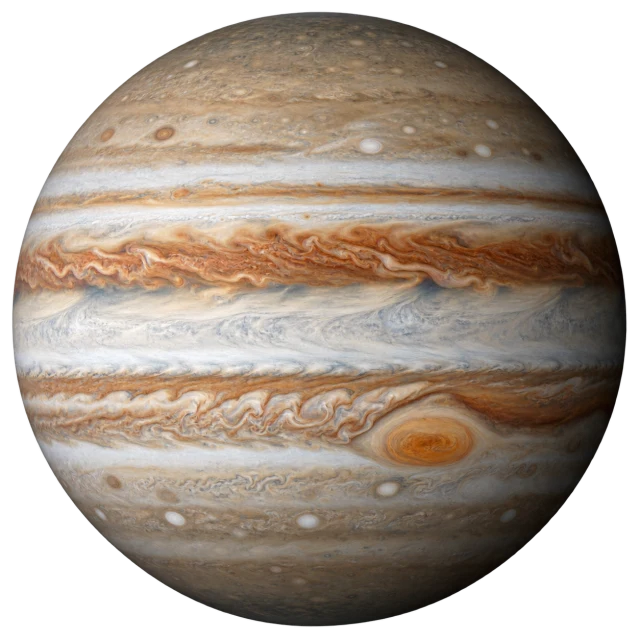
Jupiter is the fifth planet from the Sun and a gas giant, identified as 599 in JPL’s body catalogue. It has no solid surface like Earth’s. Hydrogen and helium dominate its composition, and pressure changes the state of hydrogen at great depth. Juno observations support a diluted core mixed with surrounding layers rather than a simple, sharply bounded solid sphere.
NASA gives a radius of about 69,911 km and a mean distance from the Sun of about 778 million km, or 5.2 astronomical units. Jupiter is roughly eleven times wider than Earth. These rounded figures describe its scale; equatorial and polar radii and different rotation models are not interchangeable parameters.
Atmosphere, composition, and physical properties
The NASA/NSSDCA fact sheet reports an atmosphere composed mainly, by volume, of molecular hydrogen, H2: 89.8%, and helium, He: 10.2%; both figures carry a stated uncertainty of 2.0 percentage points. Listed minor constituents are methane at 3,000 ppm with a 1,000 ppm uncertainty, ammonia at 260 ppm with a 40 ppm uncertainty, hydrogen deuteride at 28 ppm with a 10 ppm uncertainty, ethane at 5.8 ppm with a 1.5 ppm uncertainty, and water at 4 ppm. For water, the source explicitly says that the value varies with pressure.
The cited aerosols are ammonia ice, water ice, and ammonium hydrosulfide. This inventory supports the presence of condensed or particulate materials in the atmosphere, but it does not establish their vertical distribution, relative quantities, or temporal behavior. At 1 bar, the fact sheet gives a temperature of 165 K, or −108 °C, a density of 0.16 kg/m³, and a mean molecular weight of 2.22. At 0.1 bar, it gives 112 K, or −161 °C. The listed “surface pressure” is greater than 1,000 bars. Yet, because Jupiter is described as a gaseous ball and the evidence does not define a surface, this label should be treated as a fact-sheet convention rather than proof of an accessible ground.
The stated atmospheric scale height is 27 km. Winds reach up to 150 m/s at latitudes below 30 degrees and up to 40 m/s at latitudes above 30 degrees. These values show that atmospheric conditions differ with latitude, although the supplied evidence does not explain the dynamics, duration of patterns, or whether the maxima are persistent. A NASA artistic rendering of the inner magnetosphere shows magnetic field lines joining the north and south poles, auroras, and a region of intense radiation around the planet’s middle. As an artistic rendering, it identifies the stated features but does not establish exact geometry or field and radiation values.
Rotation, orbit, and environment
Jupiter has the shortest planetary day, about 9.9 hours. Its elliptical orbit takes about 4333 Earth days, roughly twelve years. NASA/NSSDCA lists orbital eccentricity of 0.0487, obliquity of 3.13°, and maximum orbital speed of 13.72 km/s. The document distinguishes mean orbital elements referred to J2000 from its summary parameters; neither is a real-time position.
The four large Galilean moons are Io, Europa, Ganymede, and Callisto. NASA does not identify these four as the source of ring dust: that dust comes from meteoroid impacts on the small inner moons. The rings are faint and nearly invisible. The catalogue of moons evolves with observations and must not be confused with an estimate of thousands of particles or small objects.
The magnetosphere and its interaction with the Sun are among the highlighted features. NASA’s facts page says a structure balloons 1 to 3 million km toward the Sun, corresponding to 7 to 21 Jupiter diameters, and tapers into a tadpole-shaped tail extending more than 1 billion km behind the planet, as far as Saturn’s orbit. The supplied excerpt does not name each technical region or explain variation with solar conditions. These dimensions should therefore be retained as the source’s range and description, not treated as a fixed boundary.
Formation, observation, and exploration
NASA dates Jupiter’s formation to about 4.6 billion years ago, from gas and dust in the young solar system. Atmospheric and gravity measurements test models of formation and internal structure. An overview diagram cannot replace these measurements; the distribution of elements at depth and the evolution of the core remain research topics.
Jupiter has been known since antiquity. Galileo Galilei observed its four largest moons in 1610. Voyager 1 discovered the rings during a flyby in 1979, not an orbiter. The Galileo mission later studied the Jovian system and provided evidence for an ocean beneath Europa’s ice. Results about moons and rings must be distinguished from findings about the planet’s interior.
Scientific relevance and limits
Jupiter is a scientific laboratory because of the documented combination of a hydrogen-helium atmosphere, high-speed winds, rapid rotation, a magnetosphere with auroras and intense radiation, dusty rings, and a satellite system with named major bodies. Atmospheric measurements and comparisons of elemental abundances with solar values connect present observations to questions of formation. The ring discovery and system observations also show that the surrounding environment is central to studying Jupiter rather than incidental.
Atmospheric figures must be read with their uncertainties and pressure levels; they do not apply uniformly throughout the planet. Wind maxima refer to latitude bands, while the magnetosphere responds to the solar environment. The sources do provide size, orbit, formation, and interior information. Scientific uncertainty concerns the precision and scope of the models, not a complete absence of data.