

Key facts
- NSF NOIRLab announced the result on 7 January 2026.
- The data come from about 10 hours of observations spread over seven nights in April and May 2025, during Rubin’s early commissioning phase.
- The study presents reliable rotation periods for 76 asteroids: 16 super-fast rotators and three ultra-fast rotators.
- 2025 MN45 has an estimated diameter of 710 metres and completes one rotation in 1.88 minutes.
- Eighteen of the 19 new fast rotators are in the main belt; the remaining one is a near-Earth object.
- The team calculates that 2025 MN45 would need cohesion comparable to that of solid rock to remain intact; the calculation estimates the strength required and does not directly measure its composition.
Related records
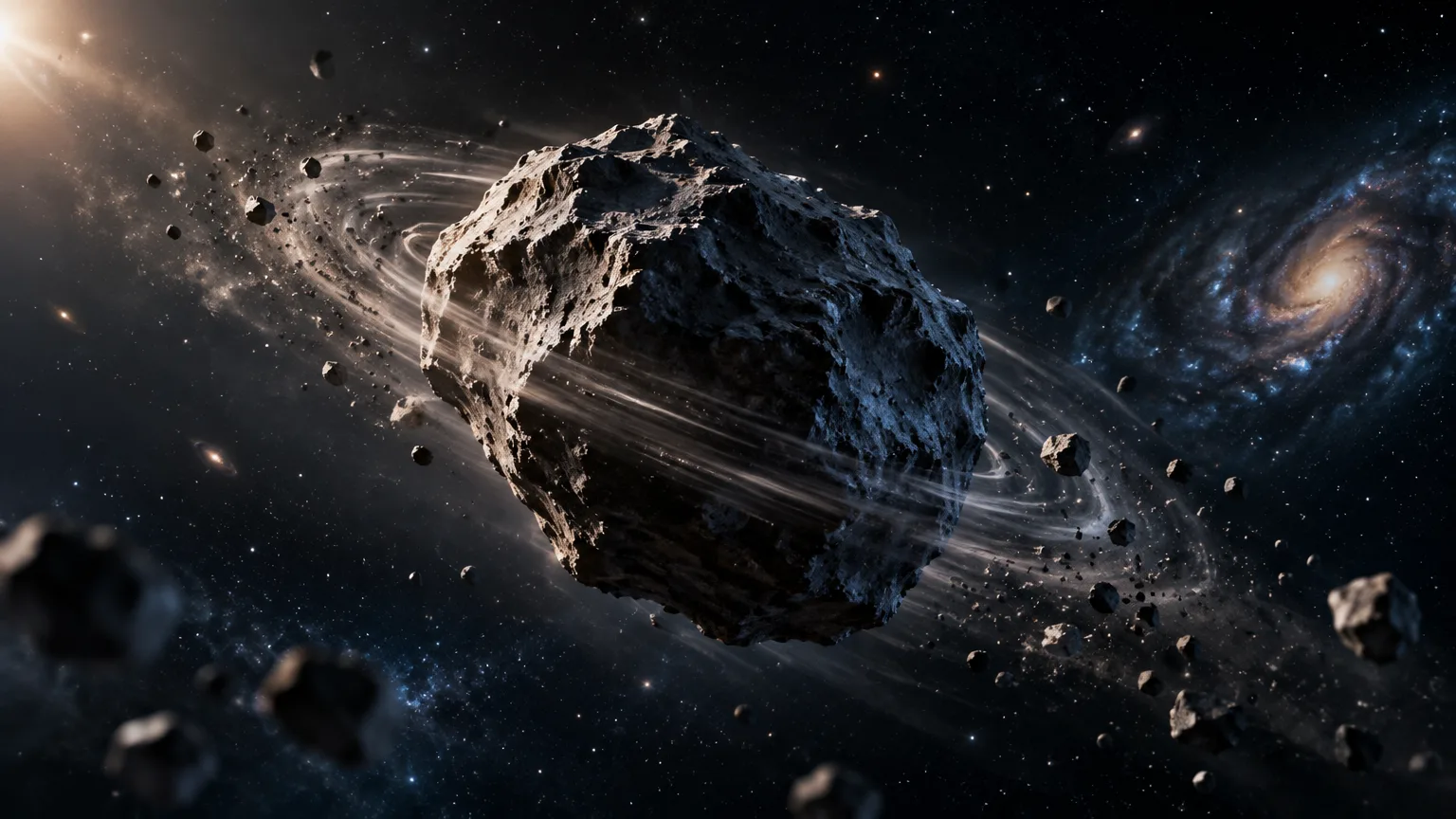
An asteroid 710 metres in diameter that completes one rotation in 1.88 minutes is among the very fast-rotating objects identified in the Vera C. Rubin Observatory’s first data. NSF NOIRLab announced the result on 7 January 2026. The object, named 2025 MN45, is described by the team as the fastest-spinning asteroid over 500 metres in diameter found up to that time.
The study presents 19 super-fast or ultra-fast rotators and rotation periods considered reliable for 76 objects. The observing campaign used for the analysis totalled about ten hours spread over seven nights in April and May 2025, during Rubin’s initial commissioning phase. Those observations preceded the observatory’s planned ten-year survey; therefore, the reported results come from its earliest observations.
Rubin and its survey of the southern sky
The Vera C. Rubin Observatory is located on Cerro Pachón in Chile. It is jointly funded by the US National Science Foundation (NSF) and the Department of Energy (DOE) Office of Science. Operations are shared by NSF NOIRLab and the SLAC National Accelerator Laboratory.
Rubin’s main mission is the Legacy Survey of Space and Time (LSST), a programme designed to repeatedly observe the southern hemisphere’s night sky for ten years. Its goal is to produce a broad, detailed record of changes in the universe. When announcing these results, NSF NOIRLab said the LSST was due to begin in the following months; the study’s observations had been made earlier, during early commissioning.
The LSST Camera can capture a great deal of light and make rapid, precise measurements. According to the announcement, Rubin can take an image every 40 seconds. By observing how an asteroid’s brightness changes, astronomers can study its rotation: a rapid observing cadence helps characterise especially short periods.
Asteroids and their rotation periods
Of the 76 asteroids with reliable rotation periods included in the study, 16 are classified as super-fast rotators, with periods of about 13 minutes to 2.2 hours. Three others are ultra-fast rotators: they complete one rotation in less than five minutes. The 19 objects in both groups are more than about 90 metres across, a length the announcement compares with that of an American football field.
For 2025 MN45, the estimated diameter is 710 metres and the rotation period is 1.88 minutes. According to the team, this combination of size and speed makes it the fastest-spinning asteroid over 500 metres in diameter discovered up to that time. The announcement also mentions other objects: 2025 MJ71 completes one rotation in 1.9 minutes; 2025 MK41 in 3.8 minutes; 2025 MV71 in 13 minutes; and 2025 MG56 in 16 minutes.
The objects’ locations stand out in the sample: 18 of the 19 new fast rotators are in the main belt, between Mars and Jupiter; the remaining one is a near-Earth object. Main-belt asteroids are generally harder to observe from our planet because they are farther away and their light is fainter. NSF NOIRLab attributes these detections to Rubin’s ability to capture light and make precise measurements.
What rotation reveals about structure
An asteroid’s rotation speed can provide clues about its properties and evolution. One possible explanation, proposed for asteroids in general, is that a past collision accelerated an object and that it is a fragment of a larger body. The announcement does not attribute 2025 MN45’s rotation to that hypothesis.
Rotation also raises a physical question: how much strength does an asteroid need to avoid breaking apart? Many asteroids are considered rubble piles, collections of fragments and rocks held together mainly by gravity. For main-belt objects, the announcement places at 2.2 hours the rotation limit that such a rubble pile can withstand without breaking apart. Beyond that rate, the body needs sufficient structural strength to hold together. According to the source’s explanation, the larger an asteroid is and the faster it spins, the stronger its constituent material must be.
The team calculates that 2025 MN45 would need a cohesive strength comparable to that of solid rock to remain intact. The calculation estimates the required strength from its size and rotation; it does not directly measure its composition. The comparison highlights the physical demands associated with such a rapid spin in an object of this size.
What the study adds and what is expected from the LSST
NSF NOIRLab reported that the study, titled “Lightcurves, rotation periods, and colors for Vera C. Rubin Observatory’s first asteroid discoveries”, appeared in The Astrophysical Journal Letters. The announcement described it as the first published, peer-reviewed scientific paper to use data from the LSST Camera. Its findings were presented as part of Rubin’s first observations; in January 2026, the institution’s stated schedule still had the ten-year LSST survey yet to begin.
The initial, densely spaced and rapid observations made it possible to detect this group of asteroids in a short time. For the regular survey, the team expects more widely spaced observations to gradually reveal other fast rotators as data accumulate. NSF NOIRLab says that this future dataset could provide information about the strength, composition and collision histories of these bodies. This is an expectation about the development of the LSST, distinct from the results of this initial sample.
The case of 2025 MN45 connects a concrete measurement—the time an asteroid takes to complete one rotation—with questions about the strength of small bodies in the solar system. It also shows how Rubin’s repeated observations can contribute to the study of distant, faint asteroids. The source of the announcement is the NSF NOIRLab announcement published on 7 January 2026.