Identity and general characteristics
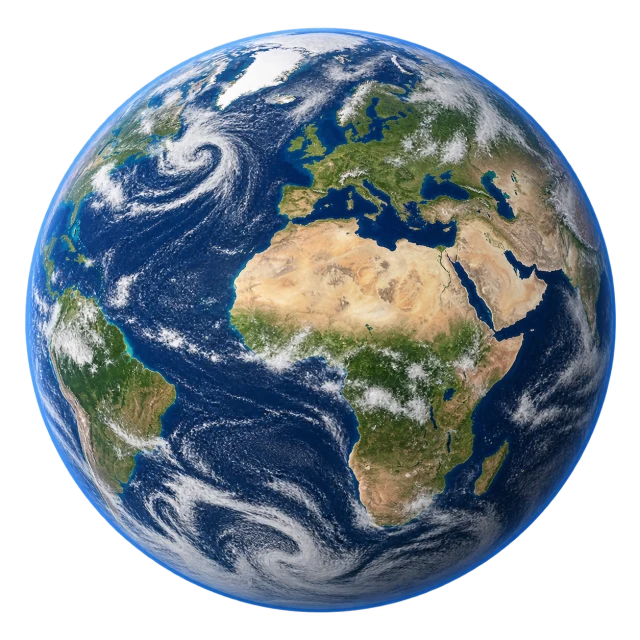
Earth is the third planet from the Sun and the fifth largest in the solar system. It is the largest of the four inner planets, which are made of rock and metal, and the only planet in the solar system with liquid water on its surface. It is also the only place we know of that is inhabited by living things. The English name Earth comes from Old English and Germanic languages and means “ground” or “earth”; unlike the names of the other planets, it does not come from Greek or Roman mythology. NASA’s source indicates that the name is about 1,000 years old.
In NASA/JPL’s NAIF numerical code system, the entry EARTH has code 399. The document distinguishes this code from 3, assigned to the Earth-Moon barycenter: a barycenter is not interchangeable with the planet and does not have planetary physical properties such as radii. Earth has an equatorial diameter of approximately 12,756 kilometers, and its average distance from the Sun is about 150 million kilometers, equivalent to one astronomical unit. Sunlight takes about eight minutes to reach Earth.
Formation and internal structure
Earth formed about 4.5 billion years ago, when gravity drew together swirling gas and dust as the solar system took shape. Like other terrestrial planets, it has a central core, a rocky mantle, and a solid crust. NASA describes four main layers: the inner core, outer core, mantle, and crust.
The inner core is a solid sphere of iron and nickel, about 1,221 kilometers in radius; its temperature can reach about 5,400 °C. It is surrounded by the outer core, made of fluid iron and nickel and about 2,300 kilometers thick. Above it lies the mantle, the thickest layer: a hot, viscous mixture of molten rock about 2,900 kilometers thick. The crust is the outer layer. On land, it is about 30 kilometers thick on average; beneath the ocean it is thinner, extending about 5 kilometers from the seafloor to the mantle.
Surface, oceans, and atmosphere
The lithosphere comprises the continental and oceanic crust and the upper part of the mantle. It is divided into large plates that move continuously. For example, the North American Plate moves westward over the Pacific Ocean basin at a rate comparable to the growth of fingernails. When plates grind past one another, overlap, collide, or pull apart, they can cause earthquakes and form mountains. Earth’s surface also has volcanoes, mountains, valleys, canyons, and plains.
The global ocean covers about 71% of the planet’s surface, has an average depth of about 3.6 kilometers, and contains 97% of Earth’s water. Almost all of Earth’s volcanoes are underwater. NASA notes that Mauna Kea in Hawaii is taller than Everest from base to summit, although much of the volcano is submerged; it also describes an extensive undersea mountain range in the Arctic and Atlantic oceans. Near the surface, the atmosphere consists of 78% nitrogen, 21% oxygen, and 1% other gases, including argon, carbon dioxide, and neon. It influences long-term climate and local weather, and protects against much of the harmful solar radiation and many meteoroids, which disintegrate before reaching the ground.
Orbit, rotation, and seasons
Earth completes an orbit around the Sun in 365.25 days and one rotation in 23.9 hours. The additional quarter day explains why a day is added to the calendar every four years to keep it in step with the orbit. The rotation axis is tilted 23.4 degrees relative to the orbital plane. This tilt causes the annual cycle of seasons: during part of the year, one hemisphere is tilted toward the Sun and receives more heating, while the other receives less direct sunlight; six months later, the situation is reversed. At the start of spring and autumn, both hemispheres receive roughly equal amounts of heat.
Moon, magnetic field, and exploration
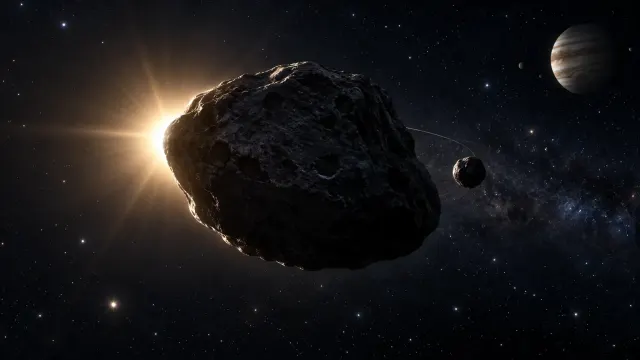
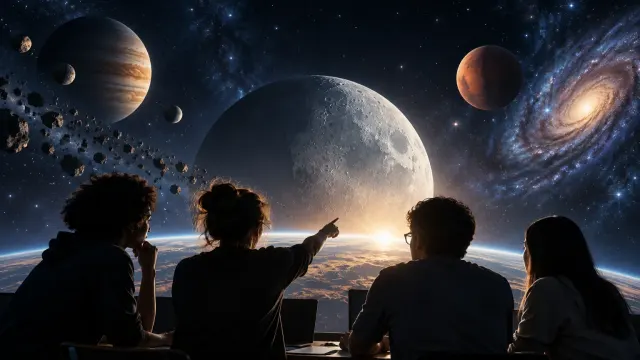
Earth has one moon, the Moon, and no rings. The Moon has a radius of about 1,738 kilometers and is at an average distance of 384,400 kilometers. It probably formed after a collision when Earth was young: the impact would have displaced material from Earth’s interior, and the fragments gathered together. The Moon stabilizes the planet’s wobble, which has made the climate less variable over thousands of years. At times, asteroids or large rocks temporarily orbit Earth for months or years before returning to an orbit around the Sun.
Earth’s rapid rotation and molten nickel-iron core contribute to generating a magnetic field, which is distorted by the solar wind. Charged particles trapped in it can collide with molecules in the atmosphere above the poles and produce auroras. The field’s polarity can reverse; the geological record indicates that, on average, these reversals occur about every 300,000 years, although their timing is very irregular.
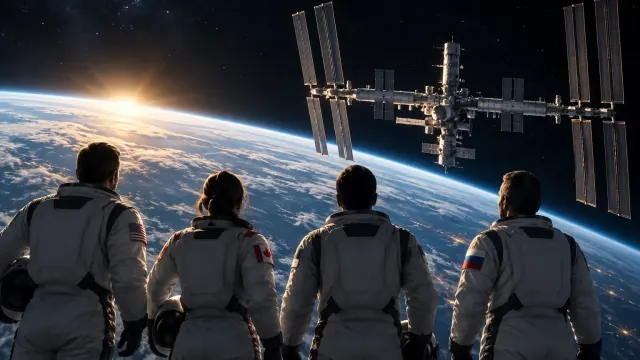
According to NASA, life began in the oceans about 3.8 billion years ago. Earth’s temperature and combination of chemicals have favored life, although some features that help sustain it are changing because of the ongoing effects of climate change. NASA also indicates that numerous orbiting spacecraft study Earth as a complete system, observing the atmosphere, ocean, glaciers, and the solid planet.