Identity and classification
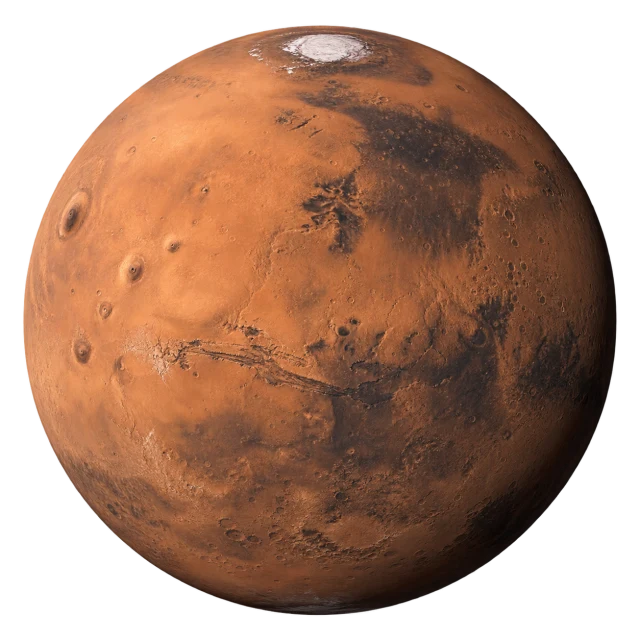
Mars, whose official identifier in the supplied JPL Horizons evidence is 499, is classified in the provided information as a planet and is the fourth planet from the Sun. NASA describes it as a cold, dusty desert world with a very thin atmosphere. ESA further characterizes it as a rocky planet. These statements define its broad nature without replacing investigation of individual regions: the Martian surface includes craters, deserts, valleys, and volcanoes, while the planet also has canyons, polar caps, seasons, and weather.
Scale, shape, and measured properties
JPL’s revision of June 2, 2025 gives a volume-mean radius of 3389.92 ± 0.04 km, an equatorial radius of 3396.19 km, and a flattening of 1/169.779. Listed volume is 16.318 × 10¹⁰ km³, mass is 6.4171 × 10²³ kg, and density is stated as 3.933 g/cm³, with uncertainty expressed by the source itself. The same record lists equatorial gravity of 3.71 m/s², polar gravity of 3.758 m/s², geometric albedo of 0.150, and GM of 42828.375662 km³/s². These figures measure dimensions, mass, shape, and gravity, but they do not by themselves establish the detailed composition of every internal layer.
Interior, surface, and geological processes
JPL estimates the core radius at approximately 1700 km, not an exact measured boundary. NASA describes an iron-, nickel-, and sulfur-rich core surrounded by a rocky mantle and crust. Its overview gives a core-radius range of 1500–2100 km and a crustal thickness of 10–50 km; these are structural estimates, not universal values at every location. InSight investigated the crust, mantle, and core between 2018 and 2022. Wind, water, volcanism, tectonics, and impacts have shaped the surface, and quantifying their contributions remains a research goal.
Water, ancient climate, and present atmosphere
NASA missions have found substantial evidence that Mars was much wetter and warmer and possessed a thicker atmosphere billions of years ago. This result is central to reconstructing Martian climate change, but the supplied material does not establish one complete chronology or mechanism for the transition. The modern atmosphere is described as very thin and made mostly of carbon dioxide, nitrogen, and argon. ESA gives surface atmospheric pressure as 6.35 mbar, less than one hundredth of Earth’s atmospheric pressure. NASA also states that people could not breathe this air. MAVEN obtained critical atmospheric measurements intended to help explain dramatic climate change across the planet’s history.
Polar regions, weather, and geological time
Mars has polar ice caps that, according to ESA, vary seasonally. NASA’s visual and descriptive material mentions water-ice clouds, polar ice, and polar regions. An image from Mars Reconnaissance Orbiter recorded seasonal changes in sand dunes in the north polar region, demonstrating that the surface environment is not static. ESA divides Martian geological time into the Pre-Noachian, 4.5–4.1 billion years ago; Noachian, 4.1–3.7 billion years ago; Hesperian, 3.7–2.9 billion years ago; and Amazonian, from 2.9 billion years ago to the present. These divisions provide a temporal framework, not a complete account of every geological event.
Rotation and solar relationship
JPL’s June 2, 2025 revision lists a sidereal rotation period of 24.622962 hours and an angular rate of 0.0000708822 rad/s. The mean solar day, or sol, lasts 88775.24415 seconds and must not be confused with rotation relative to the stars. The year lasts about 687 Earth days, axial tilt is about 25°, and mean distance from the Sun is about 228 million km. NASA explains that the elliptical orbit gives the Martian seasons different lengths.
Moons, observations, and exploration
ESA identifies two moons: Phobos, measuring 27 × 22 × 18 km and located about 6000 km above Mars, and Deimos, measuring 15 × 12 × 11 km and located about 20000 km above Mars. Mars has no rings, according to NASA’s facts page. Exploration has involved spacecraft from multiple agencies. In addition to InSight and MAVEN, ESA states that the Exobiology on Mars program includes Trace Gas Orbiter, which entered Mars orbit in 2016, and the Rosalind Franklin rover, scheduled to launch no earlier than 2028. Curiosity drilled rock and used its laser to study gray material; Opportunity found spherical hematite grains that likely formed in water.
Scientific importance and limits
Mars is scientifically important because it enables study of processes that alter a rocky planet and because its record points to past conditions wetter, warmer, and atmospherically denser than those of today. Hematite findings, observations of ice, clouds, dunes, and seasonal change, atmospheric measurements, and interior studies arise from different missions and techniques, supplying complementary evidence. Open questions include the relative contributions of water, wind, volcanism, tectonics, and cratering; the dramatic climate transition; and internal structure beyond the estimated core radius.