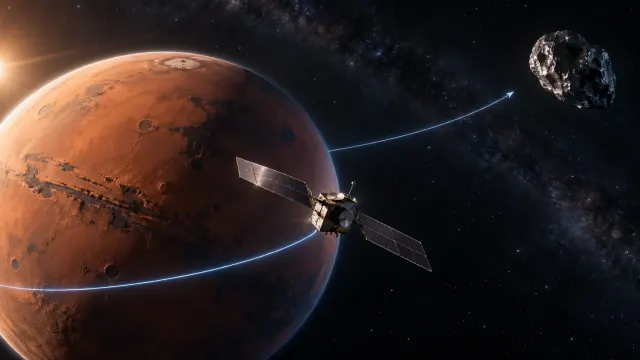
A small moon close to Mars
Phobos is the larger of the two Martian moons and the one nearer Mars. Asaph Hall discovered it in 1877; its name comes from the figure associated with fear in Greek mythology. In JPL's SPICE body identification system it is NAIF 401, while Mars is 499. These identifiers are distinct from an interactive catalogue's internal record keys.
Shape, size and density
NASA gives approximate dimensions of 27 × 22 × 18 km. Phobos is not spherical: these three axes are not conflicting estimates of a single diameter. JPL lists a mean radius of 11.08 ± 0.04 km; the equivalent mean diameter of 22.16 km used here is twice that radius, not the longest axis. The tabulated mean density is 1.872 ± 0.076 g/cm³. These quantities have uncertainties and do not describe the exact dimensions of every region.
The table also gives the gravitational parameter GM: 0.0007087 ± 0.0000006 km³/s². This is the product of the gravitational constant and mass, not a mass in kilograms. None of these numbers alone establishes a mineral composition or a unique fraction of internal voids.
Orbit and evolution
JPL's mean elements give a semimajor axis of 9,375 km, measured relative to the centre of Mars, and a period of 0.3187 days, about 7.65 hours. The semimajor axis is not an altitude above the ground. The MAR099 table uses the Laplace plane and the epoch 1 January 2000, 12:00 TDB; it describes a mean orbit and is not suitable for calculating precise present-day positions.
NASA summarizes the motion as about three orbits a day and reports an inward drift of roughly 1.8 metres per century. Its projection over about 50 million years presents alternatives: collision with Mars or breakup into a ring. It does not establish an inevitable sequence of both events or an exact date.
Surface and observations
The large crater Stickney dominates its appearance. Mars Global Surveyor images show fine dust, boulders and evidence of material sliding down slopes; HiRISE on Mars Reconnaissance Orbiter has also photographed the terrain. Repeated impacts have broken surface material into fine regolith. Phobos has no atmosphere and experiences large temperature contrasts between illuminated and dark areas.
Open questions
The dark appearance, resembling C-type carbonaceous asteroid materials, does not settle the moon's origin. NASA discusses capture of an asteroid but also notes evidence against that explanation. Density, images and orbital dynamics help test hypotheses; they do not justify treating an origin, a complete mineral inventory or a unique internal structure as established.