

Key facts
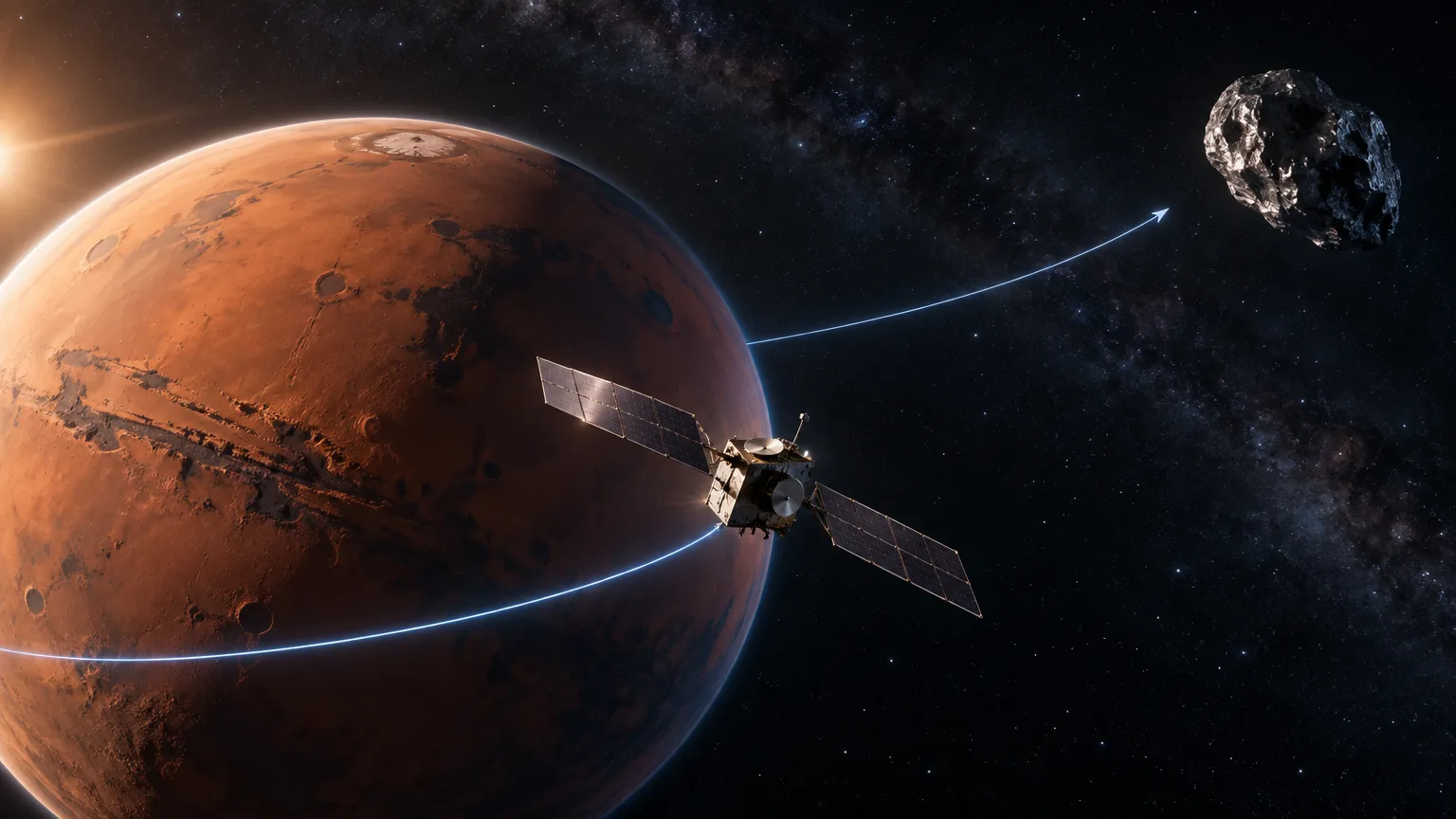
- Psyche flew past Mars on May 15, 2026; JPL published its report on July 17, 2026.
- Mars’s gravity boosted the spacecraft and slightly adjusted its trajectory toward the main asteroid belt.
- Closest approach was 2,864 miles (4,609 kilometers) from Mars.
- The spectrometer recorded an increase in neutrons near closest approach but detected no gamma rays, because the distance was too great to measure them.
- The magnetometer recorded an intense increase associated with the bow shock region; the cameras observed craters, the south polar ice cap, and the moons Phobos and Deimos.
- The mission will study the metal-rich asteroid Psyche, in the main belt between Mars and Jupiter, in 2029.
Related records
The Mars flyby let the Psyche spacecraft serve two purposes at once: use the planet’s gravity to alter its trajectory and test its instruments before reaching its destination. According to a report published by NASA’s Jet Propulsion Laboratory (JPL) on July 17, 2026, Psyche passed Mars on May 15. The maneuver gave it speed and slightly changed its course. The team also used the encounter to prepare for the mission’s science phase: the measurements it will make at asteroid Psyche in 2029.
The mission is headed for a metal-rich body in the main asteroid belt between Mars and Jupiter. Studying it will help scientists test the idea that the asteroid could be the metallic core of a planetesimal, one of the bodies that served as building blocks for a rocky planet. Mars gave the spacecraft a nearby planetary target for rehearsing its instruments before that investigation. JPL reported that the instruments performed as designed and that their data matched what NASA already knows about Mars, while also providing some observations from a different perspective.
A navigation maneuver and a science test
A planet’s gravity can change the speed and direction of a spacecraft passing nearby. In this case, Mars’s gravitational boost accelerated Psyche and steered it toward the main asteroid belt. The maneuver, prepared by the navigation team over several years, was needed to put the spacecraft on course for its target. JPL said Psyche passed Mars on the trajectory required to continue toward its rendezvous with the asteroid in the summer of 2029.
The flyby was more than a navigation maneuver. The team used Mars as a stand-in for the asteroid to calibrate the instruments and rehearse the science observations planned for arrival. At closest approach, the spacecraft was 2,864 miles (4,609 kilometers) from Mars. That distance mattered when interpreting the measurements, particularly those from the spectrometer: from there, the instrument could not measure gamma rays coming from the planet.
Neutrons detected; gamma rays out of reach
Psyche’s gamma-ray and neutron spectrometer is designed to help determine which elements make up the asteroid’s surface material. JPL explains that high-energy cosmic rays bombarding a planetary body transfer energy to elements at its surface, which emit neutrons and gamma rays at different energy levels. By measuring those emissions, scientists can compare them with the known properties of elements and investigate what the body is made of.
During the flyby, the spectrometer detected an increase in the neutron count rate near closest approach. The team had expected a signal of this kind, and the result was close to what it predicted. It did not detect gamma rays from Mars. JPL said the flyby altitude—2,864 miles (4,609 kilometers)—was too high to measure them. This result therefore does not determine the planet’s composition. It does show that the team could test the instrument in real flight conditions and that it responded as expected.
The magnetometer and cameras were tested, too
Psyche’s magnetometer is intended to measure the asteroid’s magnetic field. Those measurements will help assess the hypothesis that Psyche is the metallic core of a planetesimal. During the Mars passage, the instrument recorded an intense increase in the magnetic field in the bow shock region, where the solar wind impacts the planet’s magnetic environment. JPL said this was the first time the magnetometer had measured the magnetic-field signature of a celestial body. The observation also provided a calibration of its performance in dynamic conditions; by itself, it is not a complete characterization of Mars’s magnetic field.
The multispectral imager, made up of two identical cameras designed to photograph the asteroid’s surface at different wavelengths, also observed Mars. During approach, the planet appeared as a narrow, bright crescent. NASA attributes this appearance to the viewing angle and sunlight scattered by the atmosphere. Images taken during close approach show windblown craters, the south polar ice cap, and the large, double-ringed Huygens crater.
The observations gave the team a chance to check the cameras’ calibration and sensitivity to scattered light. They also allowed it to pick out Mars’s moons Phobos and Deimos from a great distance. According to JPL, this search served as practice for looking for possible small satellites around asteroid Psyche. To characterize and calibrate the images, the team is comparing them with observations from other missions: the Mars Reconnaissance Orbiter, Mars Odyssey, Mars Express, and ExoMars Trace Gas Orbiter; the Curiosity and Perseverance rovers; and the Hope orbiter from the United Arab Emirates’ Mars mission.
What the report concludes—and what it does not
JPL’s assessment is that the imaging instrument, magnetometer, and spectrometer delivered good results during the encounter. Their data match what NASA already knows about Mars, while also adding some new observations. The team did not expect major discoveries about a planet studied by many missions; the value of the encounter was mainly to complement that knowledge from Psyche’s perspective and rehearse with its instruments before reaching its primary target.
The results should be understood within the limits of that purpose. The neutron detection, the lack of a gamma-ray detection at that distance, and the magnetic signal from the bow shock region are specific measurements made during the flyby. They are not an exhaustive description of Mars. Likewise, the images show features on the planet, but at this stage they also served to calibrate and test the cameras. The strongest conclusion is that the spacecraft used its passage by Mars to adjust its course and that its instruments were tested in a real planetary observation before its expected arrival at the asteroid in the summer of 2029.