Identity and discovery
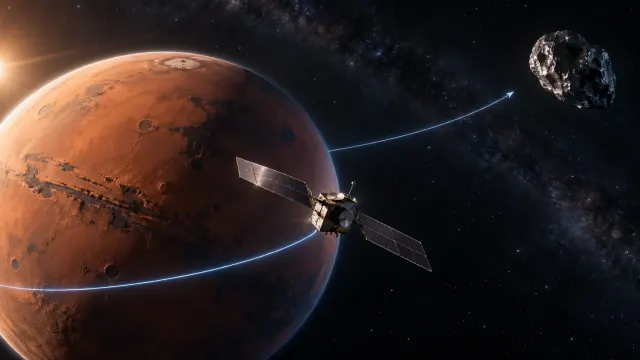
Deimos is the smaller, outermost of the two Martian moons. Asaph Hall discovered it in 1877; its name refers to dread in Greek mythology. JPL's SPICE system identifies it as NAIF 402, whereas Mars is 499. Its membership of the Martian system does not depend on the internal keys used by visualizers.
Dimensions: axes and mean radius
NASA describes an irregular body approximately 15 × 12 × 11 km across and also provides rounded dimensions in miles. These are not a single nine-mile diameter. JPL lists a mean radius of 6.2 ± 0.24 km; doubling it gives an equivalent mean diameter of 12.4 km. This describes an average scale, not the longest axis. Shape and the different definitions explain why the two measures must not be conflated.
JPL's published mean density is 1.471 ± 0.166 g/cm³. The gravitational parameter GM is 0.0000962 ± 0.0000028 km³/s²: the product of the gravitational constant and mass, not a mass in kilograms. These data exist, but their uncertainties and the absence of a unique determination of the interior prevent an exact composition or porosity from being inferred from them.
A more distant orbit
The MAR099 mean-elements table gives a semimajor axis of 23,457 km from the centre of Mars and a period of 1.2625 days, about 30.3 hours. This agrees with NASA's rounded description of one revolution every 30 hours. The semimajor axis is not an altitude above the surface.
These mean elements refer to the Laplace plane and the epoch 1 January 2000, 12:00 TDB. JPL cautions that they are not suitable for precise ephemeris calculations. They describe the scale of the orbit, not Deimos's present position. Phobos's predicted inward drift and possible breakup must not be transferred to this moon.
Craters and regolith
Despite its many craters, Deimos appears smoother than Phobos because some craters are partly filled. NASA also notes the absence of the grooves and ridges characteristic of its companion. HiRISE on Mars Reconnaissance Orbiter photographed the surface, including an enhanced-colour view from 2009.
Impacts have pulverized material into regolith, a layer of dust and fragments that NASA suggests may be up to 100 metres thick. This upper estimate is not a uniform measurement across the moon. Weak gravity allows some ejecta to escape; a description of its possible redistribution around Mars is not a detection of a ring.
Composition and open questions
The dark surface appears consistent with C-type materials resembling those of carbonaceous asteroids. This resemblance neither proves that Deimos is a captured asteroid nor describes its entire interior. The relationship between shape, density, regolith and orbit is central to investigating its origin, but does not establish a unique formation history.