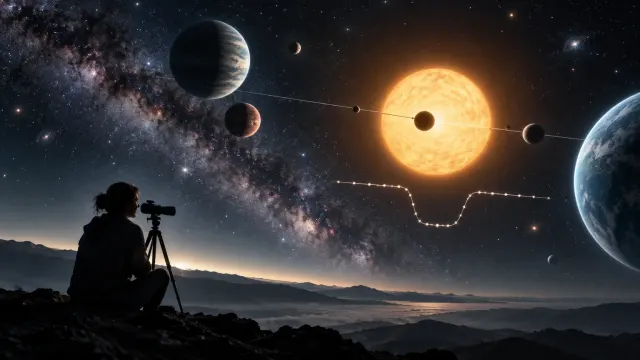
The star, not the planet
51 Pegasi and HD 217014 identify the same star in Pegasus. The letter b identifies its planet, 51 Pegasi b, also called Dimidium. Keeping the objects separate matters: the radius and temperature in this profile belong to the star, not the gas giant orbiting it. This is a Sun-like star; the retained G3 V classification belongs to the parameter set compiled by Boyajian in 2013.
A discovery that changed astronomy
Michel Mayor and Didier Queloz discovered the planet in 1995 using radial velocities. Periodic spectral shifts revealed the motion of the star under a companion's gravitational pull. It was the first exoplanet discovered around a Sun-like star, not the first exoplanet of any kind: pulsar planets had been discovered in 1992. The work was recognised with the 2019 Nobel Prize in Physics.
A giant on a short orbit
51 Pegasi b completes an orbit in approximately 4.23 days. It is a hot Jupiter, a giant planet close to its star. Its discovery demonstrated that other planetary systems need not reproduce the architecture of our Solar System. The original detection relied on stellar motion, not a photograph resolving the planet's surface. This planetary orbital period must not be assigned to the star itself.
Historical parameters and their uncertainty
The adopted values come from the individual row in Boyajian et al. (2013), Table 3 labelled as that study's measurement: a radius of 1.1501 ± 0.0195 solar radii, an effective temperature of 5750 ± 46 K and a luminosity of 1.2962 ± 0.0156 solar luminosities. They are not the weighted mean also listed in the table. The radius combines interferometry and distance, while temperature uses bolometric flux. The mass of 1.064 solar masses is an estimate from evolutionary models, without an individual error published in that row; it is neither a direct nor an exact measurement.
Distance and catalogue versions
The retained astrometry comes from HYG 4.1: 15.6079 parsecs, approximately 50.91 light-years. The two units now express the same distance. This is a historical catalogue value, not a real-time position. NASA's Exoplanet Archive contains other solutions and a more recent reference distance near 15.46 parsecs. It also contains different radii and spectral classifications. These are not mixed with the 2013 parameters as though they were one observation. Dates, methods and uncertainties make comparisons meaningful without suggesting that a catalogue update represents a sudden physical change in the star.