

Key facts
- NASA reports more than 6,000 confirmed exoplanets; its catalog is continually updated, and thousands of candidates are awaiting confirmation.
- The catalog lets users filter by planet type, discovery method, spacecraft, observatory or other facility.
- Exoplanet Watch lets volunteers help track and study exoplanets during transits; UNITE lets them contribute observations and transit information for newly discovered exoplanets.
- Hubble observes ultraviolet, visible and near-infrared light; its spectrographs analyze the components of light.
- SkyView generates images of regions of the sky at wavelengths ranging from radio to gamma rays.
Related records
Observing exoplanets does not mean pointing a telescope and expecting to see worlds as nearby disks. Distance helps explain why NASA offers different ways to explore them: consulting descriptions and data, using three-dimensional visualizations or contributing to projects that track transits. Even Proxima Centauri b, the closest known exoplanet to Earth, is about four light-years away. These resources offer a way to get closer to what is known about other worlds and how they are studied.
The field’s recent history also provides some perspective. NASA notes that 51 Pegasi b was identified in October 1995 as the first planet discovered orbiting a Sun-like star. Since then, techniques and observations have expanded the catalog: NASA’s page reports more than 6,000 confirmed exoplanets and says the number is still growing.
1. Start with the exoplanet catalog
NASA’s exoplanet portal introduces the subject and links to its catalog of confirmed planets. The catalog brings together descriptions and data for each world. It lets users filter by exoplanet type and by the method, spacecraft, observatory or other facility involved in its discovery. So, as well as looking up a particular object, users can explore which methods or facilities are associated with discoveries.
NASA organizes exoplanets into groups such as gas giants, Neptune-like planets, super-Earths and terrestrial planets, with subcategories. Measurements of size and mass help distinguish compositions ranging from rocky to gas-rich; the page also mentions worlds that might be dominated by water, ice, iron or carbon. These categories and properties describe physical aspects of planets, not a single type of world.
The catalog count is dynamic: NASA presents it as a resource that is continually updated. The same page says that thousands of candidates are awaiting confirmation. It is therefore best to read “more than 6,000” as the overall count reported by the portal, not as a fixed figure. The catalog also distinguishes confirmed planets from candidates awaiting confirmation.
2. Explore the visualizations and understand what they show
Eyes on Exoplanets offers an interactive three-dimensional representation of more than 6,000 known planets orbiting distant stars. NASA describes the represented universe as scientifically accurate and lets users zoom in on planets to explore them. It is a way to navigate catalog information visually and learn about specific worlds.
Another NASA resource, the exoplanet catalog, lets users read descriptions, consult basic data and filter results. These resources serve complementary purposes: the visualization lets users explore three-dimensional representations, while the catalog entries provide descriptions and data about the objects. Moving from a representation to an entry can help connect what the interface displays with the information NASA has collected about each planet.
NASA defines the habitable zone as the area around a star where its planets could have liquid water on the surface. It also calls it the “Goldilocks zone,” referring to conditions that could be suitable for life. The definition describes a possibility related to a planet’s location relative to its star; by itself, it does not describe every characteristic of a particular world.
3. Follow transits with citizen-science projects
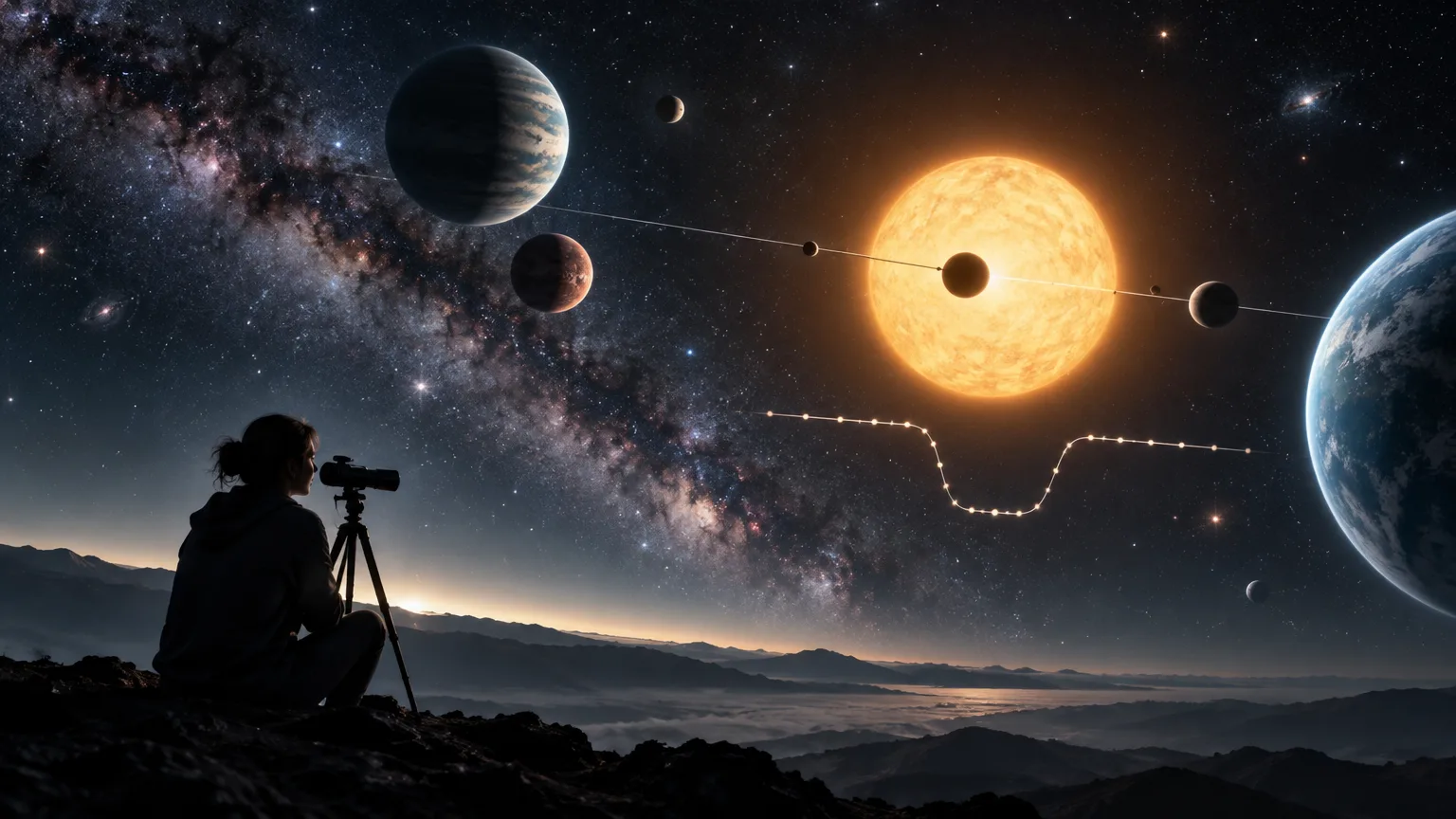
A transit occurs when, from our perspective, an exoplanet passes in front of a star. NASA invites people of different ages and backgrounds to take part in citizen-science projects. In Exoplanet Watch, volunteers help track and study exoplanets as they transit their stars.
People with a telescope can explore UNITE. According to NASA, participants can observe newly discovered exoplanets and collect information about their transits to help characterize their orbits. They also coordinate with other citizen scientists and researchers around the world to follow and learn about these worlds.
NASA explains that volunteers in citizen-science projects have contributed to thousands of important scientific discoveries. In UNITE’s case, the task described on the page focuses on contributing information about transits and orbits. Consulting each project’s description and guidance helps explain what participation involves and what kind of information it aims to gather.
4. Understand what the instruments contribute
The Hubble Space Telescope was launched in 1990 and observes ultraviolet, visible and near-infrared light. Its instruments include cameras, spectrographs and interferometers. Cameras capture images; spectrographs separate light into its components, much like a prism splits white light into a rainbow. According to NASA, analyzing that light can help study characteristics such as the temperature, density, chemical composition and velocity of objects that emit or absorb it.
Hubble has also studied the composition of atmospheres of planets around other stars. The Wide Field Camera 3, for example, has spectrographic capabilities and is often used to study exoplanet atmospheres. NASA details the capabilities of its instruments in its Hubble instrument guide. Consulting it helps connect an observation with the tool used and the type of light it can analyze.
To explore images of regions of the sky at different wavelengths, there is SkyView, a NASA virtual observatory that generates images in bands ranging from radio waves to gamma rays. It offers a way to visualize parts of the sky using surveys available at different wavelengths. The resource presents images of celestial regions; the exoplanet catalog, by contrast, brings together planet entries and options for filtering their data.
5. Read results in context
The count of confirmed planets does not include every world NASA believes exists. The portal contrasts more than 6,000 confirmed exoplanets with the billions estimated to exist, and notes that thousands of candidates are awaiting confirmation. It also says that most exoplanets discovered so far lie in a relatively small region of the Milky Way, although “small” on that scale means a region thousands of light-years across.
The tools offer different perspectives: the catalog helps locate planets and consult their descriptions; Eyes on Exoplanets lets users navigate a three-dimensional representation; Exoplanet Watch and UNITE offer ways to contribute to transit monitoring; Hubble studies light with its instruments; and SkyView generates images of regions of the sky at different wavelengths. Using each resource according to the information it provides helps build a more complete picture of how exoplanets are known.
A good way to get started is to choose a planet in the catalog, explore its entry and review the method or facility associated with its discovery. Then you can extend the exploration with the three-dimensional visualization, find out what Hubble’s instruments study or learn about citizen-science projects. The key is to pay attention to the nature of each resource: data and descriptions, interactive representations, light analysis or transit information.