Identity and discovery
Neptune is the eighth planet and the most distant from the Sun in the solar system. NASA describes it as a dark, cold ice giant battered by very intense winds; it is the only planet in the solar system that cannot be seen with the naked eye. In the NAIF/JPL table of integer codes, the name NEPTUNE is associated with code 899.
Galileo recorded Neptune as a fixed star during observations in 1612 and 1613, without identifying it as a planet at the time. Its discovery as a planet came in 1846, after observed deviations in Uranus’s orbit led French mathematician Urbain Joseph Le Verrier to predict the position and mass of an unknown body. Le Verrier sent his predictions to astronomer Johann Gottfried Galle at the Berlin Observatory, who found Neptune on the first night of searching. Triton, its largest moon, was discovered 17 days later.
Size and composition
Neptune has an equatorial diameter of 49,528 kilometres, approximately four times that of Earth. JPL reports an equatorial radius of 24,764 kilometres and a mean radius of 24,622 kilometres; the latter represents the radius of a sphere with an equivalent volume. Its tabulated mass is 102.4092 × 1024 kilograms and its mean density is 1.638 grams per cubic centimetre. JPL identifies it as the densest of the giant planets.
It has no solid surface. According to NASA’s description, its atmosphere, composed mainly of hydrogen and helium with a small proportion of methane, extends to great depths and gradually merges with water and other melted ices above a heavier solid core, whose mass would be approximately that of Earth. Most of the planet’s mass—80% or more—would consist of a hot, dense fluid of “icy” materials, including water, methane, and ammonia, above a small rocky core. Scientists consider it possible that an ocean of extremely hot water lies beneath the cold clouds; the enormous pressure would prevent it from boiling and escaping.
Atmosphere and activity
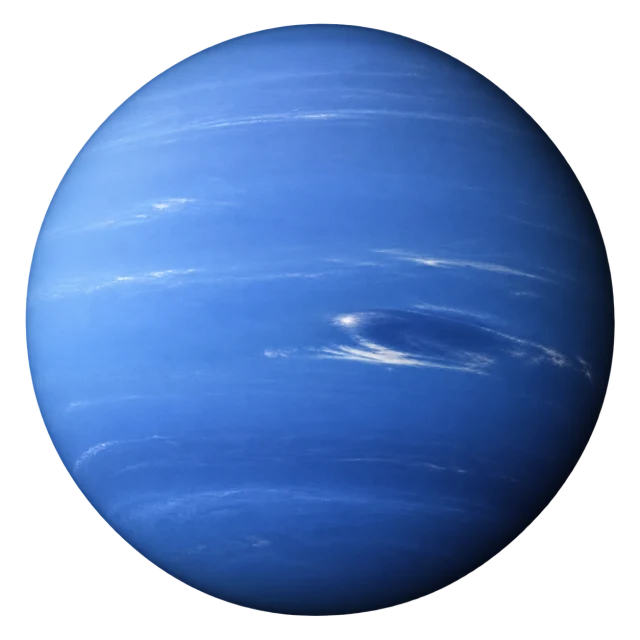
Methane absorbs other colours and reflects blue, contributing to Neptune’s observed bluish hue. Voyager 2 images taken during its 1989 encounter showed the planet as a deeper blue; NASA explains that the team adjusted those images to make clouds and other features more visible. In 2024, researchers reprocessed the images and showed that Neptune and Uranus are more similar in colour than had been thought based on those versions.
NASA characterizes Neptune as the windiest world in the solar system. Its winds can be three times stronger than Jupiter’s and nine times stronger than Earth’s; speeds exceeding 2,000 kilometres per hour have been described, capable of driving clouds of frozen methane. In 1989, Voyager 2 observed an oval storm in the southern hemisphere called the Great Dark Spot, large enough to contain Earth. That storm later disappeared, and others have appeared in different parts of the planet.
Orbit and rotation
Neptune is, on average, about 4.5 billion kilometres from the Sun, or 30 astronomical units; sunlight takes about four hours to reach it. Its sidereal orbital period, tabulated by JPL, is 164.79132 years. NASA summarizes this as about 165 Earth years, equivalent to nearly 60,190 days; in 2011 it completed its first 165-year orbit since its discovery in 1846.
The sidereal rotation listed by JPL is 0.67125 days. NASA describes the length of a Neptunian day as about 16 hours. The obliquity, between the equator and orbital plane, is about 28 degrees, so the planet experiences seasons; because its year is so long, each lasts more than 40 years.
During intervals of 20 years every 248 Earth years, Pluto’s highly eccentric orbit takes it inside Neptune’s orbit. The last such occasion noted by NASA was between 1979 and 1999. The repeating orbital relationship—Neptune completes three revolutions around the Sun for every two made by Pluto—prevents the two bodies from approaching closely enough to collide.
Rings, moons, and exploration
Neptune has at least five main rings, named Galle, Leverrier, Lassell, Arago, and Adams, and four prominent arcs in the outer Adams ring: Liberté, Egalité, Fraternité, and Courage. The arcs are accumulations of dust that, according to the laws of motion, would tend to disperse; Galatea’s gravity is thought to stabilize them. Galatea is a moon located just inside the ring. The rings are considered relatively young and short-lived.
NASA reports 16 known moons. Triton, the largest, orbits in the direction opposite to Neptune’s rotation, a feature suggesting that it may have been an independent object captured by the planet. Voyager 2 detected geysers on Triton that expelled icy material to heights of more than eight kilometres and discovered its thin atmosphere. The spacecraft obtained images of Neptune during its 1989 flyby. Neptune’s environment—its temperatures, pressures, and materials—is probably too extreme and volatile for organisms as we know them to adapt to.