

Key facts
- Voyager 2 launched on August 20, 1977, and Voyager 1 on September 5 of that year.
- The mission was initially designed to study Jupiter and Saturn; Voyager 2’s route was extended to Uranus and Neptune.
- The outer-planet alignment recurs approximately every 175 years; a gravity assist bends a spacecraft’s trajectory and increases its speed.
- The two probes took more than 33,000 images of Jupiter and its five major satellites.
- Voyager observed volcanic activity on Io, the first observation of active volcanoes on another body in the solar system.
- Voyager 1 measured helium at about 7% of the volume of Saturn’s upper atmosphere; NASA compares that figure with 11% for Jupiter.
- According to NASA, the probes explored a total of 48 moons of the outer giant planets.
Related records
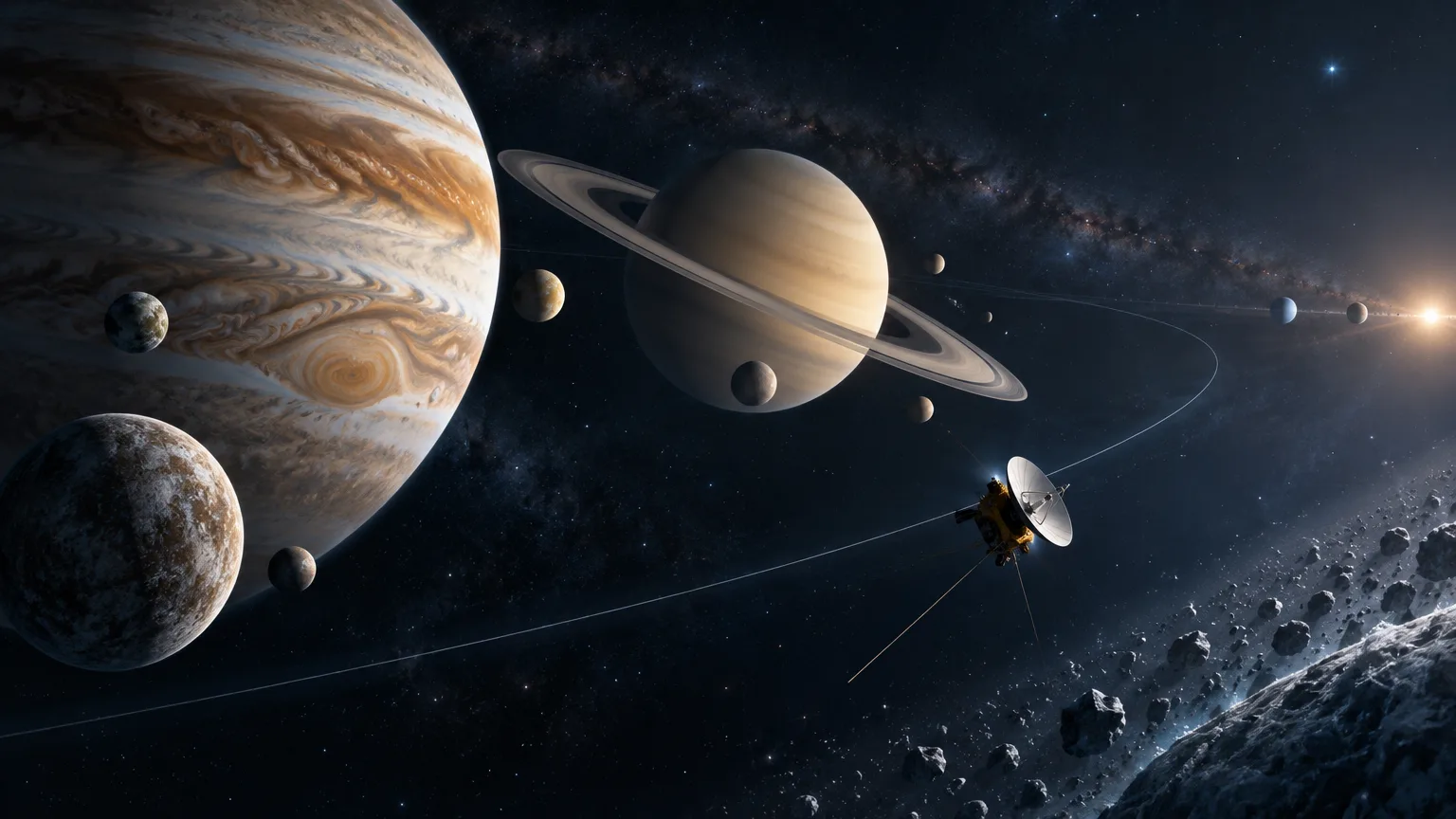
NASA’s Voyager probes set off in 1977 to study Jupiter and Saturn at close range, including Saturn’s rings and the largest moons of both planets. The plan expanded when it became possible to extend Voyager 2’s route to Uranus and Neptune. Together, the two spacecraft explored all four outer giant planets, 48 of their moons, and the ring systems and magnetic fields of those worlds, according to NASA’s account of the Voyager mission.
Planetary geometry and the gravity assist
The mission design took advantage of an unusual alignment of the outer planets that occurs approximately every 175 years. On a suitable trajectory, a spacecraft can travel from one planet to the next without needing large onboard propulsion systems. During each encounter, the planet’s gravity bends the spacecraft’s trajectory and increases its speed, helping it continue toward the next destination. This technique is known as a gravity assist.
NASA states that, thanks to this alignment, the planned flight time to Neptune was reduced from 30 years to 12. Although a four-planet journey was known to be possible, building a spacecraft capable of covering that distance, carrying the necessary instruments and operating for the required length of time was considered too expensive. The funded program therefore focused on flybys of Jupiter and Saturn. More than 10,000 trajectories were studied before routes were selected. The chosen paths allowed close encounters with Jupiter and its moon Io, and with Saturn and its moon Titan; Voyager 2’s trajectory retained the option of continuing on to Uranus and Neptune.
Two launches and a route that went farther
Voyager 2 launched first, on August 20, 1977, from Cape Canaveral, Florida. Voyager 1 was launched on September 5 on a faster, shorter trajectory. Both traveled aboard Titan-Centaur rockets and were built for a five-year mission. As the journey progressed, teams on the ground also reprogrammed the probes to give them additional capabilities.
Voyager 1 reached Jupiter on March 5, 1979, and Saturn on November 12, 1980. Voyager 2 passed Jupiter on July 9, 1979, and Saturn on August 25, 1981. Its trajectory after Saturn allowed it to continue to Uranus, which it reached in January 1986, and then to Neptune, reached in August 1989. NASA authorized the additional stages as the mission progressed. Voyager 1, by contrast, was set on a route that took it close to Titan and behind Saturn’s rings, carrying it north of the plane in which most planets orbit.
Jupiter and Io: volcanic activity and the magnetosphere
The cameras on the two probes took more than 33,000 images of Jupiter and its five major satellites, as well as recording other measurements. According to NASA, the flybys revealed physical, geological and atmospheric processes that had not been known from earlier observations. One notable finding was volcanic activity on Io, the first time active volcanoes had been observed on another body in the solar system.
The observations also connected Io’s activity with Jupiter’s surroundings. Sulfur, oxygen and sodium were detected at the outer edge of the planet’s magnetosphere. According to NASA’s explanation, these elements may have been expelled by Io’s volcanoes or knocked off its surface by the impact of high-energy particles. The magnetosphere is the region of space surrounding a planet that is influenced primarily by its magnetic field. The material observed thus placed the moon’s activity in the broader context of the Jovian system.
Saturn: winds, atmosphere and a possible explanation
The Saturn flybys provided close-up observations and high-resolution data. Near the equator, the probes measured winds of about 500 meters per second. They also recorded atmospheric features, ultraviolet emissions from hydrogen and auroras in the polar regions. Both spacecraft measured Saturn’s rotation period as 10 hours, 39 minutes and 24 seconds.
Voyager 1 found that helium made up about 7% of the volume of Saturn’s upper atmosphere; NASA’s page compares this proportion with 11% in Jupiter’s atmosphere. The source suggests that the lower proportion of helium in Saturn’s upper layers could indicate that the heavier helium is slowly sinking through the hydrogen. It adds that this possibility could help explain the excess heat Saturn emits relative to the energy it receives from the Sun. This explanation is presented as a possibility, not as a definitive conclusion.
Uranus, Neptune and the mission’s reach
In January 1986, Voyager 2 passed close to Uranus and transmitted images and extensive data about the planet, its moons, rings, atmosphere, interior and magnetic environment. Images of its five largest moons showed surfaces with varied geological histories. The cameras also detected 11 previously unobserved moons, and the instruments identified two new rings. In August 1989, the probe completed its encounter with Neptune.
The sequence of visits turned a mission initially focused on Jupiter and Saturn into a journey to all four outer giant planets. NASA puts the number of moons explored by Voyager 1 and Voyager 2 at 48, in addition to the ring systems and magnetic fields of these planets. Observations of Io, measurements of Saturn’s winds and data sent back from Uranus illustrate the variety of results obtained during the flybys. In Saturn’s case, the source continues to describe the proposed link between helium and the heat it emits as a possible explanation.