Identity and discovery
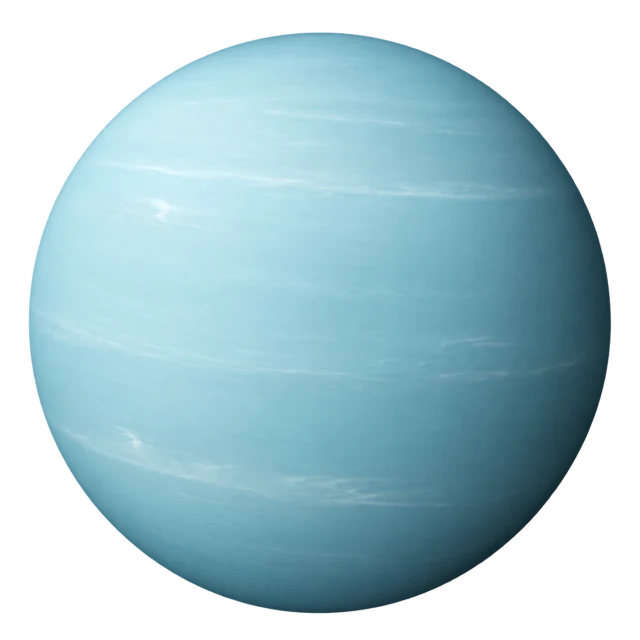
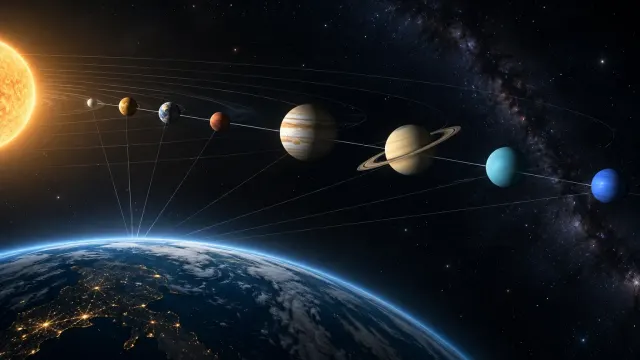
Uranus is the seventh planet from the Sun and one of the two ice giants in the outer solar system; the other is Neptune. It has the third-largest planetary diameter in the solar system, although its mass is smaller than Neptune’s. In JPL’s NAIF integer ID code system, Uranus is listed as 799.
Uranus was the first planet discovered with the aid of a telescope. William Herschel discovered it in 1781, although he initially thought it might be a comet or a star. The object was generally accepted as a new planet two years later, partly because of observations by Johann Elert Bode. Herschel unsuccessfully proposed naming it Georgium Sidus, after King George III. It was eventually named Uranus, the Greek god of the sky, at Bode’s suggestion.
Size, orbit, and rotation
Uranus has an equatorial diameter of 51,118 kilometers, about four times Earth’s diameter. Its average distance from the Sun is about 2.9 billion kilometers, or approximately 19 astronomical units. Sunlight takes about two hours and 40 minutes to reach the planet.
A day on Uranus lasts about 17 hours, while a complete orbit around the Sun takes about 84 Earth years, or 30,687 Earth days. Its most striking orbital feature is its tilt: its obliquity is 97.77 degrees, measured between the equator and orbital plane using the right-hand convention, making the planet appear to spin on its side. Uranus also rotates in the opposite direction to most planets; Venus is the other planet NASA identifies as doing so.
This tilt produces extreme seasons. For nearly a quarter of each Uranian year, the Sun shines directly over one pole, while the other half of the planet is plunged into a dark winter that lasts 21 years.
Structure and appearance
Most of Uranus’s mass—80% or more—is a hot, dense fluid of materials called “ices”: water, methane, and ammonia. These materials surround a small rocky core. Near the core, the temperature reaches about 4,982 °C. Uranus is the second-least-dense planet; only Saturn has a lower density.
The planet does not have a true surface: it consists largely of swirling fluids. A spacecraft would have nowhere solid to land and could not pass through the atmosphere unscathed because of the extreme temperatures and pressures. Atmospheric methane contributes to Uranus’s blue-green color: it absorbs the red portion of sunlight, while the remaining light is reflected from the clouds.
Atmosphere and magnetosphere
The atmosphere consists mostly of hydrogen and helium, with a small amount of methane and traces of water and ammonia. NASA gives a minimum temperature of 49 kelvin (−224.2 °C), meaning Uranus can be colder than Neptune in some places. Winds can reach 900 kilometers per hour. Near the equator they blow in a retrograde direction, opposite to the planet’s rotation; toward the poles, they shift to a prograde direction, in the direction of rotation.
During Voyager 2’s 1986 flyby, Uranus appeared generally featureless, with a few discrete clouds. Later observations have revealed dynamic clouds as Uranus approaches equinox, including rapidly changing bright features.
Uranus’s magnetosphere has an unusual, irregular shape. Its magnetic axis is tilted nearly 60 degrees from the rotation axis and is offset from the planet’s center by a distance equal to one-third of its radius. Uranus has auroras that are not aligned with the poles as they are on Earth, Jupiter, and Saturn. The magnetosphere’s tail, on the side opposite the Sun, extends millions of miles into space; the planet’s sideways rotation twists its magnetic field lines into a long, corkscrew shape.
Rings and moons
Uranus is surrounded by 13 faint rings. Its rings are mostly narrow and dark grey; outer rings include a reddish one and a blue one, like Saturn’s E ring. Some of the larger rings are surrounded by belts of fine dust. Listed in order of increasing distance from the planet, the rings are Zeta, 6, 5, 4, Alpha, Beta, Eta, Gamma, Delta, Lambda, Epsilon, Nu, and Mu.
Twenty-nine moons are known. The five major moons are Miranda, Ariel, Umbriel, Titania, and Oberon. Their names come from characters in works by William Shakespeare and, in some cases, Alexander Pope. Uranus’s inner moons appear to be roughly half water ice and half rock. The composition of the outer moons remains unknown, but they are likely captured asteroids.
Formation and exploration
Uranus formed about 4.5 billion years ago, when gravity brought together gas and dust from the early solar system. Like Neptune, it likely formed closer to the Sun and moved to the outer solar system about 4 billion years ago.
According to NASA, only one spacecraft has explored Uranus: Voyager 2, which made a close approach in January 1986 and took images of the planet and some of its moons. Uranus’s environment is not conducive to life as we know it: its temperatures, pressures, and materials are probably too extreme and volatile for organisms to adapt to.