

Key facts
- “Planet parade” is not a single technical term: it can describe an apparent alignment in the sky, while “alignment” can also refer to positions in space, such as conjunctions and oppositions.
- The planets orbit the Sun in a relatively flat plane; from Earth, that plane is projected onto the sky as the ecliptic.
- Mercury, Venus, Mars, Jupiter, and Saturn can be seen without optical aid when conditions allow; Neptune requires a telescope, and NASA recommends a telescope for Uranus.
- NASA’s article about planetary alignments was published on February 4, 2025, and focused in particular on an observing opportunity in January and February of that year.
- According to NASA, the outer-planet geometry used by the Voyager mission recurs approximately every 175 years; gravity assists reduced the travel time to Neptune from 30 to 12 years.
- Voyager 1 and Voyager 2 were launched in 1977; Voyager 2 reached Uranus in 1986 and Neptune in 1989.
Related records
The expression “planet parade” evokes several worlds arranged in a row. However, it is not a technical astronomy term and does not designate a single configuration. In its explanation of planetary alignments and planet parades, published on February 4, 2025, NASA notes that “planetary alignment” can refer both to planets’ positions in space—such as conjunctions and oppositions—and to several celestial bodies that appear to form a line or arc in the sky when viewed from Earth.
The distinction matters: several planets appearing close together in the sky does not prove that they are physically grouped or lie along the same straight line in space. Their appearance in the sky depends on geometry and perspective. NASA’s article also focused on a specific observing opportunity in January and February 2025. That time reference describes that event, while the geometric explanation helps explain the phenomenon in general.
The ecliptic and perspective from Earth
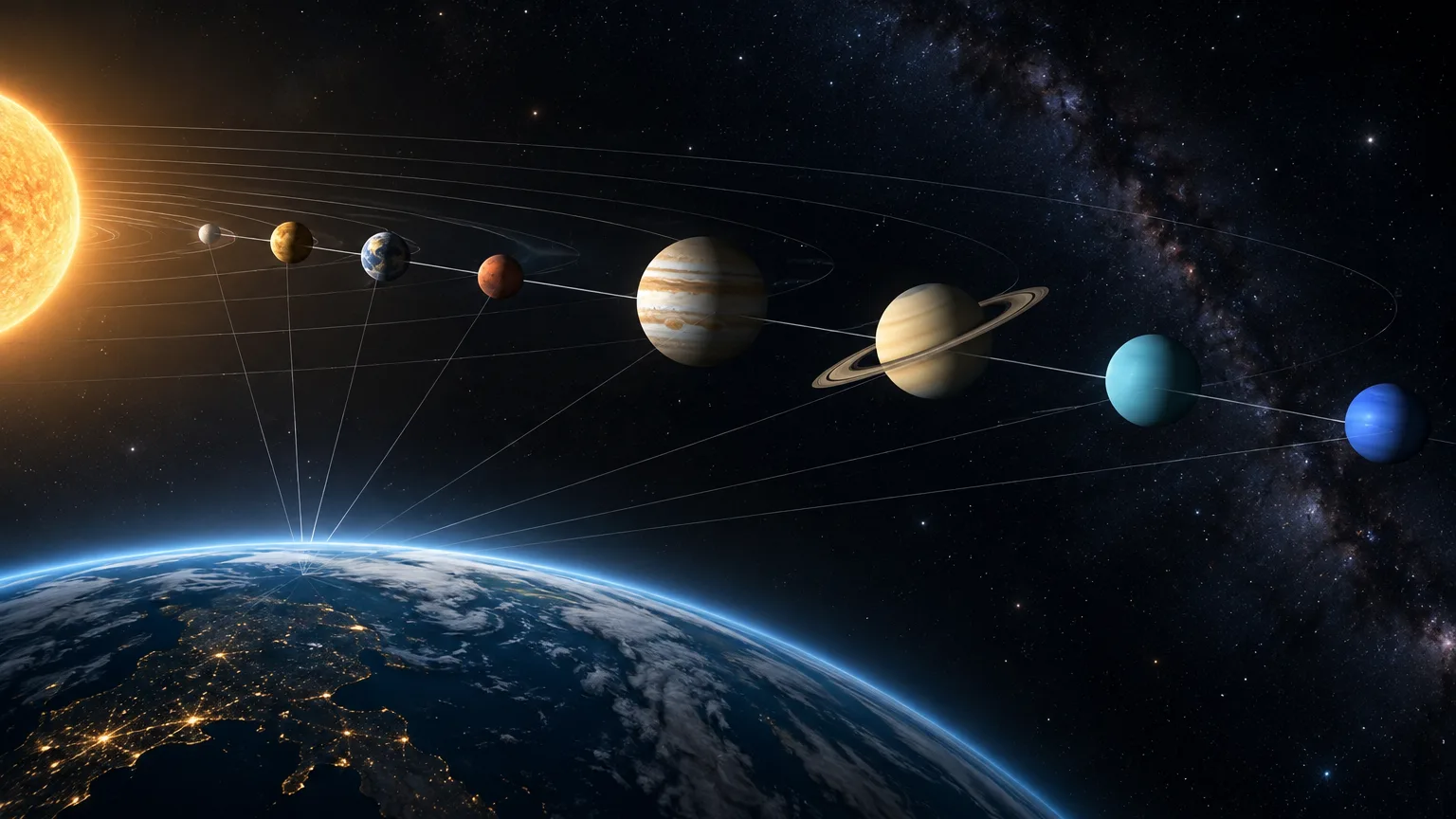
The planets in the solar system orbit the Sun in a relatively flat plane, like a disk. Earth also moves within that plane. From our vantage point, therefore, we see the system almost edge-on: the orbits are projected onto the sky as a line or arc. This apparent line is called the ecliptic.
The planets do not have to occupy the same point on the ecliptic or be at similar distances from Earth to appear aligned. It is enough for them to be visible, from our perspective, along a shared portion of the sky. Their apparent positions change as the planets move and Earth travels along its own orbit. The line we see is therefore a projection of three-dimensional positions; on its own, it is not enough to describe where each planet is in space.
The word “alignment” can also refer to spatial configurations. NASA mentions conjunctions and oppositions as phenomena in which planets can align in space. It is therefore useful to distinguish an apparent alignment in the sky from the bodies’ relative positions in three dimensions: the same term is used for different phenomena.
Orbits, motion, and gravity
The planets’ positions are not fixed. NASA’s explanation of planetary motion describes how Kepler’s laws characterize orbits and how Newton explained motion and gravity. Planetary orbits are elliptical, although some are very nearly circular. A planet moves faster when it is close to the Sun and more slowly when it is farther away; consequently, relative positions and the appearance of the sky change over time.
The Sun’s gravity curves the planets’ motion and keeps them in orbit. Earth is moving too, so we observe the system from a body following its own path, not from a stationary point outside it. The combination of these motions explains why the planets change position relative to the background stars and why several of them can appear in the sky during the same period.
What can be seen with the naked eye
According to NASA, Mercury, Venus, Mars, Jupiter, and Saturn can be seen without optical aid when conditions allow. Neptune requires a telescope. Uranus is faint: it can be detected with good eyesight under suitable conditions, but NASA recommends a telescope and notes the importance of a dark sky and knowing its position precisely. Therefore, counting six or seven planets in an alignment does not mean that all of them are visible to the naked eye.
Height above the horizon also matters. The atmosphere near the ground dims celestial objects, and buildings, trees, or other obstacles can hide them. NASA says that, for most observers, a planet should be a few degrees above the horizon; a height of 10 degrees or more is preferable. Near the glow of dawn or dusk, a low planet can be difficult to detect even if it is bright.
Visibility therefore depends on the observing location and conditions as well as the planets’ positions: a clear horizon, the time, sky brightness, and weather all matter. Groups of several planets visible to the naked eye offer an opportunity to observe different worlds at once, but the specific conditions are not the same everywhere.
Orbital geometry and the Voyager routes
Orbital geometry can also be used to plan space travel. According to NASA, the history of the Voyager mission shows how the arrangement of the outer planets made it possible to design a route in which each planet’s gravity changed the probes’ course and speed. This technique is known as a gravity assist.
Voyager 1 and Voyager 2 were launched in 1977. Their initial mission was designed to study Jupiter and Saturn up close. The trajectory chosen for Voyager 2 kept open the possibility of continuing on to Uranus and Neptune. NASA describes the arrangement of Jupiter, Saturn, Uranus, and Neptune that made this journey possible as a configuration that recurs approximately every 175 years. With gravity assists, the journey to Neptune was reduced, according to the agency, from 30 years to 12.
Voyager 2 reached Uranus in 1986 and Neptune in 1989. This was not a row of planets observed from Earth, but a calculated route for a moving spacecraft that would pass by several worlds. The example shows two different uses of geometry: interpreting how planets appear in the sky and planning a trajectory that takes advantage of their positions and gravity.
What an alignment explains and which conditions matter
An apparent row in the sky can be understood in terms of the relatively flat plane of the orbits and the vantage point from which we observe. That appearance does not by itself determine the planets’ three-dimensional arrangement, although spatial alignments described as conjunctions and oppositions also exist. Distinguishing these uses avoids interpreting every “alignment” as if it meant the same thing.
Observing conditions and dates are specific. The opportunity described by NASA was for January and February 2025; its information is not a calendar for other dates. To find out which planets can be observed at a particular time, the location, height above the horizon, time, and sky conditions must all be considered. The central idea, by contrast, is general: from Earth, planets orbiting in a relatively flat plane appear projected onto the strip called the ecliptic.