Identity and physical scale
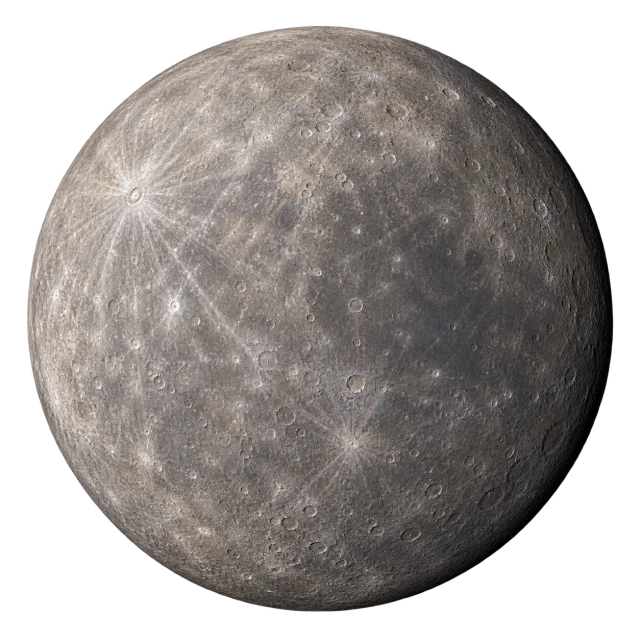
Mercury is the smallest planet in the Solar System and the closest to the Sun. Its NASA/JPL NAIF code is 199, not a stellar identifier. JPL’s physical-parameter table gives a mean radius of 2439.4 ± 0.1 km, a mass of 3.30103 × 10²³ kg and a mean density of 5.4289 g/cm3. The mean radius describes an equivalent-volume sphere, not the elevation at every surface location. Mercury belongs to the Solar System and does not have a fixed stellar distance in parsecs.
Rotation, solar day, and illumination
JPL lists a sidereal rotation period of 58.6462 Earth days, measured against the stars. The solar day, which also depends on orbital motion, lasts about 176 Earth days according to NASA. A year lasts about 88 days: Mercury turns three times for every two orbits. One axial rotation therefore does not equal a full sunrise-to-sunrise cycle. Its changing orbital speed and rotation explain why, from some regions, the Sun appears to pause and briefly move backwards across the sky.
ESA gives approximate temperatures ranging from −180 °C at night to 450 °C in daytime. The supplied evidence does not provide a full geographic or seasonal temperature map, nor a quantified heat-transport model. It does, however, support relating the extreme contrast to illumination and to the lack of a dense atmosphere. These figures should consequently be read as reference day and night conditions, rather than as a uniform planetary temperature.
Exosphere and near-surface material
Mercury lacks a dense atmosphere comparable to Earth’s. NASA describes an extremely thin exosphere, supplied by atoms knocked off the surface by the solar wind and meteoroid impacts. Its main constituents include oxygen, sodium, hydrogen, helium and potassium. This envelope does not effectively retain heat at night. Gas around the planet does not imply Earth-like pressure, protection or atmospheric circulation.
Interior, magnetism, and inferential limits
Mercury has an unusually large metallic core. NASA gives its radius as about 2074 km, approximately 85% of the planetary radius: this compares radii, not volumes. Evidence indicates that part of the core is molten. A study reported by NASA in 2019 used MESSENGER rotation and gravity measurements to infer a solid inner core about 2000 km in diameter. These are model-based estimates, not measurements from drilling into the planet. The mantle and crust form a much thinner outer shell; the surface magnetic field is weak compared with Earth’s.
Exploration and scientific importance
NASA’s MESSENGER spacecraft orbited Mercury for more than four years. NASA credits the mission with determining surface composition, revealing geological history, finding details of the internal magnetic field, and verifying that polar deposits are dominantly water ice. The wording is significant: it concerns the dominance of water ice in detected polar deposits, not a claim of globally exposed surface water. The mission shows why Mercury is scientifically consequential: its observations connect geology, composition, gravity, magnetism, polar volatiles, and the interaction between the surface and solar wind.
Open questions and documentary scope
NASA places Mercury’s formation about 4.5 billion years ago. Its surface preserves numerous craters and large impact basins, including Caloris, about 1550 km across, and Rachmaninoff, about 306 km across. Plains and scarps associated with contraction as the planet cooled are also present. Mercury has no moons or rings. These facts are documented and should not be called unknown merely because they are missing from a retrieved excerpt. Its detailed internal and geological evolution remains an active subject of observations, models and mission-archive research.