

Key facts
- NASA lists one star, eight planets and five dwarf planets in the Solar System.
- NASA’s Solar System Exploration page reports at least 290 moons, more than 1.3 million asteroids and about 3,900 comets.
- SDO studies the solar atmosphere to help understand the Sun’s influence on Earth and near-Earth space.
- New Horizons studies Pluto, its moons and other Kuiper Belt objects; Webb studies phases of the universe’s history, including the formation of solar systems.
Related records
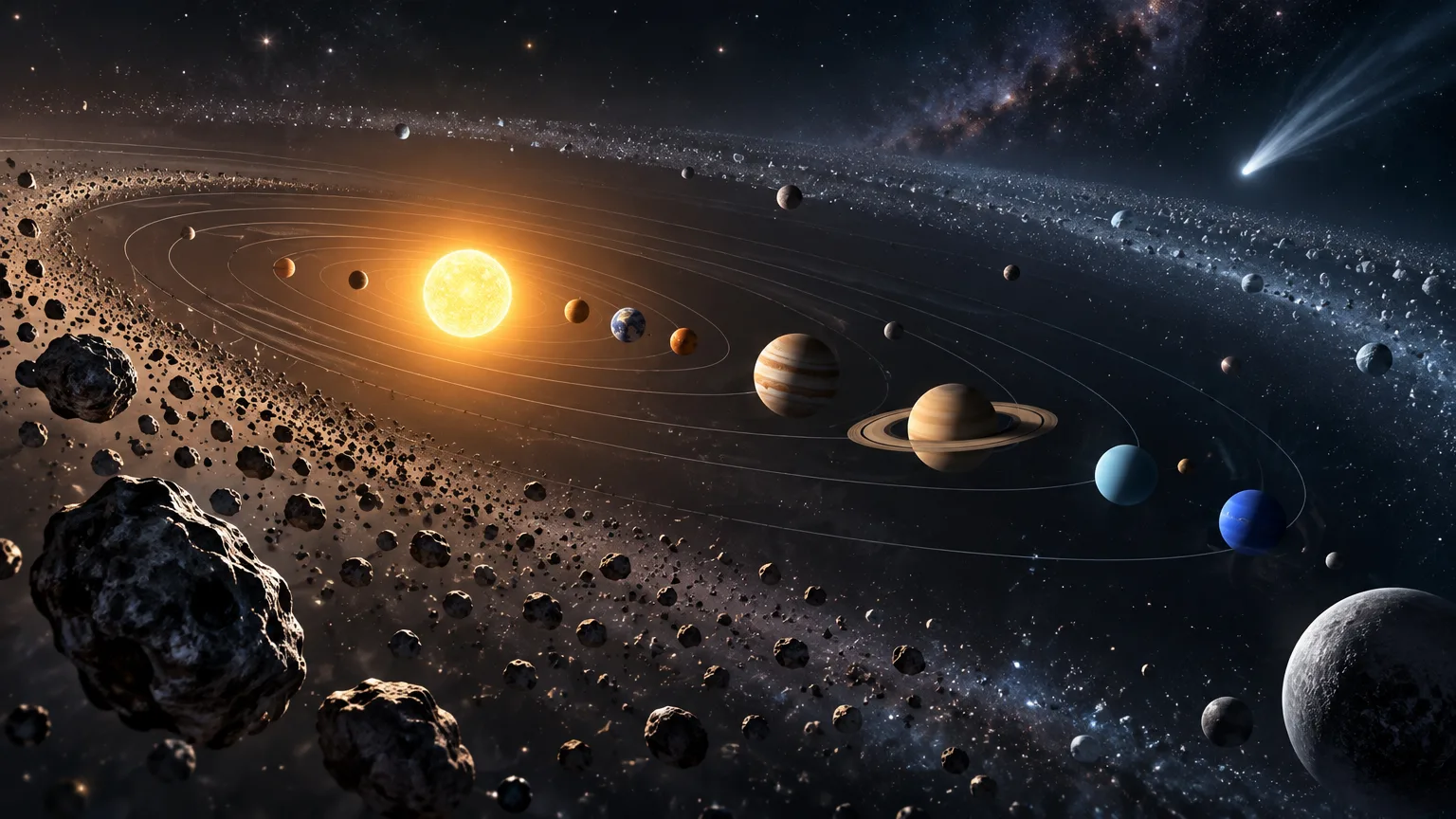
When people talk about the Solar System, the usual image is a star surrounded by planets. It is a useful starting point, but it does not capture the full range of objects NASA includes in its inventory. Alongside the eight planets—Mercury, Venus, Earth, Mars, Jupiter, Saturn, Uranus and Neptune—the agency recognizes five dwarf planets and records a population of moons, asteroids and comets.
The numbers make that diversity clear: NASA’s Solar System Exploration page lists at least 290 moons, more than 1.3 million asteroids and about 3,900 comets. These are not equivalent quantities: “at least” gives a minimum, “more than” sets a threshold, and “about” signals an approximation. NASA’s Solar System facts page also offers a general summary, though the information provided here does not specify a cutoff date or counting method.
An inventory that extends beyond the planets
The eight planets are the most familiar category, but not the only one. NASA officially recognizes five dwarf planets, but the available material does not name them or explain the classification criteria. It is therefore important not to confuse the planet count with a count of every world in the Solar System. Moons expand the inventory further: 290 is a reported minimum, not a claim that the total is exactly that number.
Asteroids and comets are listed in much larger numbers. The estimate of more than 1.3 million asteroids and the figure of about 3,900 comets come from the same NASA exploration page. They are public-facing figures from an institutional source, not a dataset whose methodology, observation date or error margins are described in the evidence available here. The number of known objects can change as objects are identified; these figures should not be treated as a definitive, unchanging counter.
The Sun is part of the story
Understanding the Solar System involves more than cataloguing its bodies: studying the star at its center matters too. NASA’s Solar Dynamics Observatory (SDO) is designed to help scientists understand the Sun’s influence on Earth and near-Earth space. According to the mission’s official description, it does this by studying the solar atmosphere on small scales of space and time.
That objective links solar observation to Earth’s environment, but it does not support attributing specific findings to the observatory that are absent from the supplied information. The NASA Science page describes the agency’s broader scientific aims: exploring the secrets of space and the origins of the universe, searching for life elsewhere, and protecting and improving life on Earth. These goals provide context for the missions, but they are not discoveries in themselves.
Missions with different destinations and questions
Other missions focus on distant regions. New Horizons is a NASA mission to study the dwarf planet Pluto, its moons and other objects in the Kuiper Belt, a region of the Solar System. That description summarizes its purpose; the available evidence does not provide specific scientific findings from the mission here.
The James Webb Space Telescope has a different reach: it studies phases in the history of the universe, from the first luminous glows after the Big Bang to the formation of solar systems capable of supporting conditions associated with life. The mission page does not present it simply as a census of objects in our own Solar System. SDO, New Horizons and Webb thus illustrate different ways to investigate space: observing the Sun, exploring worlds and bodies in an outer region, and studying cosmic history and the formation of systems.
What we know—and what these figures cannot tell us
The cited sources are NASA institutional pages describing the Solar System, its categories and selected missions. The information supplied includes no scientific papers, peer-reviewed results, preprints or new report that would support announcing a recent discovery. This article explains the overview presented by those pages; it is not a breaking-news update.
There are also specific limitations: the information does not say when the moon, asteroid and comet counts were updated, how each figure was defined, or what uncertainty accompanies the estimates. The moon count is phrased as a minimum, the comet count as an approximation, and the asteroid count as a threshold exceeded. Without those details, it is not possible to compare counts from different years or interpret differences as evidence of a physical change in the Solar System.
The cautious conclusion is that the eight planets are only part of a much broader inventory, while the cited missions investigate distinct, complementary questions. NASA’s figures offer the public a useful sense of scale, but they should be read with their qualifiers and with the absence of an explicit reference date in the available information in mind.