Identity and general characteristics
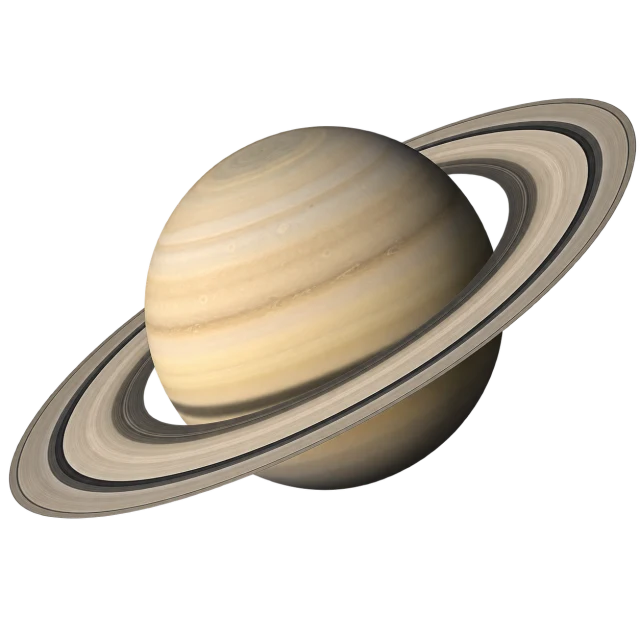
Saturn is the sixth planet from the Sun and the second-largest in the solar system. It is a huge sphere composed mainly of hydrogen and helium, the same two elements that make up most of the Sun. Its equatorial diameter is about 120,500 kilometers, approximately nine times that of Earth. Saturn is known for its extensive and complex rings, although it is not the only planet with rings. In the NAIF/JPL nomenclature, the planet's numerical code is 699.
Known since antiquity because it is visible to the naked eye, Saturn was named after the Roman god of agriculture and wealth, the father of Jupiter. Its environment is too extreme and volatile for life as we know it. By contrast, some of its moons, including Enceladus and Titan, have internal oceans and could offer conditions of interest for studying the possibility of life.
Orbit and rotation
Saturn is at an average distance of about 1.4 billion kilometers from the Sun, equivalent to 9.5 astronomical units. Sunlight takes approximately 80 minutes to reach it. It completes an orbit around the Sun in about 29.4 Earth years, or 10,756 Earth days. Its day lasts around 10.7 hours, one of the shortest among the planets in the solar system.
Saturn's axis is tilted 26.73 degrees relative to the plane of its orbit. As a result, the planet experiences seasons, just like Earth, whose axis is also tilted, although to a lesser extent.
Composition, interior, and atmosphere
Saturn has no defined solid surface: it is a gas giant composed largely of gases and fluids that become denser with depth. According to NASA's model of its interior, there may be a dense core of metals such as iron and nickel at the center, surrounded by rocky material and other compounds subjected to intense pressure and heat. Farther out are layers of liquid metallic hydrogen and liquid hydrogen. Pressure and temperature increase toward the interior until they reach conditions that would destroy a spacecraft attempting to pass through the planet. Its average density is lower than that of water.
The atmosphere has yellow, brown, and gray clouds, as well as faint bands, jet streams, and storms. In the equatorial region, upper-atmosphere winds can reach about 500 meters per second. A distinctive atmospheric structure lies near the north pole: a hexagonal pattern associated with a jet stream, observed in images from the Voyager probes in the early 1980s and studied in greater detail by Cassini. It extends about 30,000 kilometers and contains a large rotating storm at its center.
Saturn has a magnetic field that is less extensive than Jupiter's, but is described as 578 times more powerful than Earth's. The magnetosphere is the region where the planet's field dominates the behavior of electrically charged particles; it encompasses Saturn, its rings, and many of its moons. Cassini observations showed that at least some Saturnian auroras depend on particles ejected by the moons and on the rapid rotation of the magnetic field, rather than being determined mainly by the solar wind. This mechanism is not fully explained.
Rings and moons
The rings are made up of billions of fragments of ice and rock, coated with other materials such as dust. The particles range from tiny grains to house-sized chunks; a few can reach dimensions comparable to mountains. One hypothesis about their origin holds that they came from comets, asteroids, or moons that broke apart when they came too close to the planet and were torn apart by its gravity.
The system extends up to about 282,000 kilometers from Saturn, although the main rings are typically only about 10 meters high vertically. The rings are designated by letters according to the order in which they were discovered. Moving outward, the sequence given by NASA is D, C, B, the Cassini Division, A, F, G, and E; much farther away is the faint Phoebe ring, in the orbit of that moon. The Cassini Division, about 4,700 kilometers wide, separates rings A and B. Each ring orbits at a different speed.
The system also hosts moons with diverse features: Titan has a hazy atmosphere and methane lakes, while Enceladus ejects jets of water. As of March 2025, 274 moons orbiting Saturn had been confirmed; other Saturnian moons were still awaiting confirmation and official naming by the International Astronomical Union.
Exploration
The Cassini mission arrived at Saturn in 2004. The spacecraft took one of its last views of the planet and the main rings on October 28, 2016; the mission concluded on September 15, 2017. Earlier, the Voyager probes had recorded images of the north polar hexagon in the early 1980s, and Cassini observed it more closely.