

Key facts
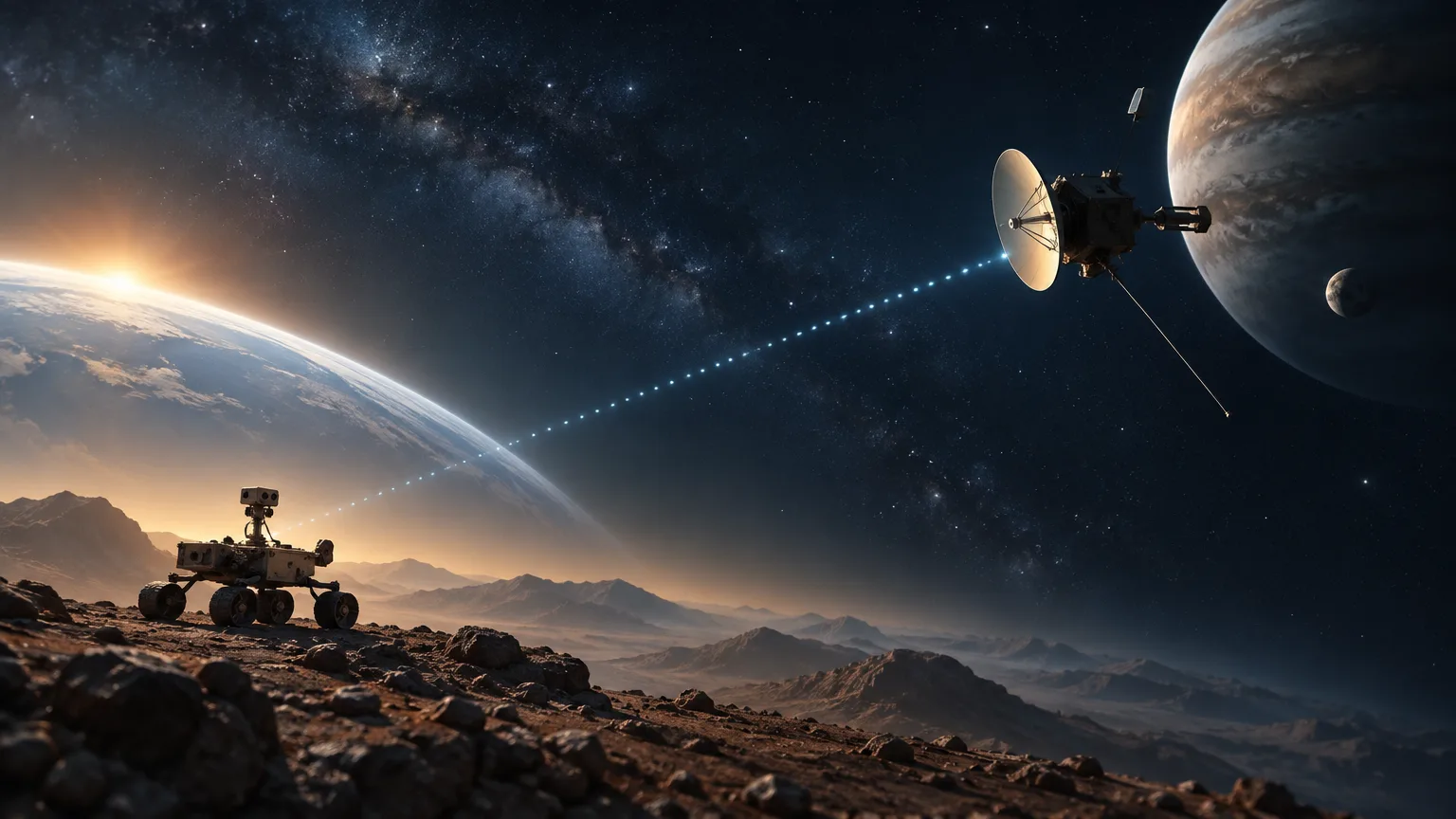
- NASA uses robotic systems to explore other worlds, support astronauts on the International Space Station, and study the universe.
- Ingenuity completed 51 flights on Mars since its first flight on April 19, 2021; it operated with minimal commands sent from Earth in advance.
- Europa Clipper was launched on October 14, 2024, to investigate Europa, a moon of Jupiter, in detail.
- Bobby Braun of Johns Hopkins Applied Physics Laboratory indicated that Dragonfly would be sent to Titan in 2028 as a car-sized, nuclear-powered octocopter to search for chemical components of life.
- An article by Yeison Alejandro Aldana published in Indagare in 2020 describes a semi-assisted terrestrial prototype operable remotely via the internet.
Related records
Robotic exploration does not consist of a single class of machine. NASA includes in this category systems that study planets and other solar system objects, assist astronauts on the International Space Station, and contribute to the study of the universe. It also mentions autonomous systems that allow robots, spacecraft, and aircraft to operate in dynamic environments without relying on external control. These are general functions: each machine is designed for a specific task and environment.
Mission technology goes beyond the vehicle. NASA identifies propulsion, navigation, landing, energy, scientific instruments, and communications as relevant elements. The latter systems connect spacecraft with Earth: agency antennas send commands and receive images and scientific data. Instruments, in turn, can collect information on planetary geology, atmospheres, and environmental conditions. This framework helps understand why two robots are not comparable just because both move or can receive instructions.
Autonomy: working with prepared instructions
The word "autonomous" describes a capability, not necessarily a machine that decides all aspects of a mission by itself. A concrete NASA example is Ingenuity, the Mars helicopter. The agency reports that it completed 51 flights since its first Martian flight on April 19, 2021. It also explains that it flew without direct human control during the flight: it took off, flew, and landed with minimal commands sent from Earth in advance.
The case shows how human preparation can be combined with autonomous execution. NASA presents Ingenuity as an apparatus that had to perform maneuvers with prior instructions, not as a system disconnected from planning or communications with Earth. In general terms, reliable communications are essential for agency missions; however, the operating mode depends on the system and the task of each vehicle.
Europa Clipper: a spacecraft heading to Jupiter's moon
Europa Clipper was launched on October 14, 2024, to carry out detailed research on Europa, one of Jupiter's moons, according to the NASA solar system exploration page. It is an example of a robotic mission that studies a distant destination via a spacecraft. The launch date and objective describe the mission; the cited page does not turn them into scientific results about Europa.
In NASA's overview, robotic exploration can also serve as a precursor to crewed missions. The agency describes this role among the functions of its systems, alongside the investigation of other worlds and support for astronauts. It is a general relationship between robotics and human exploration, not a guarantee that a specific mission will be followed by a crewed one.
Dragonfly: an octocopter planned for Titan
Dragonfly is a future mission discussed by Bobby Braun, head of the space exploration sector at the Applied Physics Laboratory (APL) of Johns Hopkins. In an interview published by Johns Hopkins, Braun stated that the plan was to send an octocopter the size of a car and powered by nuclear energy to Titan, a moon of Saturn, in 2028, to search for chemical components of life. The source attributes this objective and schedule to Braun; therefore, 2028 is a planned date in the interview.
Braun added that in 2026, Dragonfly's subsystems would begin to be integrated at APL facilities in Maryland and at its partner Lockheed Martin in Colorado, where the assembly of hardware destined for the mission would begin. In the same interview, he mentioned a series of robotic landings on the Moon planned for 2026, with scientific payloads or technology demonstrations. These are plans described by the interviewee, not a list of completed events.
A terrestrial prototype and the importance of context
An article by Yeison Alejandro Aldana published in Indagare in 2020 presents the development of a semi-assisted robot prototype with mechanical, software, and actuation capabilities, operable remotely via the internet. The reference places it in the field of uncrewed terrestrial vehicles, exploration robotics, and digital control. It is a useful case for explaining remote operation in a terrestrial robot; its described characteristics are not those of Europa Clipper, Ingenuity, or Dragonfly.
Therefore, the sources speak of projects of different nature: an internet-controlled terrestrial prototype, a helicopter that performed flights on Mars, a spacecraft launched to study Europa, and a mission planned for Titan. Distinguishing them allows speaking of robotics without transferring the functions or objectives of one machine to another. Autonomy, type of locomotion, destination, and scientific purpose depend on each design and the specific information about its mission.
What these missions show
Collectively, the examples illustrate several ways to expand exploration: operating scientific instruments, moving across another world, sending remote commands, and executing maneuvers with prepared instructions. NASA describes robotics as part of its exploration and astronaut support activities; the cases of Ingenuity and Europa Clipper show two vehicles with different purposes. Dragonfly provides a specific future objective as stated by an APL official, while the Indagare work describes a semi-assisted terrestrial prototype.
The most useful reading is to focus on the specific mission before attributing capabilities to a robot. In these examples, the sources specify Ingenuity's flight history, Europa Clipper's launch and destination, and Dragonfly's size, energy, objective, and planned schedule. The 2020 article, for its part, describes the internet operation of a terrestrial prototype. These details allow understanding the scope of each case without confusing future plans with completed facts or equating different projects.