Identity and classification
Atlas is identified in the supplied evidence as an inner moon of Saturn. Its supplied official identifier is MOON-ATLAS-SATURN-ATLAS. As a moon, it is a natural satellite rather than an individual ring particle. NASA’s general discussion of moons distinguishes chunks of ice and rock in planetary rings from distinct moons or moonlets embedded in those rings. Atlas is also included among Saturn’s small ring moons shown by Cassini alongside Daphnis and Pan in a montage displayed at the same scale for visual comparison.
NASA’s Atlas page places the object around the outer edge of Saturn’s A Ring. A separate NASA description says it orbits just outside the A Ring, described there as Saturn’s outermost bright main ring. Both statements support a qualitative location closely associated with the A Ring’s outer boundary. The available evidence does not, however, provide orbital distance, eccentricity, inclination, resonance designation, or an orbital period. This profile therefore does not turn that qualitative placement into a numerically specified orbit.
Shape, size, and visible geology
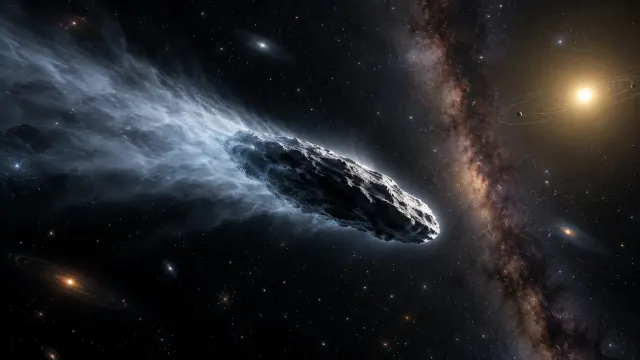
The most conspicuous documented feature of Atlas is its outline. NASA calls it a distinctive flying-saucer shape produced by a prominent equatorial ridge. The source says that this ridge is not seen on Saturn’s other small moons, while identifying Pan as a comparison for the general unusual appearance. That comparison needs restraint: the evidence supports the statement that Atlas and Pan are visually notable small ring moons, but it does not provide a measured ridge height, ridge width, surface roughness, volume, or material composition for Atlas.
A Cassini close-approach description gives Atlas a width of 19 miles, or 30 kilometers. This is the explicit size measure in the evidence. It should not be treated as a mean diameter, radius, three-axis shape model, or volume. No formal geological map, crater inventory, mineral identification, or topographic dataset is supplied. NASA states that the close images would help characterize Atlas’s shape and geology; that stated purpose establishes why the observations matter, but it is not itself a published, complete geological interpretation.
Observation and exploration
The best documented observation in this record was made by NASA’s Cassini spacecraft on April 12, 2017. It acquired raw, unprocessed images of Atlas during a flyby with a closest-approach distance of about 7,000 miles, or 11,000 kilometers. NASA describes these as the closest images ever taken of Atlas at that time. Their raw status matters because the supplied material identifies an observational product associated with the encounter, not a final global map or a fully resolved physical model.
The scientific purpose of the close pass was to improve characterization of the moon’s shape and geology. Yet the evidence excerpts do not report which particular geological features were subsequently recognized, what image resolution was achieved, how much of the surface was covered, or whether topographic or compositional products were derived. They also do not give a discovery date or discoverer. Such information must not be inferred from the fact that Cassini imaged Atlas in 2017. What can be stated securely is that Cassini observed it closely on that date and that NASA connected the images with shape and geology characterization.
Ring environment and scientific importance
Atlas is important because it lies directly beside the outer edge of the A Ring. NASA explains generally that shepherd moons help keep rings in line and that discrete moons or moonlets can occur within ring systems. The supplied evidence does not explicitly label Atlas a shepherd moon, nor does it describe a particular mechanism by which Atlas acts on the A Ring. A general explanation of ring moons should not be converted into an object-specific dynamical claim without direct supporting data.
Its equatorial ridge and ring-edge setting nevertheless make Atlas a useful target for studying the morphological diversity of Saturn’s small moons and the boundary between a defined satellite and surrounding ring material. This is a cautious scientific relevance statement grounded in Cassini’s stated observational objective and the moon’s unusual visible form, not proof of a particular origin process. The evidence gives no Atlas-owned rings, no satellites orbiting Atlas, and no quantified interactions with other Saturnian bodies.
Formation, interior, atmosphere, and unresolved limits
No supplied source establishes how Atlas formed, how its ridge developed, how old it is, or whether its shape reflects accretion, impacts, ring dynamics, or another process. There are also no provided values for mass, gravity, density, porosity, internal structure, material strength, or directly measured ice-and-rock composition. NASA’s general statement that Saturn’s rings contain chunks of ice and rock is not a compositional measurement of Atlas and cannot be treated as one.
Likewise, the evidence reports no atmosphere or exosphere, present geological activity, magnetic field, temperature, rotation period, or spin-axis orientation for Atlas. Information about Saturn’s axial tilt and seasons belongs to the planet and does not establish rotational or climatic properties of this moon. Within this evidence set, the central open questions are the material and geometric nature of the equatorial ridge, the geology that Cassini’s images were intended to clarify, Atlas’s precise dynamical relation to the A Ring, and its broader evolution. Addressing them requires measurements or sources not provided here.