Identity and classification
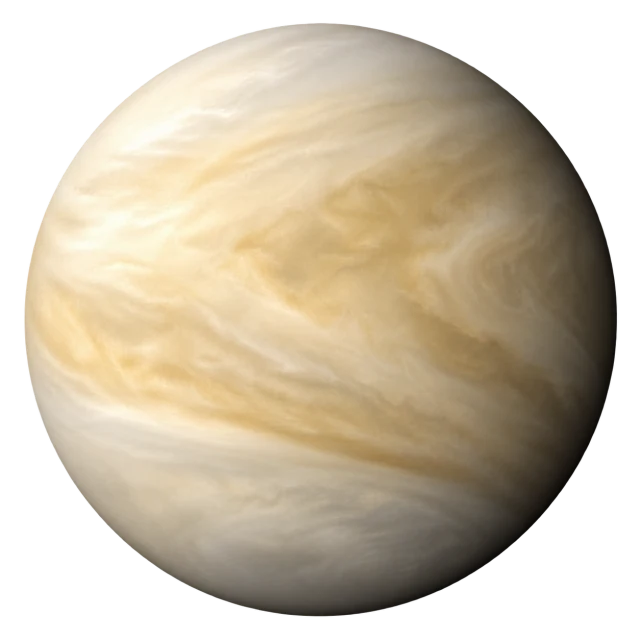
Venus is the second planet from the Sun, with NAIF code 299. JPL gives a mean radius of 6051.8 ± 1.0 km, a mass of 4.86731 × 1024 kg and a mean density of 5.243 g/cm3. Its size resembles Earth’s, but surface conditions differ greatly. These parameters are documented; incomplete source retrieval does not make them unknown.
Its most securely documented characteristic is its extreme surface environment. NASA identifies Venus as the hottest planet in the solar system and gives a surface temperature of about 872 °F, or 467 °C. NASA/NSSDCA’s parameter sheet lists an average temperature of 737 K, or 464 °C, while another NASA source gives 465 °C. These slight differences should not automatically be treated as a physical conflict: the sources use wording such as “about,” “average,” or a rounded value. On the available evidence, the careful formulation is a reference range of approximately 464–467 °C.
Atmosphere, clouds, and surface conditions
Venus’s atmosphere is the best quantified component in the assembled sources. Near the surface, its volume composition is given as 96.5% carbon dioxide (CO₂) and 3.5% nitrogen (N₂). Reported minor constituents, in parts per million, include sulfur dioxide at 150 ppm, argon at 70 ppm, water at 20 ppm, carbon monoxide at 17 ppm, helium at 12 ppm, and neon at 7 ppm. The same fact sheet reports an approximate total atmospheric mass of 4.8 × 10²⁰ kg, surface density of about 65 kg/m³, scale height of 15.9 km, and mean molecular weight of 43.45.
The listed surface pressure is 92 bar. NASA compares its squeezing force with being more than 3,000 feet, about 930 m, underwater on Earth; another NASA source summarizes it as nearly one hundred times Earth’s surface pressure. Both comparisons convey the exceptional magnitude, but neither replaces the measurement in bar. Near-surface wind speeds are estimated at 0.3 to 1.0 m/s, and the diurnal temperature range is listed as approximately zero in the NASA/NSSDCA sheet. That last value is an approximation in a compiled dataset, not evidence of absolute uniformity at every place or time.
The atmosphere and surface do not rotate at the same rate. The cloud layers exhibit superrotation: their circulation is much faster than the planet’s rotation. Near-surface wind measurements must be distinguished from upper-cloud dynamics; a value measured at one altitude does not describe the entire atmosphere. Observations at different wavelengths probe different regions of this opaque envelope.
Surface, geology, and interior
Magellan radar mapped extensive volcanic terrain and mountains. A study announced by NASA/JPL on March 15, 2023 identified changes in a vent at Maat Mons between images taken in February and October 1991, interpreted as evidence of volcanic activity. The study’s publication date is not the eruption date. Nor does this constitute continuous or real-time monitoring of every Venusian volcano.
NASA describes an interior with an iron core, a hot-rock mantle and a rocky crust. The broad resemblance to Earth does not imply identical tectonics or thermal histories. Models and gravity, topography and radar data help reconstruct connections between the interior and surface. The detailed layers and their evolution remain subjects of research.
Rotation, orbit, and surroundings
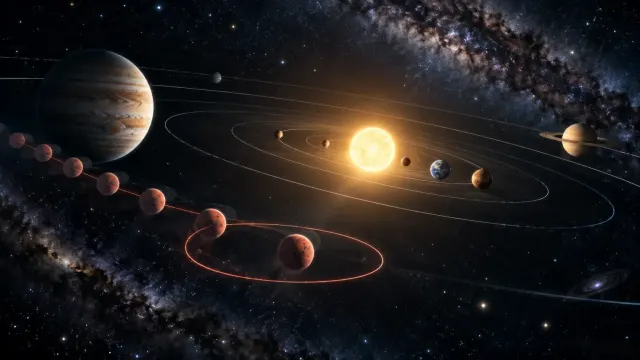
Venus rotates in a retrograde direction. JPL lists a sidereal period of −243.018 Earth days; the sign denotes direction, not a negative duration. NASA/NSSDCA gives an orbital period of 224.701 days, a semimajor axis of 108.210 million kilometres and an eccentricity of 0.0068. Its table lists a solar day of 2802 hours, about 116.75 Earth days. Rotation, solar day and year are different quantities.
Venus has no moons or rings. Zoozve is a quasi-satellite orbiting the Sun, not a moon gravitationally bound to Venus. The planet lacks an Earth-like intrinsic magnetic field; interaction between the solar wind and ionosphere creates an induced field. The absence of an Earth-like dynamo does not imply an absence of magnetic interaction.
Observation, exploration, and scientific importance
The documented exploration record includes an image of Venus taken by Mariner 10 as the spacecraft departed. Galileo and Cassini, during brief flybys en route to Jupiter and Saturn respectively, were the first spacecraft cited as using nightside thermal emissions from deep in Venus’s atmosphere to observe through dense clouds and study lower atmospheric layers. Venus Express was Europe’s first mission dedicated to Venus and orbited the planet from 2006 to 2014. Magellan supplied the observations underlying the description of a volcanically extreme and geologically reshaped surface.
Comparing Venus and Earth helps investigate how similarly sized worlds develop very different climates and surfaces. The CO₂-rich atmosphere, greenhouse effect, cloud dynamics and heat exchange with the interior are parts of that investigation. Reconstructions of ancient climate and possible water history must be distinguished from conditions observed today; an evolutionary hypothesis is not a detection of life.