

Key facts
- ESO published the results on 1 July 2026; Olivier Hainaut’s study had been accepted for publication in Astronomy & Astrophysics.
- ESO’s statement counted more than 14,000 satellites in orbit and described proposals to launch more than 1.7 million additional ones.
- In the VLT simulation, dozens of trails would appear per image two hours after the start of the night, with field-of-view losses of up to 28%.
- The VLT estimate assumes satellites faint enough not to be visible to the naked eye in good conditions.
- The Reflect Orbital simulation assumed that no beam would point directly at or near an observatory; for a fleet of 50,000, the overall brightness of the sky could increase by a factor of three to four.
- Hainaut proposes a maximum of 100,000 current and future satellites, provided they are fainter than visual magnitude 7; he said he would prefer 50,000 and clarified that 100,000 is not an exact threshold.
Related records
On 1 July 2026, the European Southern Observatory (ESO) released the results of a study on the potential impact of satellite constellations on astronomical observations. Its author, Olivier Hainaut, simulated the positions, movements and brightness of current and planned fleets. ESO said the study had been accepted for publication in the journal Astronomy & Astrophysics.
The central issue is not only how many bright points might cross an astronomical photograph. Satellite light can also raise the sky’s background brightness, even when the objects cannot be seen with the naked eye. These are different effects, and the study calculates both. Its results describe simulated scenarios, not the measured effect of a future fleet that has already been deployed.
From thousands of satellites in orbit to much larger proposals
According to ESO’s statement, the number of satellites in orbit has risen rapidly since 2019 and exceeded 14,000 when the study was published. This figure includes operational satellites; counting inactive spacecraft and debris as well, the statement gave a total of 32,000 objects. The proposals considered in the analysis would add more than 1.7 million satellites.
Among them is SpaceX’s plan to send an additional one million satellites for space-based data centres. Other proposals cited by ESO include the Cinnamon constellation from E-Space and CTC-1 and CTC-2 from China. The US company Reflect Orbital, meanwhile, proposes large satellites with mirrors to reflect sunlight towards Earth at night. The company proposes that the beams cover at least five kilometres over the Earth’s surface and has announced a target of 50,000 satellites by 2035.
These plans should not be confused with satellites already present in the sky. In an update added to its statement, ESO said that on 9 July the US Federal Communications Commission (FCC) had authorised Reflect Orbital to deploy a demonstration satellite. The information distinguishes this authorisation for a prototype from the plans to form a complete constellation.
Trails can cover part of the images
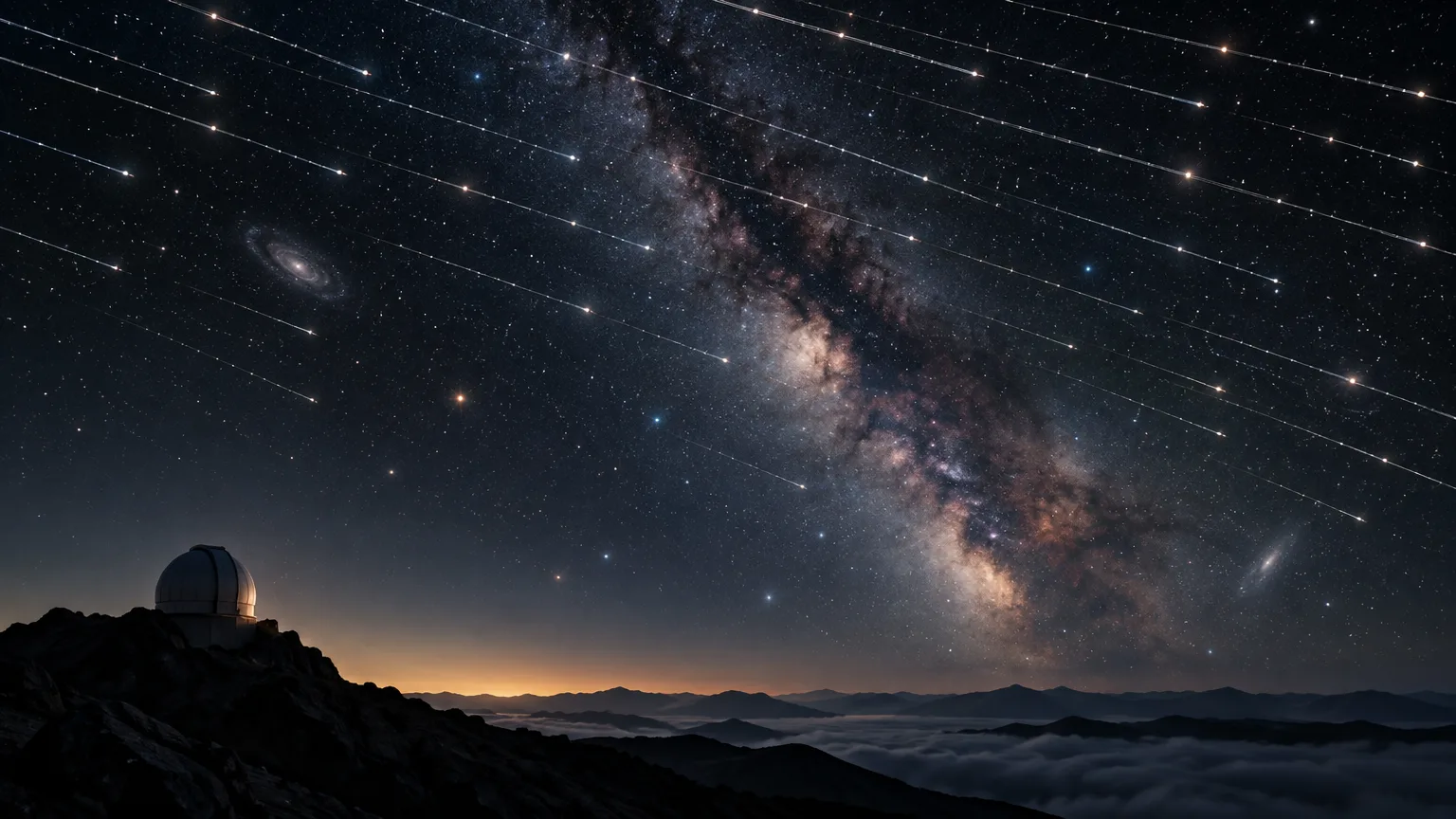
A satellite illuminated by the Sun can leave a bright line as it crosses the field observed by a telescope. To study this effect, Hainaut simulated observations with ESO’s Very Large Telescope (VLT), located at Paranal, Chile. In the scenario analysed, dozens of trails would appear in each image two hours after the start of the night. The loss of the field of view could reach 28%.
This calculation for the VLT assumes that the satellites are faint enough not to be visible to the naked eye in good conditions. ESO warns that if they were somewhat brighter, some cameras could be more severely affected. In particular, the statement notes that the Vera C. Rubin Observatory camera could produce mostly unusable images for several hours per night. The mechanism matters: in cameras with complex, high-density electronics, a trail that saturates the detector can generate ghost trails and potentially contaminate an entire image.
The loss does not always amount to a narrow strip across the photograph. The study considers that bright trails may affect larger areas of an image, depending on the camera. Therefore, the percentage of the field of view calculated for the VLT instrument should not be confused with the estimate of unusable images for Rubin: they refer to different cameras and effects described in different ways.
The overall brightness of the sky may also increase
The other route of impact is less evident in a single photograph: light from the constellations can contribute to the sky’s background brightness. As ESO explains, satellites too faint to be seen directly can create a veil of diffuse light. Light from brighter satellites can also be scattered in different directions as it passes through the atmosphere. Hainaut’s analysis included this effect as well as the individual trails.
Reflect Orbital’s mirror satellites represent an especially bright case in the simulations. According to the calculations reported by ESO, a satellite seen from within one of its beams would appear four times brighter than the full Moon. Even outside the beam, each spacecraft would have a brightness comparable to Venus. For the complete constellation of 50,000 satellites, the study calculates that the sky could be three to four times brighter overall.
The estimate for Reflect Orbital has an important condition: the simulations assumed that no satellite would direct its beam at or near an observatory. Even with that assumption, ESO says that the trail from a single mirror satellite could spoil an observation with a camera such as Rubin’s. With the full fleet, while the satellites were illuminated by the Sun, all images from a camera of that type would be lost, according to the simulated scenario.
The proposed limit and its conditions
In response to the results, Hainaut proposes limiting the total number of current and future satellites to 100,000, provided they are faint enough not to be visible to the naked eye from a dark site. ESO’s statement specifies that their brightness would have to be fainter than visual magnitude 7. According to the text, this level would also prevent satellites from saturating detectors such as the one in the Rubin camera.
Hainaut stresses that 100,000 is not an exact boundary between a protected sky and a damaged one: he says he would prefer 50,000 and compares the losses associated with 100,000 satellites with those from other technical problems, such as equipment failures. In addition, the proposed figure is conditional on brightness. If some satellites were brighter than the stated threshold, the total would have to be much lower.
ESO said it used the study as a basis for responding to applications filed with the FCC by SpaceX and Reflect Orbital, in collaboration with the UK’s Royal Astronomical Society and the International Astronomical Union. The decision on those applications rested with the commission. Thus, the scientific results presented by ESO, the companies’ launch scenarios and regulatory decisions are distinct elements: the study estimates consequences for astronomical observations under specific conditions, while the proposals and their permits determine which fleets might reach orbit.
What the simulations allow us to conclude
The work highlights two challenges for ground-based optical astronomy: trails that interfere with individual exposures and additional brightness that can spread across the sky. The simulations provide quantitative estimates for the instruments and fleets described in ESO’s statement, but their results depend on assumptions such as satellite brightness and observing time and, in Reflect Orbital’s case, the orientation of the beams.
Hainaut’s proposal to limit the total population to 100,000 faint satellites is therefore a conditional recommendation, not a universal threshold presented as exact. His figure should be read alongside the warning that brighter satellites would require an even lower total. The study thus frames the debate about megaconstellations in concrete observational terms: how many trails affect images, how much the sky background is illuminated and what brightness conditions are assumed in the calculations.