

Key facts
- The retrograde motion of planets led to questioning the Aristotelian geocentric theory.
- Copernicus proposed the heliocentric model in 1515 and published it in 1543.
- Galileo observed the moons of Jupiter in 1610, contradicting geocentrism.
- Kepler formulated three laws of planetary motion based on Tycho Brahe's observations.
- Newton published the laws of motion and universal gravitation in 1687.
- Newton's second law is expressed as F=ma.
- Newtonian theory dominated physics until Einstein's relativity in 1905.
Related records
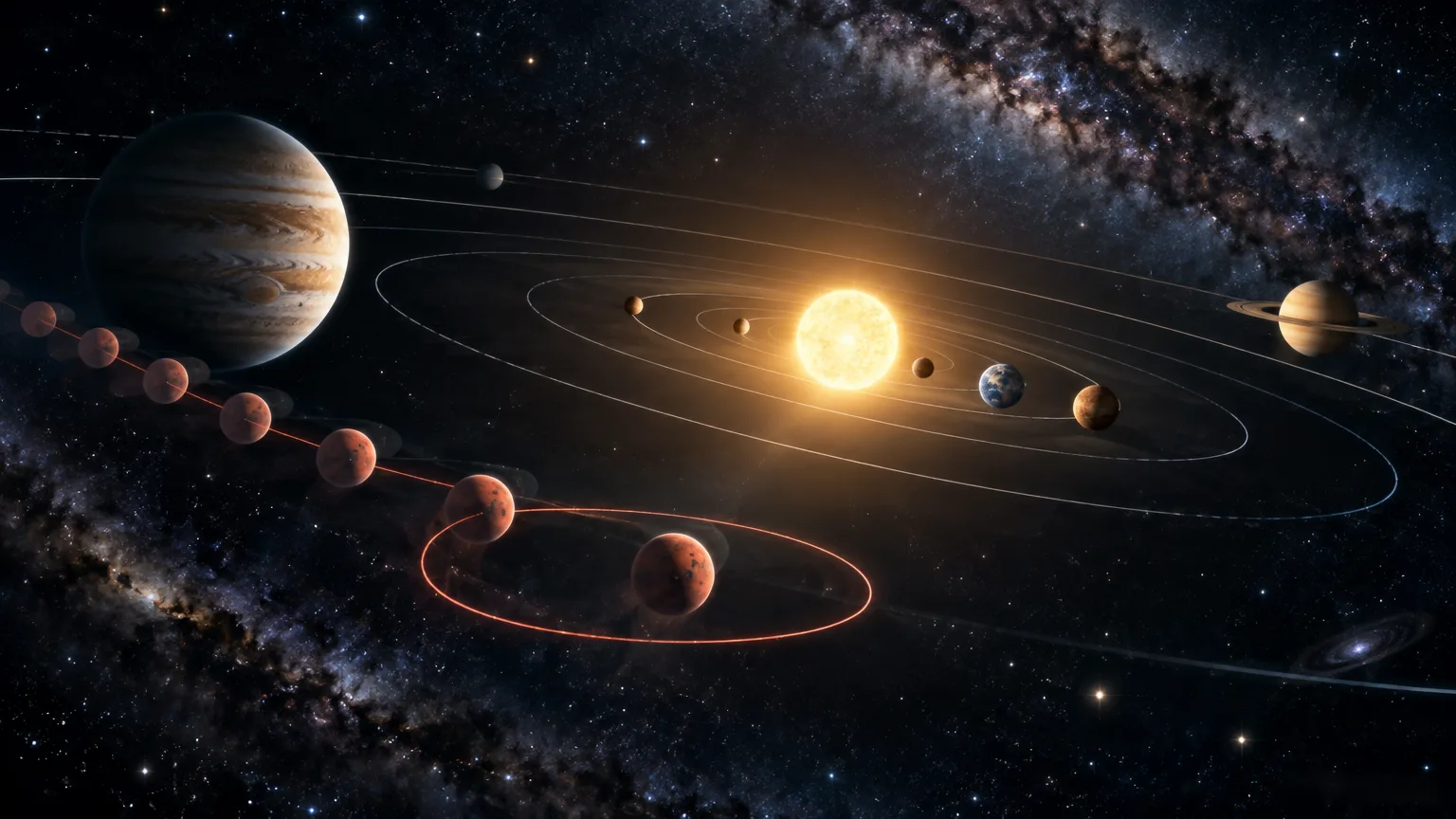
Planets move in an apparently erratic manner across the night sky, unlike fixed stars. This behavior, known as retrograde motion, led Renaissance astronomers to question the geocentric theory that had prevailed for centuries. According to Aristotle's view, the Earth was stationary, and the planets, the Sun, and the stars revolved around it. For nearly a thousand years, this view dominated natural philosophy and was integrated into Christian theology.
The Challenge to Geocentrism
In 1515, the Polish priest Nicolaus Copernicus proposed that the Earth was just another planet and that all planets revolved around the Sun. Although he did not publish his theory until 1543, shortly before his death, his heliocentric model laid the foundations for a new understanding of the cosmos. Acceptance of this idea was slow and, in some cases, dangerous; the Italian scientist Giordano Bruno was executed for defending, among other ideas, the Copernican view.
Evidence in favor of heliocentrism strengthened in 1610, when Galileo Galilei observed with his telescope that moons were orbiting Jupiter. This finding directly contradicted the idea that all celestial bodies orbited the Earth. Additionally, Galileo observed the phases of Venus, demonstrating that this planet orbits the Sun.
Kepler's Laws
While Galileo was observing, the German mathematician Johannes Kepler was developing the laws that describe planetary orbits. Using the precise observations collected by Tycho Brahe, Kepler discovered that orbits are not circular, as previously believed, but elliptical.
- First law: Planets move in ellipses with the Sun at one of the foci.
- Second law: An imaginary line between a planet and the Sun sweeps out equal areas in equal times, implying that planets move faster when they are closer to the Sun.
- Third law: There is a precise mathematical relationship between a planet's distance from the Sun and the time it takes to complete its orbit.
Newton's Unification
In 1687, Isaac Newton published the Principia Mathematica, where he unified the laws of motion and universal gravitation. Newton explained that the force of gravity, which depends on mass and decreases with distance, is what keeps planets in their elliptical orbits. His second law, expressed as F=ma, relates the force applied to an object to its mass and acceleration.
Newtonian theory explained not only planetary motion but also phenomena such as tides, caused by the Moon's gravitational attraction. This view remained unquestioned for nearly 220 years, until Albert Einstein presented the theory of special relativity in 1905, introducing new considerations regarding mass, time, and distance.
Legacy in Planetary Science
The transition from geocentrism to orbital mechanics was not just a change of model, but the birth of modern science. Kepler's and Newton's laws remain the basis for predicting the motion of celestial bodies and planning space missions. The understanding of gravity and orbital motion, derived from the need to explain retrograde motion, remains fundamental in the exploration of the solar system and beyond.