A collection of galaxies, not a galaxy
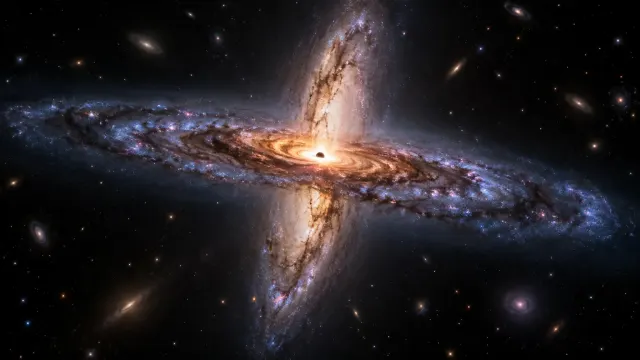
The Virgo Cluster is a gravitationally bound collection of galaxies. NASA describes it as the nearest large cluster to our galactic neighbourhood. Its population exceeds a thousand; NASA’s M87 profile uses about 2,000 galaxies as an indicative figure, not an exact, unchanging census. It contains large elliptical and spiral galaxies and must not be confused with a single galaxy or a star cluster.
Neighbourhood and cosmic hierarchy
M87 is a dominant galaxy in the central region. NASA places M87 roughly 54 million light-years away and NGC 4698, another Virgo member, about 55 million light-years away. These are approximate distances to particular galaxies, not a single identical distance for every member. The cluster and the Local Group are distinct structures. The 2014 description of Laniakea includes both within a larger structure; supercluster membership does not mean that the whole structure is gravitationally bound like a cluster.
Hot gas and galaxy evolution
The space between galaxies contains hot gas visible in X-rays. Chandra revealed a long tail of stripped gas in M86 as the galaxy moves through the cluster medium. Pressure from this gas can remove a galaxy’s material and alter its supply for star formation. The physical explanation includes the gravity of galaxies, gas and dark matter; the latter is inferred from its effects, not directly photographed as a luminous component.
A nearby laboratory
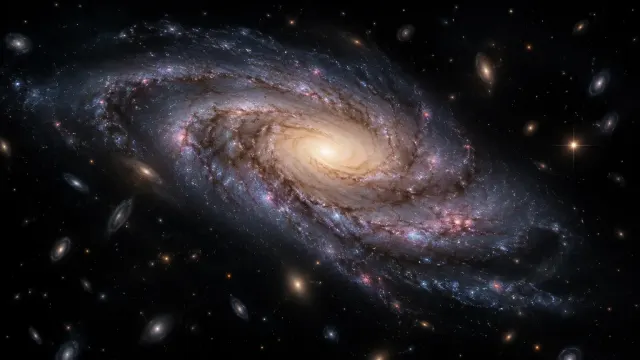
NASA’s release of 18 September 2026 identifies NGC 4698 as a Virgo member and describes a Hubble programme studying the cluster’s galaxies. Resolving star clusters and nebulae helps connect local processes with a galaxy’s journey through the larger system. Observations of one galaxy cannot automatically be applied to all the others: NGC 4698’s unusual bulge and rotation belong to that galaxy, not to the entire cluster.