

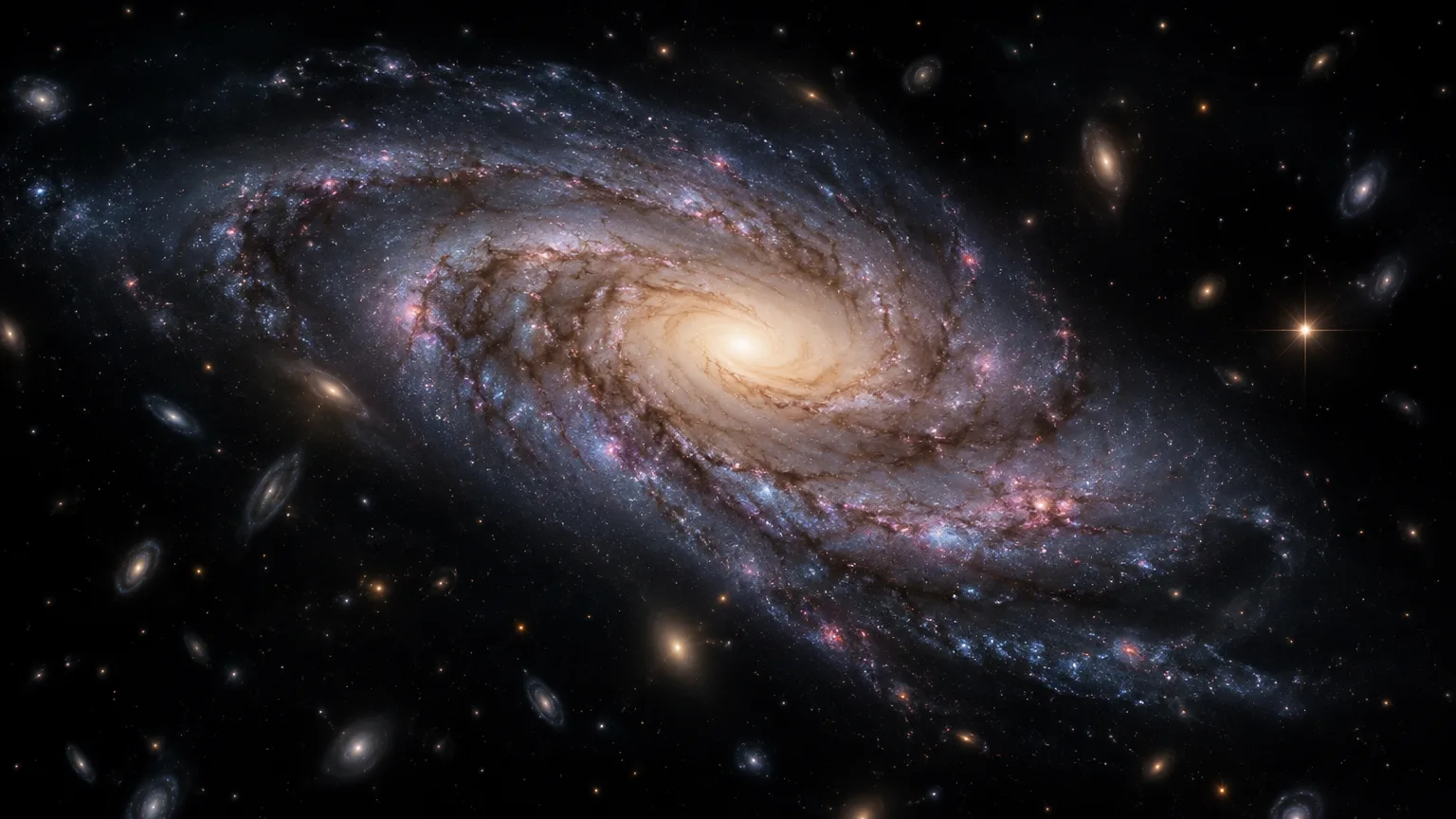
Key facts
- NASA published a report about the image on September 25, 2026, and said the image had been released on September 18, 2026.
- NASA describes NGC 4698 as a spiral galaxy with arms curling around a thin disk of stars, gas, and dust.
- NASA Science places the galaxy about 55 million light-years away in the constellation Virgo.
- The image was taken by the Hubble Space Telescope, a mission of NASA and the European Space Agency.
- Available sources call the galaxy apparently serene and chaotic but do not explain which specific feature prompted that characterization.
Related records
On September 25, 2026, NASA published a report about an image of the spiral galaxy NGC 4698 taken by the Hubble Space Telescope. The image itself had already been released on September 18. The distinction between those dates matters: the report’s news is the presentation of the image and its accompanying description, not an observation with a specified date of acquisition in the available information. NASA characterizes the scene as apparently serene but says it conceals a chaotic feature.
The evidence available here establishes the object’s general classification and location, but does not reconstruct every detail of the observation. It gives no date for when Hubble took the image, no exposure time, no filters used, and no measurements. Nor does it provide numerical details about the galaxy beyond the approximate distance listed on another NASA Science page. The announcement should therefore be read as a presentation of an image, not as a complete explanation of NGC 4698.
What we know about NGC 4698
NGC 4698 is a spiral galaxy, a broad category whose general features include spiral arms curling around a thin disk. According to NASA’s description, that disk contains stars, gas, and dust. The comparison with the Milky Way helps convey its general form: NASA also identifies our own galaxy as a spiral. That comparison does not mean the two galaxies are identical, nor does it by itself tell us how they differ.
NASA Science places NGC 4698 about 55 million light-years away, in the constellation Virgo. This provides a sense of scale and location, but it is not a detail visible in the image: the distance is contextual information published by the agency. Virgo is the region of the sky where the object appears from our perspective; it does not mean the galaxy is close to Earth in an everyday sense.
The image and NASA’s description
The image was taken with the Hubble Space Telescope, a joint NASA and European Space Agency mission, according to the NASA Science page presenting it. Hubble is the instrument that produced this view; the sources provided do not contain enough information to describe the equipment or specific operations involved in this observation. The official description contrasts a serene appearance with a “chaotic secret,” while another NASA Science page calls the galaxy “out of sync.”
Those phrases convey the agency’s reading of the image, but they are not accompanied here by a detailed physical explanation. The information does not say which part of NGC 4698 appears disordered, which property is out of step, or what observations support that assessment. It is therefore not possible to state from this evidence what causes the supposed chaos, or to attribute it to an interaction, collision, or specific process. Visual appearance and scientific interpretation are related, but they are not interchangeable.
Its place in the constellation Virgo
A secondary outlet covering the report describes NGC 4698 as part of the Virgo Cluster, a group of galaxies held together by gravity. According to that outlet, the cluster contains more than a thousand galaxies and is the nearest large cluster. Those details come from a secondary source in the evidence provided, so they should be understood as attributed context, not as measurements presented in NASA’s image report.
This context helps place the galaxy within a larger structure, but it does not by itself explain the word “chaotic.” The material provided does not establish a connection between the cluster environment and the feature NASA refers to. It would be speculative to present cluster membership as the cause of the described appearance. The cautious conclusion is narrower: NGC 4698 is a spiral galaxy in the direction of Virgo and, according to NASA Science, lies about 55 million light-years away.
What the announcement does—and does not—mean
The report offers a new opportunity to view a spiral galaxy through Hubble and draws attention to a contrast between its appearance and NASA’s description. But the available material does not explain exactly what the secret is or provide enough data to assess that interpretation independently. The attention-grabbing headline should not stand in for missing information: these sources do not establish a mechanism, an evolutionary history, or a specific discovery.
It is also useful to separate the image’s release date from the report’s publication date. NASA says the image was released on September 18, 2026; the news page is dated September 25. The information here does not say when the image was taken, and neither date should be mistaken for the date when the galaxy was discovered.
A suggestive image, with questions still open
What can be stated is concrete: Hubble captured a view of NGC 4698; NASA presented it as a spiral galaxy with arms surrounding a thin disk of stars, gas, and dust; and NASA Science places it about 55 million light-years away in Virgo. The agency describes a contrast between apparent calm and chaos, but the evidence provided does not detail the feature responsible. That limitation does not diminish the image; it defines what the report allows us to conclude and what still awaits a fuller explanation.
For now, the interest lies both in the view of the galaxy and in the question NASA raises. To know exactly what it means for NGC 4698 to be “out of sync” or to hide a “chaotic secret,” more information would be needed about the structures observed and the evidence supporting that interpretation. Until then, the wording should remain an agency characterization, not a cause that has already been established.