

Key facts
- ESA released the NGC 4698 image and description on 18 September 2026.
- NGC 4698 lies about 55 million light-years away in Virgo and belongs to the Virgo Cluster.
- Its bulge extends almost at a right angle to its disc, and the stars and gas near the centre rotate perpendicular to the rest of the disc.
- ESA reports signs of active growth in the central supermassive black hole, whose mass is millions of times the Sun’s.
- Gas brought in from outside and a minor galactic merger are possible explanations, not confirmed causes of the structure.
Related records
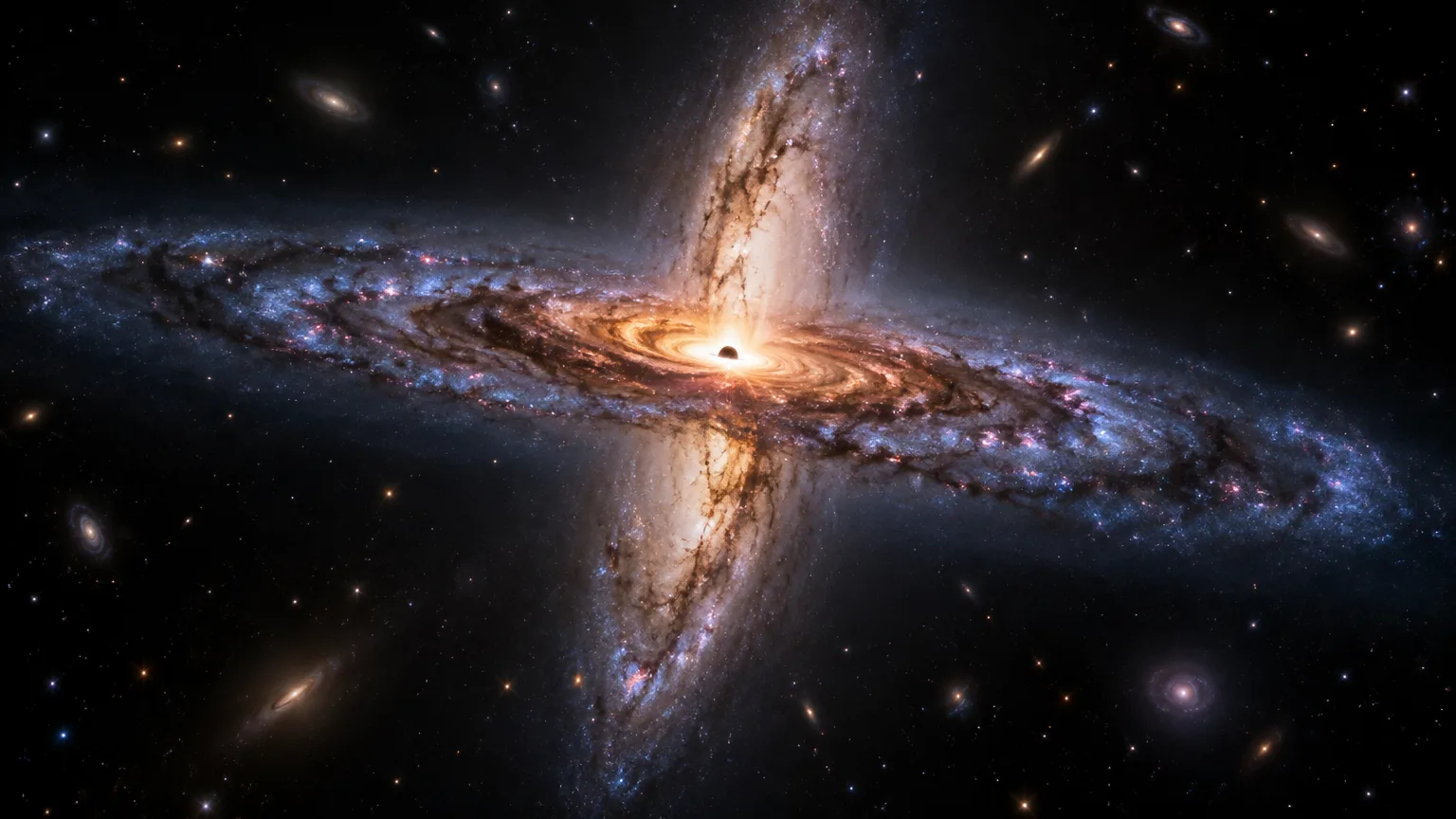
ESA’s image release on 18 September 2026 turns the spotlight on NGC 4698, a spiral galaxy about 55 million light-years away in the constellation Virgo. It belongs to the Virgo Cluster, a gravitationally bound collection of more than one thousand galaxies that ESA describes as the nearest large galaxy cluster. The image was made using data from the NASA/ESA Hubble Space Telescope, collected for an observing programme focused on galaxies in that cluster. The news is the publication of the image and its accompanying explanation, not an announcement of a newly discovered black hole.
What makes a galaxy “out of sync”
In some respects, NGC 4698 resembles the Milky Way: it has a thin disc of stars, gas and dust, spiral arms, and a central bulge. But its bulge—the brighter, thicker central region—extends in a direction close to perpendicular to the disc. In the Hubble image, the bulge’s faint glow of stars seems to peek above and below the disc’s dusty lanes.
The unusual geometry is not only a matter of shape. According to ESA, the stars and gas closest to the galaxy’s centre rotate perpendicular to the rest of the disc. The system therefore appears “out of sync”: its central components do not share the orientation or overall motion of the spiral structure. The agency says only a few spiral galaxies are known to have a bulge arranged in this way.
The black hole and what growth means
A black hole is not an empty hole but an extremely compact concentration of matter. Its gravity is intense enough to define a boundary called the event horizon. At the centre of NGC 4698, the bulge’s stars—which are smaller, older and cooler than the massive blue stars visible in the disc’s outer regions—orbit a supermassive black hole with a mass millions of times that of the Sun, ESA says.
The agency reports that scientists have found signs the black hole is actively growing: it draws gas inward through gravity. That wording matters. The information provided gives no measurement of the growth rate and describes no specific method used to calculate it. Nor does it mean the black hole’s event horizon has been directly observed. The image shows the galaxy and its stellar structure; growth is inferred from signals that researchers interpret as gas accretion activity.
A possible clue in gas brought in from outside
How might NGC 4698 have acquired such a misaligned central region? The explanation ESA considers most likely points beyond the galaxy. If NGC 4698 drew in gas from an external source, the newly collected material could have formed a disc of gas and stars at the centre, tilted relative to the main disc. In that scenario, the central structure would preserve the imprint of material arriving from a different direction.
There is another possible clue: some observations suggest that NGC 4698 experienced a minor galactic merger in the past. The evidence described by ESA is a short tail of hydrogen extending from one side of the galaxy. The agency does not present this interpretation as a definitive reconstruction. A minor merger is one possible explanation for the gas supply, not a proven single cause of the galaxy’s present geometry.
What the image reveals—and what remains open
Hubble provides a view of the bulge, disc and dust lanes, but an image alone cannot settle the galaxy’s dynamical history. According to ESA’s page, the data came from observing programme 18103, whose principal investigator was D. Thilker. The information released does not detail the measurements or give quantitative results for the amount of gas acquired, the timing of a possible merger, or the black hole’s growth rate.
Black holes are also studied through signals other than light. A research paper published in 2016 by the LIGO Scientific Collaboration and the Virgo Collaboration reported the detection of gravitational waves emitted by two merging black holes. Gravitational waves are disturbances that travel through spacetime; they offer a way to study mergers that does not depend on obtaining an image of the objects. That paper and the Hubble image of NGC 4698 are different kinds of evidence: the former concerns a merger signal detected through its waves, while the latter lets researchers examine a galaxy’s structure and signs associated with its nucleus. The 2016 paper was published in Physical Review Letters; it is not a preprint.
A plausible history, not a settled conclusion
NGC 4698 is interesting because it brings together an unusual central shape, misaligned motion and signs of activity around a supermassive black hole. Gas arriving from outside and a minor merger offer a possible shared explanation for these features, but ESA’s published account leaves that explanation in the realm of hypothesis. The described observations are the unusual structure, perpendicular rotation in the central region and signs that the black hole is growing. Exactly how this configuration formed remains an open question.
Sources: ESA/Hubble: NGC 4698 image and description, published 18 September 2026; LIGO and Virgo paper on gravitational waves from a binary black-hole merger.