

Key facts
- NASA says 2026 will have two solar and two lunar eclipses; the cited information does not provide local details for all four.
- The Perseid peak is expected from the night of August 12 into the early morning of August 13; the guide highlights the Northern Hemisphere.
- In June, Venus will appear to pass behind the Moon from parts of the United States, Canada, Brazil and Venezuela, within a specific path.
- In January, Jupiter reaches its greatest apparent size and brightness of the year; a Moon-Saturn pairing and the Beehive or Praesepe Cluster are also highlighted.
- NASA’s annual overview is dated January 16, 2026, and mentions the history of the Marshall Space Flight Center observatory.
Related records
The sky in 2026 combines events that can be seen with the unaided eye with others whose visibility depends much more strongly on location. NASA presents the year as a series of opportunities to observe planets, the Moon, meteors and eclipses. However, the available summaries do not include all the information needed to plan a local observation of every event: in some cases, an exact date, time or detailed geographic viewing zone is missing. This overview therefore separates what the sources identify from what they do not allow us to specify.
NASA is the United States space agency. Its skywatching pages collect public-facing recommendations and astronomical events of interest; its 2026 eclipse page specifies that dates and times are given in Universal Time (UT), also colloquially called GMT. Local times may differ, and an event’s appearance on a general calendar does not by itself establish whether it can be seen from a particular place.
A year with four eclipses, but not visible everywhere
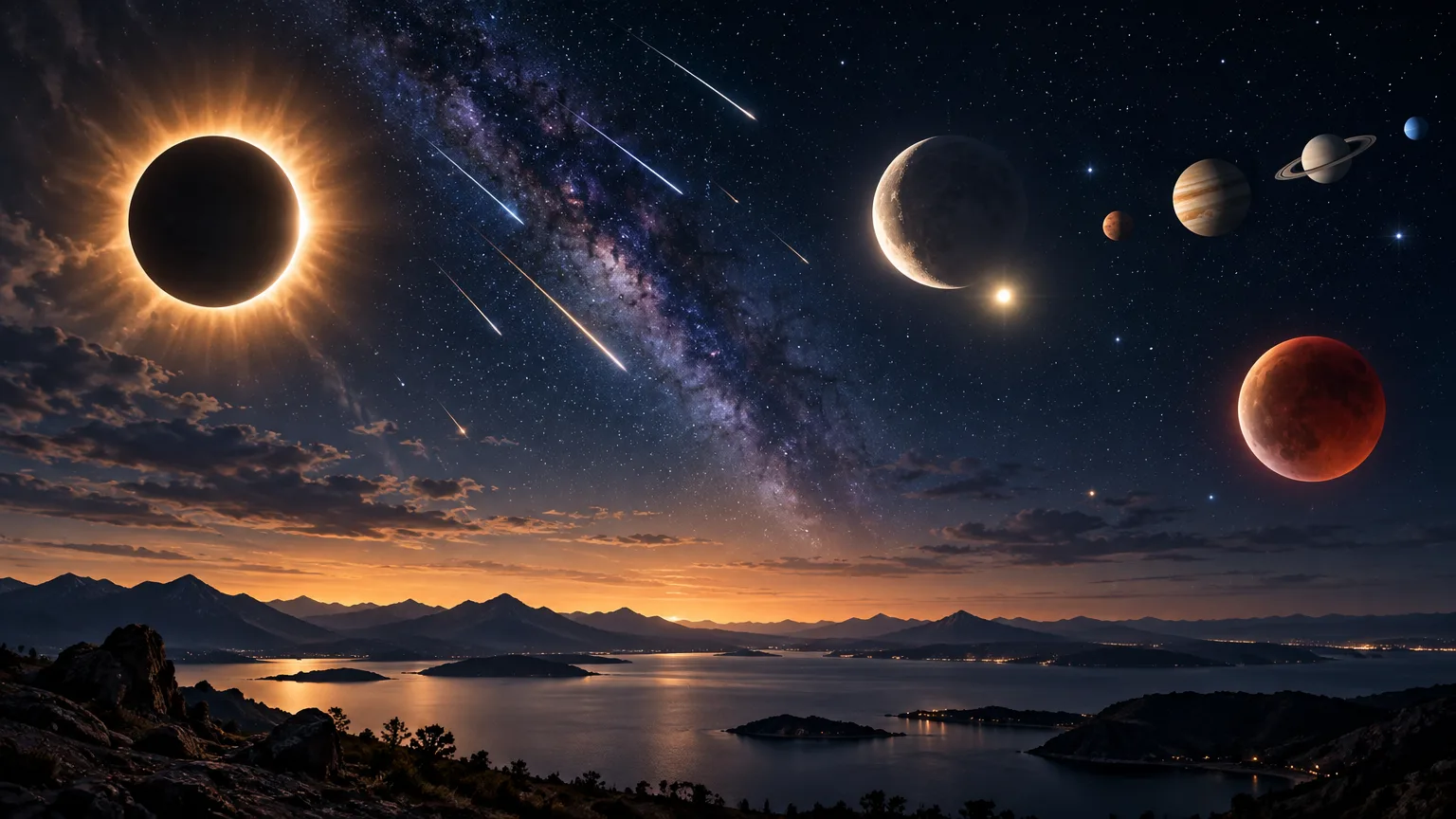
NASA’s page on eclipses states that 2026 will bring two solar eclipses and two lunar eclipses. That is a year-wide total, not a promise that every observer can see all four: eclipses are visible only from certain areas, and their circumstances vary by location. The information provided here does not include the dates, times or visibility maps for all four events, so it cannot serve as a complete local observing guide.
A solar eclipse occurs when the Moon passes in front of the Sun from Earth’s perspective; a lunar eclipse occurs when the Moon passes through Earth’s shadow. NASA lists a solar eclipse and a deep partial lunar eclipse among August’s highlights. The available description does not specify the dates of those two eclipses or which territories will have the best viewing conditions. “Deep partial” describes the type of lunar eclipse, but is not enough on its own to determine how it will look from a particular location.
For interpreting times, note that NASA’s eclipse listing uses UT, also referred to as GMT in the page’s explanation. Converting a time to local civil time and checking whether an eclipse is visible from a particular place are separate steps. Before planning an observation, consult the event’s specific data and location maps. The evidence available here does not provide those details and cannot establish a local viewing time.
August: the Perseids and several skywatching highlights
NASA places the Perseid meteor shower’s peak from the night of August 12 into the early morning hours of August 13. Meteor showers are periods when, as seen from the ground, many streaks of light appear to come from a region of the sky. The cited date marks the expected interval of greatest activity in the guide; it does not mean meteors appear only during those hours or that the display will have the same intensity everywhere.
NASA describes the Perseids as a notable event for the Northern Hemisphere. It also mentions bright Venus after sunset, along with the solar eclipse and deep partial lunar eclipse in August. These are different kinds of observations: the Perseids are sought in the night sky; Venus can stand out in twilight; and the opportunity to see an eclipse depends on the geographic viewing zone and its timing. The source information supplied here does not specify the best date in August to see Venus or where the eclipses will be visible.
Thus, August 12 and 13 are useful reference dates for people following Perseid activity, particularly in the Northern Hemisphere, but they are not a local forecast of weather or meteor counts. For the other events highlighted that month, the information reviewed does not allow specific viewing times and locations to be given.
June: the Moon passes in front of Venus from some locations
NASA’s June guide describes an occultation of Venus by the Moon. An occultation happens when one celestial object passes in front of another from an observer’s line of sight. In this case, Venus will appear to disappear behind the lunar disk and reappear later. The planet does not cease to exist or suddenly change position; the effect is caused by the apparent alignment of the two bodies as seen from Earth.
NASA says the event will be visible from parts of the United States, Canada, Brazil and Venezuela, provided the observer is within the appropriate viewing path. Outside that band, some people may still see the Moon and Venus close together in the sky, but not the occultation itself. The description does not identify cities, precise path boundaries, a date or a time, so this information alone cannot determine whether the event will be visible from a particular place.
The same summary includes a safety warning related to the observation. The material provided does not explain the procedure or the specific risk, so those details should not be filled in by guesswork. Anyone planning to observe the event should consult the original guide’s safety instructions, especially before using optical equipment. The key distinction is between seeing two objects near one another and being within the zone from which Venus appears to pass behind the Moon.
The rest of the calendar: planets and a star cluster
For January, NASA notes that Jupiter reaches its greatest apparent size and brightness of the year. “Apparent” refers to how it looks from Earth, not a physical change in the planet’s actual size. The guide also points to a visual pairing of the Moon and Saturn and the visibility of the Beehive Cluster, also known as the Praesepe. A cluster is a group of stars observed together as a region of the sky; the information reviewed does not specify the best time or conditions for distinguishing it here.
These notes show that the calendar is not limited to dramatic eclipses: it also includes changes in how readily planets and star groupings can be picked out. NASA published an annual overview titled “Most Notable 2026 Astronomical Events: A Year of Watching the Skies” on January 16, 2026. The page also mentions the 20th anniversary of the Marshall Space Flight Center’s observatory: the site began as an engine test location in 1958, became a solar observatory in 1968 and was transformed into a lunar and meteor observatory in 2006. That history describes a NASA facility and its evolution; it is not, by itself, an observing date for the public.
Other monthly guides appear in the available results, but their summaries do not always identify an event or provide enough information to describe it confidently. For example, an April summary gives broad observing windows in both hemispheres without naming the object involved. Its identity cannot be inferred from that description alone.
What is known—and what an individual observer still needs
The clearest picture offered by the sources is the yearly eclipse total, the expected Perseid peak interval, the nature of the Moon-Venus occultation and several planetary appearances or pairings. By contrast, the information here does not provide every time, map, city, observing condition or exact date for the August eclipses. Nor is there a basis for promising that local weather will allow an observation.
- Perseids: peak indicated from the night of August 12 into the early morning of August 13; the guide highlights viewing in the Northern Hemisphere.
- Eclipses: two solar and two lunar in 2026; the information provided does not detail local circumstances for each one.
- June: Venus occulted by the Moon from parts of the United States, Canada, Brazil and Venezuela, along a specific path not detailed here.
- January: Jupiter at its greatest apparent size and brightness of the year; a Moon-Saturn pairing and the Beehive or Praesepe Cluster are also highlighted.
To turn this general calendar into an observing plan, the prudent approach is to consult NASA’s monthly guide and event-specific local information, including maps and times expressed for the relevant time zone. For observations involving the Sun, follow official safety instructions; this summary does not replace them.
In short, 2026 offers reasons to look up throughout the year, but a calendar is a starting point, not a guarantee of universal visibility. The difference between a global astronomical event and what one person can see from a particular location depends on the event’s geometry and local information that, in several cases, is not included in the available material.