

Key facts
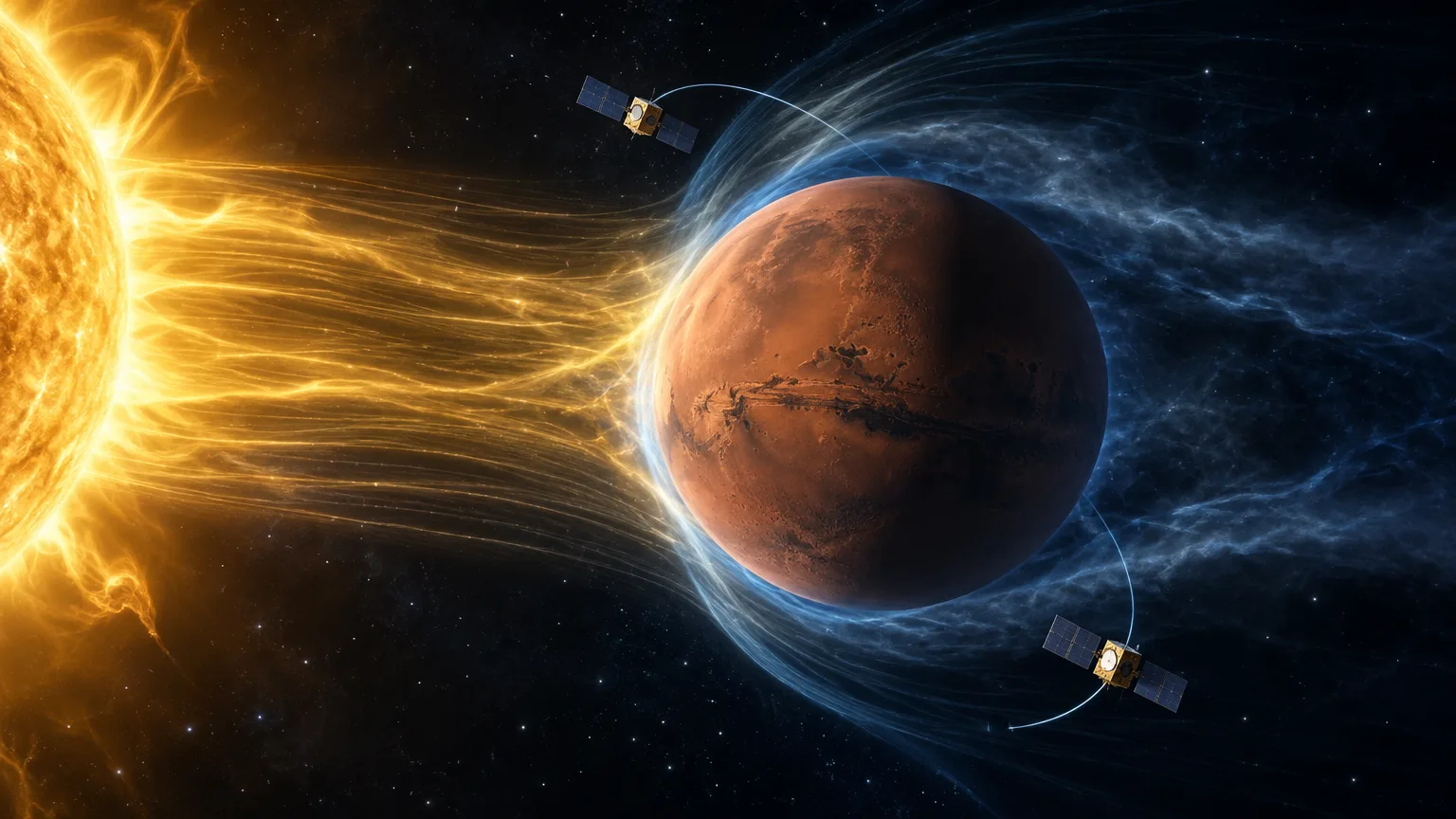
- ESCAPADE stands for Escape and Plasma Acceleration and Dynamics Explorers and consists of two orbiters roughly the size of a refrigerator.
- NASA says the mission launched on November 13 and will study Mars’s response to the solar wind in real time.
- The orbiters are expected to arrive in September 2027; the science mission would begin the following spring.
- NASA cites ancient river valleys, deltas, lake beds, and rocks and minerals formed in liquid water as evidence of Mars’s watery past.
- The Martian atmosphere is thin and consists mainly of carbon dioxide, nitrogen and argon.
- Mars does not currently have a global magnetic field; some areas of its southern crust preserve remnants of one from about 4 billion years ago.
Related records
ESCAPADE will study in real time how Mars responds to the solar wind. The NASA mission consists of two orbiters roughly the size of a refrigerator. Its name stands for Escape and Plasma Acceleration and Dynamics Explorers. On its Mars facts page, NASA says the mission launched on November 13 and expects the two orbiters to reach the planet in September 2027. The science mission would begin the following spring.
The agency’s stated goal is to study Mars’s response to the solar wind and help explain the planet’s climate history: how it went from a past with rivers, lakes and floods to the cold, dry desert we see today. Arrival and the start of science operations are planned milestones. The announcement describes the mission’s purpose and expected schedule; the observations that will inform its scientific work belong to the stage after arrival.
A mission to study Mars’s response
NASA presents ESCAPADE as a mission involving two twin satellites focused on the Martian response to the solar wind. Its objective links the study of the planet today with a broader question about its climate evolution. The mission will seek to observe that response in real time, and the agency says the work will help explain Mars’s transformation from a world with rivers, lakes and floods into today’s cold, dry environment.
The mission is part of NASA’s robotic planetary exploration program. The agency explains that its missions gather data to study how planets formed, what processes have occurred and remain active, and why worlds followed different evolutionary paths. In this context, ESCAPADE focuses on Mars and its response to the solar wind. Its scientific purpose should be distinguished from the geological evidence that already describes the planet’s past.
Signs of a watery past
The context for ESCAPADE is a Mars that, according to NASA, was much warmer and wetter billions of years ago and had a denser atmosphere. Among the signs of a watery past, the agency lists networks of river valleys, deltas and ancient lake beds. It also cites surface rocks and minerals that could only have formed in liquid water.
Some surface features suggest that Mars experienced major floods about 3.5 billion years ago. These traces provide the geological context for the question that motivates the mission. ESCAPADE, by contrast, will study the planet’s response to the solar wind. NASA links this objective to understanding climate history, without presenting the orbiters’ future observations as results already obtained.
Mars today: atmosphere, water and magnetism
NASA describes present-day Mars as a cold, desert world with a very thin atmosphere composed mainly of carbon dioxide, nitrogen and argon. That atmosphere is too thin for liquid water to remain on the surface for long. The agency says water is now present as ice beneath the surface of the polar regions and as briny water that flows seasonally down some slopes and crater walls.
The planet does not currently have a global magnetic field. However, some areas of the crust in the southern hemisphere are highly magnetized, indicating remnants of a field from about 4 billion years ago. These data describe present-day features and signs of Mars’s past; NASA presents the study of the response to the solar wind as a way to help explain its climate history.
ESCAPADE’s planned schedule
NASA’s facts page says the mission launched on November 13 and sets September 2027 as the expected arrival date for the orbiters at Mars. The science mission is scheduled to begin the following spring. The announced sequence therefore distinguishes the launch already recorded by the agency, the future arrival at the planet and the subsequent start of scientific work.
The schedule is a forecast, while NASA’s stated objective is to study the Martian response to the solar wind in real time. The agency connects that study with the planet’s climate history and with the contrast between evidence of an ancient Mars with water and today’s cold, dry conditions. In line with that purpose and the stated schedule, the mission will provide observations of the Martian environment.
Sources: NASA Science: Mars facts and NASA Science: planetary science.