

Key facts
- SAM aboard Curiosity analyzed Mary Anning 3, roughly 3.5-billion-year-old clay-rich sandstone from the Knockfarrill Hill member, Glen Torridon, Gale crater.
- The experiment used 25% TMAH in methanol and combined hydrolysis, pyrolysis of up to 550 °C and methylation.
- Products were studied using evolved gas analysis (EGA) and gas chromatography–mass spectrometry (GC-MS).
- The paper reports more than 20 organic molecules; seven stood out in the GC-MS data: trimethylbenzene, tetramethylbenzene, methyl benzoate, dihydronaphthalene, naphthalene, benzothiophene and methylnaphthalene.
- Retention-time comparisons confirmed six of those molecules; methylnaphthalene remained a tentative identification.
- Thirty chromatographic peaks were associated with one or more molecules, but the remaining identities were not confirmed by retention times.
- Laboratory tests attributed the loss of the nonanoic acid internal standard to venting during EGA sampling; pyrene could not be detected because of the columns’ heating ranges.
Related records
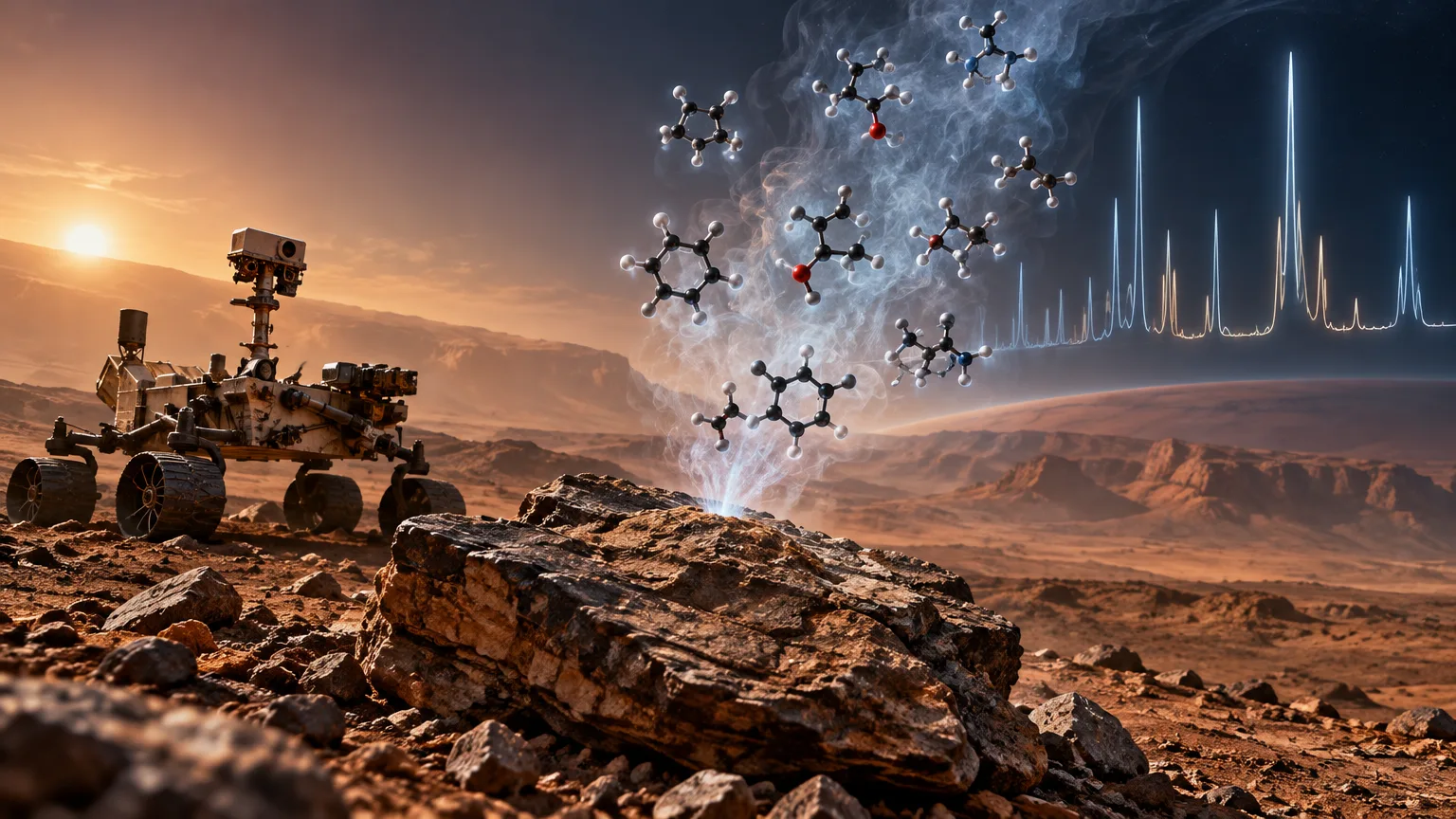
NASA’s Curiosity rover analyzed a Martian rock sample containing more than 20 organic molecules, according to a study of the first in situ thermochemolysis experiment with tetramethylammonium hydroxide (TMAH) on a planetary body. The sample, Mary Anning 3, was roughly 3.5-billion-year-old clay-rich sandstone from the Knockfarrill Hill member, in Glen Torridon, a region of Gale crater.
The analysis used the SAM (Sample Analysis at Mars) instrument suite aboard Curiosity. By combining a chemical reagent, heat and two gas-analysis methods, the team released and detected compounds from the rock. The study distinguishes between seven molecules present in the experiment data and the broader set of signals: laboratory comparisons confirmed six identifications, while the seventh, methylnaphthalene, was considered tentative.
A sample from ancient lake and river environments
Mary Anning 3 comes from clay-rich deposits that researchers associate with ancient lake environments. The cross-bedded sandstones of Knockfarrill Hill also indicate a transition toward higher-energy river conditions. The mineralogy of these clays is dominated by dioctahedral smectites and iron-rich dioctahedral clays. The paper notes that smectites in particular can provide favorable conditions for concentrating and preserving organic matter.
Curiosity drilled and analyzed the Mary Anning 3 target on sol 2879, the unit the mission uses to count Martian days. The location matters to this analysis because the clay-rich rock may have preserved organic matter either free or incorporated into macromolecular structures. The authors interpret the experiment as having released molecules preserved in the rock despite roughly 3.5 billion years of diagenesis—the changes sediments undergo after deposition—and exposure to radiation.
How SAM’s wet chemistry works
The experimental cup contained 25% TMAH in methanol. This strongly alkaline reagent can hydrolyze organic matter that is free or bound to mineral surfaces. The procedure also used thermal cracking, with pyrolysis of up to 550 °C, and methylation. This generated volatile organic fragments that could be sent for gas analysis.
The products were measured in two ways. In evolved gas analysis (EGA), the mass spectrometer continuously recorded the overall composition of the gases during heating. For gas chromatography–mass spectrometry (GC-MS), gases were periodically collected in a hydrocarbon trap; they were then released with heat and separated on two chromatographic columns, which were analyzed consecutively. Chromatography helps separate mixture components, while mass spectrometry provides information for identifying them.
EGA showed signals from high-molecular-weight molecules, with ions of up to 537 in mass-to-charge ratio. There was also a complex signal associated with detector saturation by ions such as those of trimethylamine, a product of TMAH decomposition. The team used these measurements and GC-MS together to assess the compounds, since they provided different types of information.
Seven notable molecules, with different levels of confirmation
Seven molecules appeared in the TMAH experiment’s GC-MS data but not in the cleaning analyses carried out before and after the sample analysis: trimethylbenzene, tetramethylbenzene, methyl benzoate, dihydronaphthalene, naphthalene, benzothiophene and methylnaphthalene. The products described also include aromatic molecules with one and two rings. Benzothiophene contains carbon and sulfur; methyl benzoate is an ester of benzoic acid.
To check some identifications, the team compared SAM results with retention-time tests using a similar laboratory instrument. Those comparisons confirmed six compounds: trimethylbenzene, tetramethylbenzene, methyl benzoate, dihydronaphthalene, naphthalene and benzothiophene. Methylnaphthalene remained a tentative identification.
The study also describes 30 chromatographic peaks associated with one or more molecules. The identities of the remaining signals could not be confirmed by retention-time analysis; the mass spectra allowed possible identities to be proposed, but not verified by that criterion. Therefore, the count of more than 20 molecules should be read alongside this distinction between signals, notable identifications and levels of confirmation.
Controls and instrumental limitations
The cup contained control substances: 1-fluoronaphthalene and pyrene as recovery standards, and nonanoic acid as an internal standard. Detection of 1-fluoronaphthalene and trimethylamine confirmed that the cup had been punctured and the reagent heated. By contrast, neither nonanoic acid nor its expected methyl ester was detected. According to laboratory tests described by the authors, venting gases during periodic EGA sampling caused this standard to be lost. The team attributed this to the experimental design and SAM’s valve configuration.
Pyrene could not be detected in this test either: its elution lay outside the heating range of one column, and the other stopped being heated before the compound could reach the detector. These conditions limit which controls and signals could be measured and help define the scope of the experiment; they do not invalidate the identifications that were checked against the stated criteria.
What the result allows us to conclude
The methodological finding is that TMAH could release a range of organic products from ancient Martian sandstone and make them analyzable by SAM. The authors consider that some of these compounds had been preserved in the rock as free or macromolecular organic matter. The evidence presented concerns the presence and preservation of compounds, not their origin: the study itself raises both an exogenous origin—for example, meteorites, comets or interplanetary dust—and an endogenous, abiotic or biological origin as possibilities.
Therefore, detection alone does not resolve how the molecules formed. It does provide practical information for interpreting Martian organic matter and optimizing future TMAH experiments, including those planned for instruments on the Rosalind Franklin Mars mission and Dragonfly to Titan. The value of the test lies in having tried on Mars a technique capable of revealing compounds that may be trapped in or incorporated into ancient rock materials.
The study was published in Nature Communications. Read the scientific paper.