

Key facts
- ESO reported on March 24, 2026, that two planets are forming in the disk of the young star WISPIT 2.
- The team had previously detected one planet and confirmed a second with ESO telescopes.
- ESO also reported observations of hot minerals beginning to solidify—the first specks of planet-forming material.
- NASA summarizes the Solar System as having eight planets and says its planetary science examines the system’s origin and evolution.
Related records
Two planets forming around a young star
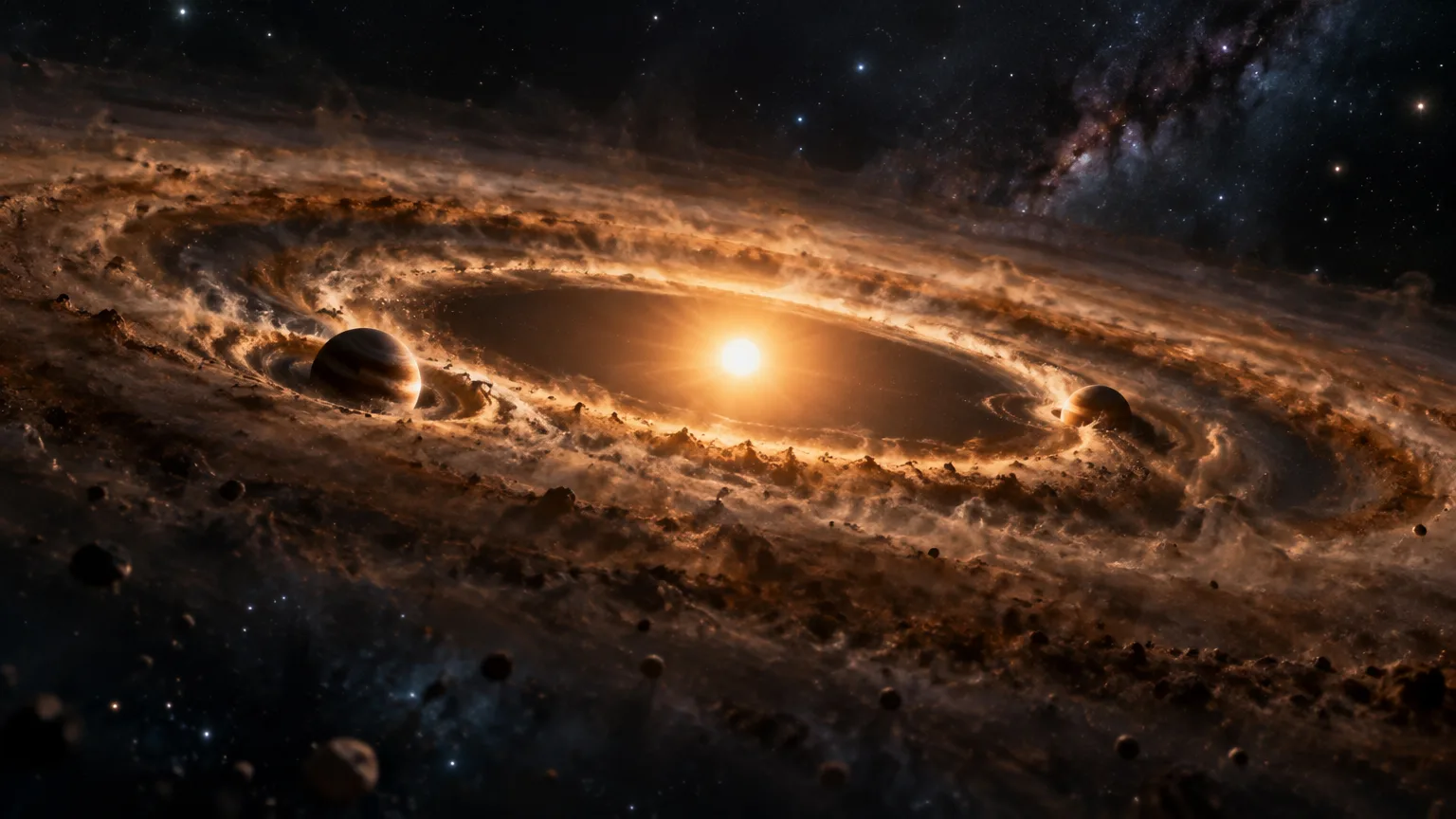
On March 24, 2026, the European Southern Observatory (ESO) reported that astronomers had observed two planets forming in the disk around a young star called WISPIT 2. According to ESO’s published summary, the team had previously detected one of the planets and subsequently used the organization’s telescopes to confirm the presence of a second.
The result matters because it places the observation in the environment where planet formation unfolds: a disk associated with a young star. Rather than concerning only an already established planet, the announcement explicitly refers to worlds in formation. This is an important distinction for planetary science, whose aims include understanding the origin and evolution of systems.
ESO is an astronomical organization that operates telescopes and communicates research results. In this case, the information provided identifies WISPIT 2, its surrounding disk, and confirmation of a second planet as the central elements of the finding.
What the announcement adds—and what it cannot establish
The available evidence supports saying that ESO describes two planets forming in WISPIT 2’s disk and that the second presence was confirmed with ESO telescopes. However, the supplied material does not specify their masses, sizes, orbits, compositions, or ages. Nor does it detail which specific instruments took part in the confirmation or how their properties were derived.
It would therefore be premature to equate these objects with particular Solar System planets or to conclude that WISPIT 2 will evolve in a given way. The existence of two forming planets does not, by itself, establish how many bodies will ultimately belong to the system or what its final configuration will be. The news provides an observation and a confirmation, not a complete biography of the system.
From the first minerals to planets
Another ESO communication helps place the finding within a broader sequence. Using ALMA—a telescope in which ESO is a partner—and the James Webb Space Telescope, researchers observed the creation of the first specks of planet-forming material: hot minerals just beginning to solidify. ESO described that result as the first identification of a planetary system at such an early stage of formation.
The two news items do not necessarily describe the same system or the same evolutionary moment. That is precisely why they complement each other: one concerns initial mineral particles, and the other two planets forming in a disk. Together, they illustrate how research can study different stages without a single observation covering the entire process. ESO also says the mineral finding opens a window onto the past of our own Solar System.
The Solar System as a reference, not a confirmed template
Comparison with our cosmic neighborhood calls for caution. NASA summarizes the Solar System as having one star, eight planets, five dwarf planets, at least 290 moons, more than 1.3 million asteroids, and about 3,900 comets. That inventory shows the diversity of bodies a mature system can contain, but it does not demonstrate that WISPIT 2 will acquire a similar architecture.
It also helps explain why a forming planet is only part of a larger question. Moving from a young disk to a system like the Solar System involves bodies of many kinds as well as the central star. The supplied data do not describe that evolution for WISPIT 2; they only place its observation within the broader question of how planetary systems originate and change.
Missions, research, and scientific priorities
NASA defines planetary science as a field in which missions and research inform our understanding of the Solar System’s origin and evolution. The agency says its work is guided by recommendations from the National Academies’ Planetary Science and Astrobiology Decadal Survey 2023-2032. A decadal survey of this kind sets recommendations for priorities over a decade; in the available description, NASA presents it as guidance for its missions and research.
NASA pages also compile a Solar System inventory and news from missions and research. Those sources provide useful institutional context, but the references supplied do not connect a specific NASA mission to the WISPIT 2 finding. The confirmation reported for that system belongs to ESO’s announcement.
Uncertainties and the next informational step
The value of these observations lies in documenting difficult-to-study stages, not in settling the debate about planetary origins. Basic aspects of WISPIT 2 remain open in the evidence available here: the physical characteristics of both planets, their orbital relationship, the disk’s contents, and its future evolution. No quantitative comparison with Earth, Jupiter, or other Solar System worlds is provided either.
The most robust conclusion is limited: ESO reported the observation of two planets forming around WISPIT 2 after confirming a second planet, and other ESO-associated observations have detected minerals beginning to solidify at an even earlier stage. They are pieces of evidence about the birth of planetary systems, not a definitive account of how any one of them will end.
Sources: ESO news releases; observation of planet-forming material; NASA Solar System exploration; NASA planetary science.