

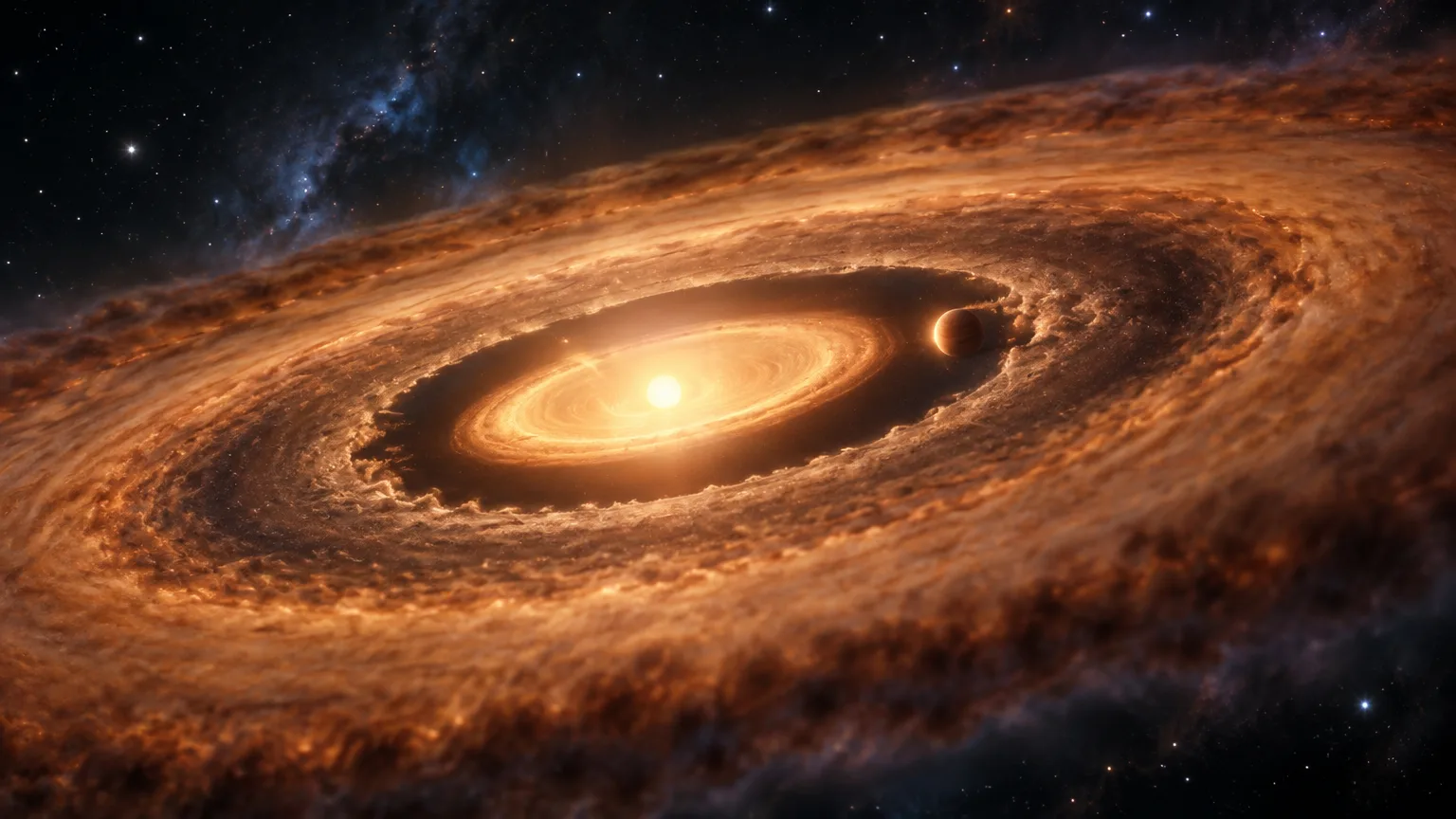
Key facts
- The paper by Andrea Bernardi and ten co-authors was published on September 16, 2026, in The Astrophysical Journal Letters; DOI: 10.3847/2041-8213/ae9bb6.
- High-contrast observations of seven stars were obtained with the Keck/NIRC2 vortex coronagraph between May and June 2018.
- The study confirms the previously proposed planetary candidate Elias 2-24 b inside a narrow gap in its protoplanetary disk.
- The reported separation is 394 ± 31 milliarcseconds, equivalent to 54.9 ± 4.3 astronomical units.
- The inferred mass is 1.9–4 Jupiter masses, based on photometry compared with one-million-year isochrones; the calculation does not include accretion effects.
- The authors assign the planet an age of one million years or less and describe it as the youngest exoplanet discovered as of the study’s publication date.
Related records
The scientific paper confirming Elias 2-24 b is Searching for Embedded Protoplanets with the Keck/NIRC2 Vortex Coronagraph: Confirmation of a Core-accretion Planet in the Narrow Gap of the Elias 2-24 Disk. Andrea Bernardi, Alice Zurlo, Lucas A. Cieza, Garreth Ruane, Valentin Christiaens, Anuroop Dasgupta, Greta Guidi, Dimitri Mawet, Dino Mesa, Sebastián Pérez, and Jonathan P. Williams published it on September 16, 2026, in The Astrophysical Journal Letters. The paper’s DOI is 10.3847/2041-8213/ae9bb6.
The main result is the confirmation of Elias 2-24 b, a previously proposed planetary candidate, in a narrow gap in the protoplanetary disk surrounding the star Elias 2-24. The authors estimate that the planet has between 1.9 and 4 Jupiter masses. This figure comes from comparing photometry obtained from the observations with evolutionary models for an age of one million years; it is not a direct measurement of the planet’s mass and, the authors caution, does not include accretion effects.
The search across seven stars
The team presents high-contrast images of seven stars, taken between May and June 2018 with the vortex coronagraph on the Keck/NIRC2 instrument. The targets have protoplanetary disks with structures—such as gaps and cavities—that could be related to planet formation. The survey was guided by the question of whether planets embedded in those disks could be directly detected.
Keck/NIRC2 is the instrument used to obtain the images; the vortex coronagraph helps study the regions close to bright stars. To process the data, the researchers used their own pipeline based on the Python package VIP. They applied angular and reference differential imaging techniques, combined with principal component analysis, and calculated 5σ contrast curves and detection limits for the targets.
A candidate in the disk gap
The study places Elias 2-24 b at an angular separation of 394 ± 31 milliarcseconds, corresponding to 54.9 ± 4.3 astronomical units according to the paper. The authors locate it inside the narrow gap in the protoplanetary disk. The result confirms a candidate that had already been proposed in the scientific literature; it is not a detection reported without prior indications.
Previous observations provide useful context for understanding the significance of the result. The paper notes that the confirmation is consistent with detections reported by earlier studies. In addition, a W. M. Keck Observatory release published on September 16, 2026, describes the combination of Keck observations with independent observations from the Very Large Telescope (VLT) and complementary evidence from ALMA, the Atacama Large Millimeter/submillimeter Array. A NASA Science article published on September 29, meanwhile, explains that ALMA had shown a gap in the disk and that the VLT had detected a faint source in that region. These earlier findings provide context; the result presented in Bernardi and colleagues’ paper is the confirmation based on the study of the Keck/NIRC2 observations.
How the mass is estimated
To calculate the mass, the team compared photometry derived from the observations with isochrones—models that relate an object’s observable properties to its evolution—for an age of one million years. This comparison yields a range of 1.9–4 Jupiter masses. The estimate is therefore an inference dependent on those models and the photometry, not a dynamical determination described in the study’s abstract.
There is an explicit condition for interpreting this range: the authors did not incorporate accretion effects, meaning the planet’s growth through the accumulation of material. The paper says that the estimate is consistent with other estimates that take into account the properties of the gap and interactions between the planet and the disk. This agreement connects different approaches to estimating mass, but the caveat about accretion remains part of the result.
Age and scope of the confirmation
The authors state that Elias 2-24 b is one million years old or younger and describe it as the youngest exoplanet discovered as of the study’s publication date. An exoplanet is a planet that orbits a star other than the Sun. Its age places it at an early stage of planet formation, while it remains associated with its host star’s disk.
The team links the confirmation to questions about the timescales of planet formation and the origin of gaps observed in very young disks. The survey sought planets embedded in disks whose substructures could be signs of planet formation; in the case of Elias 2-24 b, it reports the object’s location within a gap. The object’s position and association with that structure are results of the study; the mass estimate, by contrast, retains the qualifications of the photometric method described.
The paper and its key data
The study brings together high-contrast observations of seven stars, image analysis, and characterization of the Elias 2-24 b candidate. The confirmation provides a case for studying a very young planet inside a protoplanetary disk and examining the relationship between planets and disk structures. The paper highlights implications for understanding planet formation while specifying the conditions attached to its mass estimate.
- Authors: Andrea Bernardi, Alice Zurlo, Lucas A. Cieza, Garreth Ruane, Valentin Christiaens, Anuroop Dasgupta, Greta Guidi, Dimitri Mawet, Dino Mesa, Sebastián Pérez, and Jonathan P. Williams.
- Publication: The Astrophysical Journal Letters, September 16, 2026.
- DOI: 10.3847/2041-8213/ae9bb6.
- Reported separation: 394 ± 31 milliarcseconds, equivalent in the paper to 54.9 ± 4.3 astronomical units.
- Inferred mass: 1.9–4 Jupiter masses, based on photometry compared with one-million-year isochrones, without incorporating accretion effects.