

Key facts
- The scientific paper and NASA JPL’s account were published on January 26, 2026.
- The map covers 0.77° × 0.70° of the COSMOS field in the constellation Sextans.
- Webb observed the region for about 255 hours and identified nearly 800,000 galaxies.
- Researchers measured the shapes of 129 galaxies per square arcminute; the reported angular resolution is 1.00 ± 0.01 arcminutes.
- The map traces mass features to z ≈ 2 and mentions a more distant structure at z ≈ 1.1.
- Ordinary matter accounts for about one-sixth of all matter in the universe, according to the paper.
Related records
Ordinary matter—including particles such as protons and neutrons—accounts for about one-sixth of all matter in the universe; the rest is dark matter, according to the paper published in Nature Astronomy. Dark matter does not emit, reflect, absorb, or block light. Its presence is studied, among other ways, through its gravitational effect. The team’s map therefore is not a photograph of an invisible substance: it uses the deflection of light from distant galaxies caused by mass between those galaxies and Earth.
A region observed by many telescopes
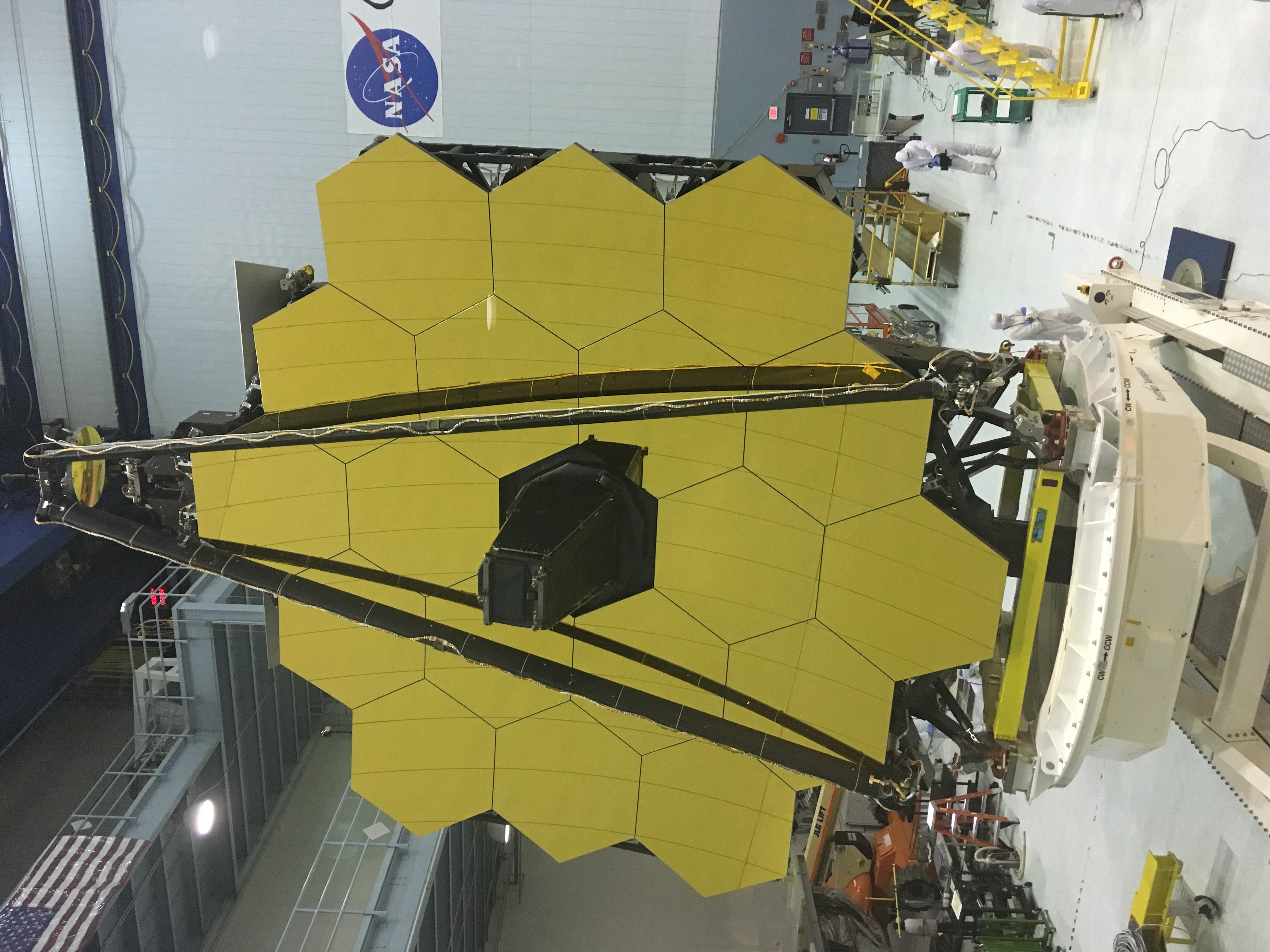
Information about the result was published on January 26, 2026: the scientific paper appeared that day, and NASA JPL released an account of the work. The research uses images from the James Webb Space Telescope, an international mission led by NASA with the European Space Agency and the Canadian Space Agency. The map covers 0.77° × 0.70° within the COSMOS field, in the constellation Sextans. The full region described by JPL is about 2.5 times the size of the full Moon.
At least 15 ground- and space-based telescopes have observed this region for the COSMOS survey. JPL describes the goal as precisely measuring where ordinary matter is and comparing its distribution with that of dark matter. Webb observed the area for about 255 hours and identified nearly 800,000 galaxies, some for the first time.
From bent light to a mass map
The team used weak gravitational lensing: it measured how intervening mass curves space and deflects toward Earth the light from distant galaxies. The distortion in that light makes it possible to infer the distribution of foreground mass. By studying many galaxies, the researchers built a mass map that includes dark matter; it is not a direct optical detection of that matter.
The paper reports measurements of the shapes of 129 galaxies per square arcminute, with independent measurements for many of them in the F115W and F150W bands. Based on this analysis, the authors report an angular resolution of 1.00 ± 0.01 arcminutes. The paper and NASA describe the map’s resolution as more than twice that of earlier maps of the same region made with the Hubble Space Telescope.
Webb’s sensitivity made it possible to include about ten times as many galaxies as maps of the area made with ground-based observatories and twice as many as Hubble’s map. To refine distance measurements for many galaxies, the team also used Webb’s MIRI instrument along with observations from other ground- and space-based telescopes. MIRI detects mid-infrared wavelengths; according to JPL, those wavelengths also make it effective at detecting galaxies obscured by cosmic dust clouds.
Filaments, clusters, and ordinary matter
The map shows dense regions of dark matter connected by lower-density filaments, forming a web-like structure known as the cosmic web. Ordinary matter, including galaxies, tends to follow that structure. The paper describes mass features out to a redshift of z ≈ 2 and mentions a structure identified as the most distant at z ≈ 1.1.
The spatial overlap between dark matter and ordinary matter is one of the study’s central observations. The authors interpret this correspondence as evidence of a gravitational relationship: dark matter’s gravity would pull ordinary matter toward the same regions. In JPL’s account, scientists think dark matter may have begun clumping first, with those clumps then pulling ordinary matter together into regions containing enough material for stars and galaxies to begin forming. The map provides a high-resolution benchmark for testing theories about dark matter and the formation of large-scale cosmic structure.
What the map adds—and what remains undetermined
The result offers new detail about the distribution of matter in this region and the overlap between its dark and luminous components. It does not identify the particles that make up dark matter or directly determine its nature. This is a reconstruction using weak gravitational lensing: interpreting it relies on the deflection of light from galaxies and the measurements used to make the map. The result therefore allows researchers to study the distribution and the observed gravitational relationship, but it is not an identification of dark matter.
JPL also described the Nancy Grace Roman Space Telescope as a future mission that would map dark matter over an area 4,400 times larger than COSMOS. According to the same account, its maps would not exceed Webb’s spatial resolution. In this case, the comparison illustrates the different coverage of the two projects: Webb’s map details a bounded region, while Roman is planned to study a much larger area. These are not measurements of the same area at an identical level of detail, but projects described with different coverage.
The map’s importance lies in specifying how invisible mass is distributed in the studied field and where it lies relative to ordinary matter. Webb has not made dark matter visible; it has made it possible to trace its gravitational effects in greater detail in a region already observed by multiple telescopes.