

Key facts
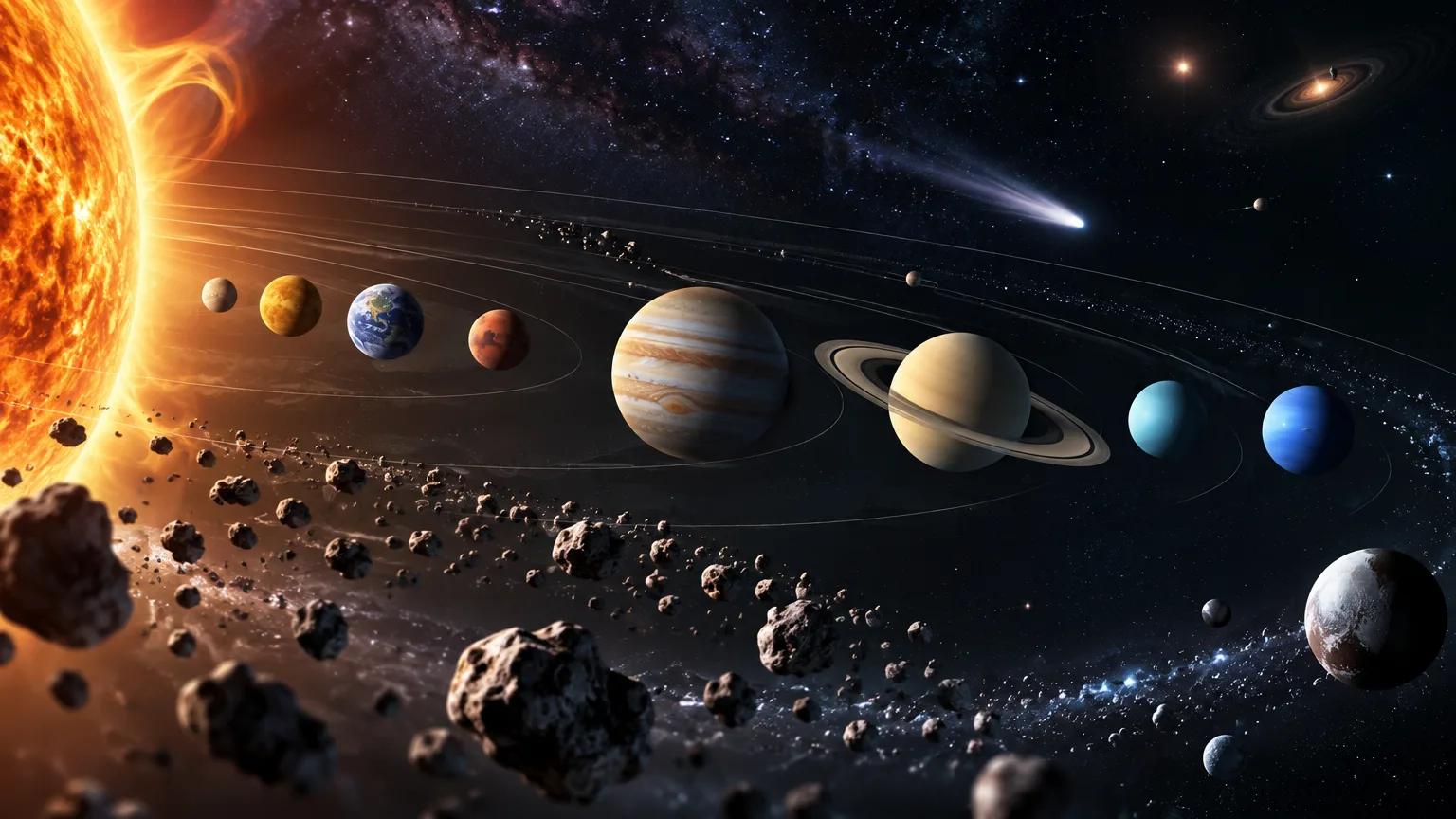
- NASA lists one star, eight planets, five dwarf planets, at least 290 moons, more than 1.3 million asteroids and about 3,900 comets.
- IMAP launched on September 24, 2025, to help study the heliosphere’s boundary.
- NASA Science says the Parker Solar Probe was the first spacecraft to fly through the solar corona.
- NASA’s astronomy page attributes a change in Didymos’s orbit around the Sun to DART.
- On March 24, 2026, ESO reported two forming planets in the disc around the young star WISPIT 2, outside the solar system.
Related records
The solar system is often pictured as a star surrounded by planets, but that image leaves out much of its variety. NASA summarizes its known inventory as one star, eight planets, five dwarf planets, at least 290 moons, more than 1.3 million asteroids and about 3,900 comets. These are figures from the agency’s Solar System Exploration page; they should not be read as a permanent final count. Objects are discovered, observed more closely and can be reclassified as their characteristics become better understood.
This inventory includes very different kinds of bodies. Planets are the major worlds orbiting the Sun; dwarf planets and smaller bodies are also part of the system, though they are not interchangeable categories. Moons orbit planets or other bodies, while asteroids and comets travel around the Sun. Together, they provide the setting for missions studying different parts of the system.
More than a collection of planets
One useful way to broaden the picture is to consider the environment created by the Sun itself. The heliosphere is a huge bubble created by the solar wind and, according to NASA Science, surrounds and protects our solar system. It is not a solid wall: it is a region of solar influence whose boundary and properties are still being investigated. Studying it helps describe how far the Sun’s environment extends, although the available sources do not specify the exact shape of that boundary or how it changes.
NASA’s IMAP mission is intended to help researchers better understand the boundary of the heliosphere. The information provided says the spacecraft launched on September 24, 2025. This separates the concrete event—the launch—from the scientific goal of studying a boundary that remains under investigation. The description provides no IMAP results, so it would be inaccurate to present any question about that boundary as settled.
The Sun as a place of investigation
The Sun is not only the gravitational centre of the system; it is also an active star whose outer atmosphere can be studied up close. NASA Science says the Parker Solar Probe was the first spacecraft to fly through the solar corona. The corona is the outermost layer of the Sun’s atmosphere. The milestone establishes that a spacecraft reached that region; by itself, it does not explain which solar processes were measured or what specific conclusions followed.
The difference between exploring the Sun and observing it from a distance matters. Parker approached the corona, while the James Webb Space Telescope studies astronomical objects with its observing instruments. A NASA news item notes that tiny dust could yield important answers under Webb’s gaze, but the information available does not specify which dust, object or result was involved. It is therefore reasonable to describe this as a line of research, not to assign it a particular discovery.
Asteroids: orbits can change too
Asteroids are part of the solar system’s inventory and can also be targets for planetary-defence experiments. NASA’s astronomy page presents a change in the orbit of the asteroid Didymos around the Sun as a result of the DART mission. This wording supports saying that NASA attributes an orbital change to DART, but the evidence collected here does not explain how the change was measured, how long it lasted or exactly what mechanism produced it.
The distinction matters: a webpage headline is not a substitute for the details of a scientific report. At the level supported by this evidence, DART shows that a space mission can study an asteroid’s orbital response. On its own, it does not provide enough information to claim that all asteroids can be deflected in the same way or that a specific threat to Earth exists.
Other star systems as context
The search for worlds is not limited to the solar system. The European Southern Observatory (ESO) reported on its press page, dated March 24, 2026, that astronomers had observed two planets forming in the disc around the young star WISPIT 2. This is a system distinct from our own. The finding described offers an example of planet formation beyond the solar system, but the supplied evidence does not detail the methods, the planets’ properties or the direct comparisons that can be made with our neighbourhood.
Such observations broaden the context: the solar system is one example of a planetary system, not the only environment that can be studied. Even so, a result about WISPIT 2 should not be presented as the discovery of a new solar-system planet or as proof that all systems form in the same way.
What we know, and what remains open
The available sources support a broad overview: a system with a wide diversity of objects; a heliosphere boundary that IMAP is studying; a probe that crossed the solar corona; and a DART mission that NASA associates with an orbital change for Didymos. They also point to Webb research on dust and observations of planets forming around WISPIT 2. They do not provide enough detail to reconstruct the full methods or results of these investigations.
It is therefore important to distinguish published counts, mission milestones and open questions. The number of known bodies can change; the heliosphere’s boundary remains under study; and headlines about DART or Webb are not enough to quantify results. The solar system is understood through complementary observations and missions, but each claim must stay within what the sources allow us to verify.