

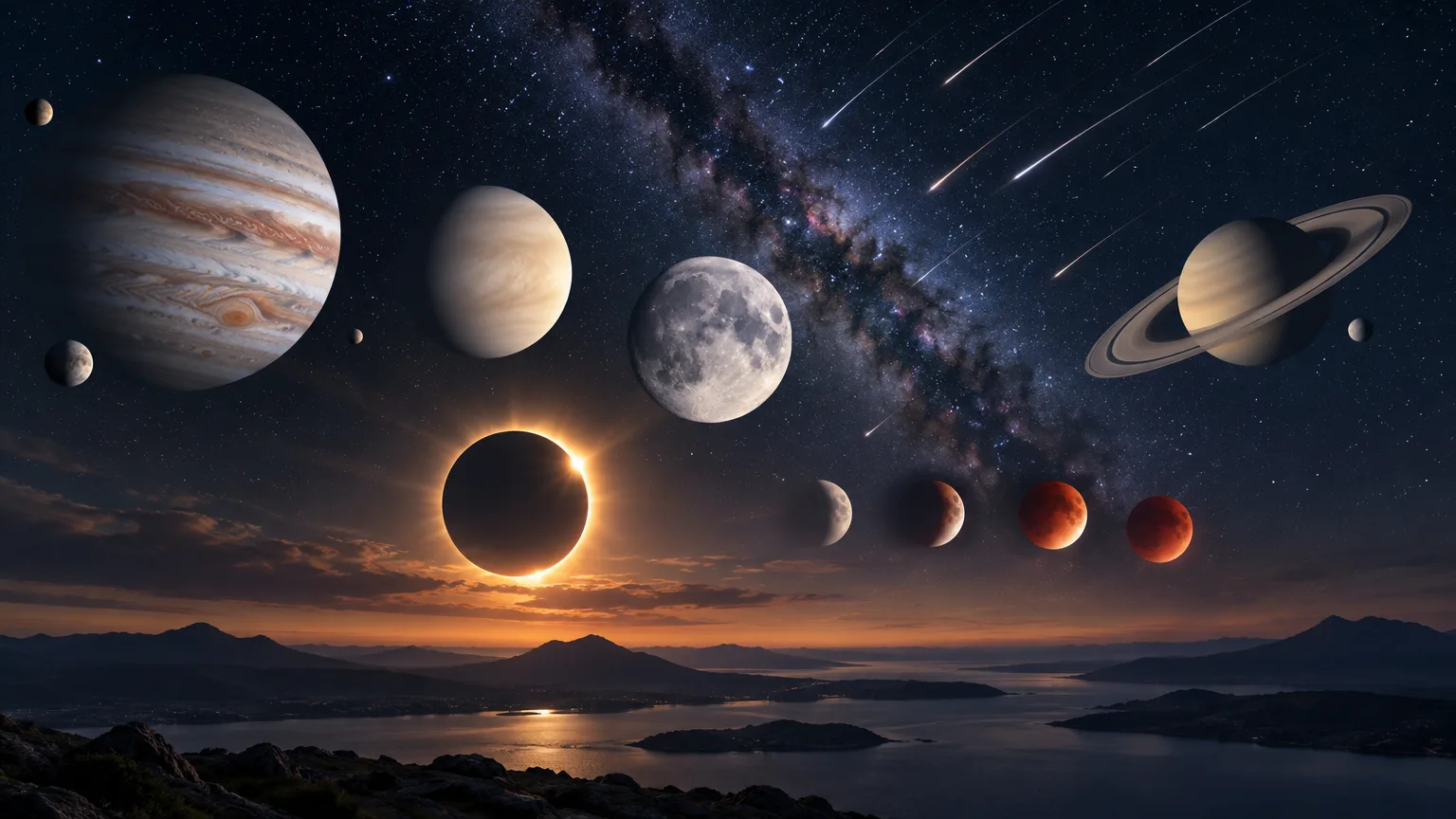
Key facts
- NASA forecasts two solar eclipses and two lunar eclipses in 2026.
- In January, Jupiter will be at its largest and brightest for the year; the guide also highlights the Moon near Saturn and the Beehive Cluster, or Praesepe.
- A June occultation of Venus by the Moon will be visible from some areas of the contiguous United States, Canada, Brazil and Venezuela; elsewhere, observers may see an apparent close pairing.
- Before sunrise on July 11 and 12, NASA recommends looking east for the Moon aligned with some planets.
- The Perseids are expected to peak from the night of August 12 into the early morning of August 13 in the Northern Hemisphere.
- NASA’s August guide also highlights Venus after sunset, a solar eclipse and a deep partial lunar eclipse.
Related records
NASA’s 2026 skywatching recommendations bring together events spread throughout the year: prominent planets, apparent encounters between the Moon and other objects, a meteor shower and eclipses. They are not a single schedule giving universal times for every observer. Whether an event can be seen depends on where the observer is, according to the information available, and several summaries do not specify dates or times. The guidance below is therefore a general overview, not a guarantee of local visibility.
A year with four eclipses, but not all visible from the same place
NASA’s eclipse catalog says that two solar eclipses and two lunar eclipses will occur in 2026. That figure covers the year as a whole: it does not mean all four will be visible from one country, or that they will share the same duration or characteristics. The supplied information does not provide their dates, paths or viewing regions here, so those details should not be assumed.
Among the events highlighted for August, NASA Science mentions a solar eclipse and a deep partial lunar eclipse. The summary does not say which parts of the world will be able to see them or give an exact date for either eclipse. It is important, then, to distinguish the events’ appearance in the month’s guide from the practical possibility of seeing them from a particular location.
January: Jupiter and two other targets
For January, NASA notes that Jupiter will be at its largest and brightest for the year. This compares it with the rest of 2026, but the summary gives no precise time or detailed instructions for finding it. The same guide suggests watching a pairing of the Moon and Saturn, as well as the Beehive Cluster, also called Praesepe.
These three targets show that the guide is not limited to exceptional events such as eclipses: it also includes planets and a star cluster that the guide says will be visible that month. The available source does not specify the nights or sky conditions, so the exact observing dates should be checked in the relevant monthly guide.
June and July: the Moon near Venus and other planets
For June, NASA describes an occultation of Venus by the Moon. To observers within the right viewing path, Venus will appear to disappear behind our natural satellite and then reappear. The event will be visible from some areas of the contiguous United States, Canada, Brazil and Venezuela. Outside the exact path, many observers may still see the Moon and Venus close together in the sky, but they will not see the occultation itself.
The June summary includes an important safety note, but the available text does not explain what it says. Based on this evidence, it is not possible to specify which precaution NASA recommends. The distinction between an occultation visible from a particular geographic path and an apparent close pairing seen from nearby areas also matters: seeing the two objects close together is not the same as seeing one pass behind the other.
For July, the specific recommendation is to look east before sunrise on July 11 and 12, when the Moon and some planets will appear aligned. The source excerpt does not identify those planets or give a universal time. It provides a general direction and time of day, while the details needed to plan a local observation must be checked in the original guide.
August: Perseids, Venus and eclipses
The Perseids are expected to peak from the night of August 12 into the early morning of August 13, according to NASA Science. The source describes them as a meteor shower lighting up the Northern Hemisphere sky. This peak interval is a guide to the shower’s activity, not a promise that the same number of meteors will be visible everywhere.
NASA’s English-language guide adds other highlights for the month: bright Venus after sunset, a solar eclipse and a deep partial lunar eclipse. The summary does not provide precise geographic visibility for these eclipses, nor does it establish that all the events occur on the same night. Taken together, it shows that August offers several different reasons to observe, with important differences between an event visible in a particular region and one that can be seen across a broader area.
How to read the calendar—and what still needs confirming
The dates and descriptions available do not amount to a complete calendar. January’s events are given by month, but not by specific nights; June’s occultation and general viewing regions are described without a date; and July has two named mornings, although the planets are not identified in the excerpt. For August, the Perseids’ peak interval is known, while the summaries do not spell out local eclipse visibility. NASA’s general reference confirms four eclipses during the year but does not, by itself, answer those observing questions.
The calendar is therefore best read as a selection of opportunities, not a complete forecast for every city. Before planning an observation, check the relevant NASA monthly page and confirm the date, time and visibility for the specific location. This is particularly important when an event depends on a particular geographic path or when a guide includes a safety note whose details are absent from the available summary.
The firmest conclusion is also the most cautious: 2026 includes eclipses, apparent alignments, prominent planets and the Perseids, but not every event will be observable from everywhere. The confirmed dates in these excerpts are limited; where details are missing, they should not be replaced with assumptions.