

Key facts
- NASA lists two solar eclipses and two lunar eclipses in 2026.
- NASA’s eclipse page uses Universal Time (UT), commonly called GMT.
- NASA highlights Mercury at its annual brightest, the Lyrid peak, and a bright comet for April.
- For June, NASA forecasts an apparent Venus occultation by the Moon visible from parts of the United States, Canada, Brazil, and Venezuela.
- The August summary mentions a solar eclipse, the Perseids, Venus after sunset, and a deep partial lunar eclipse.
Related records
Skywatching is not only about knowing that an event happens. An observer’s location, the rising or setting time of an object, weather, and any need for special protection all matter. The NASA sources assembled for 2026 outline a year of eclipses, visible planets, a meteor shower, and an announced comet. They also make one essential limit clear: a global calendar cannot replace information for a specific location.
What the 2026 calendar says
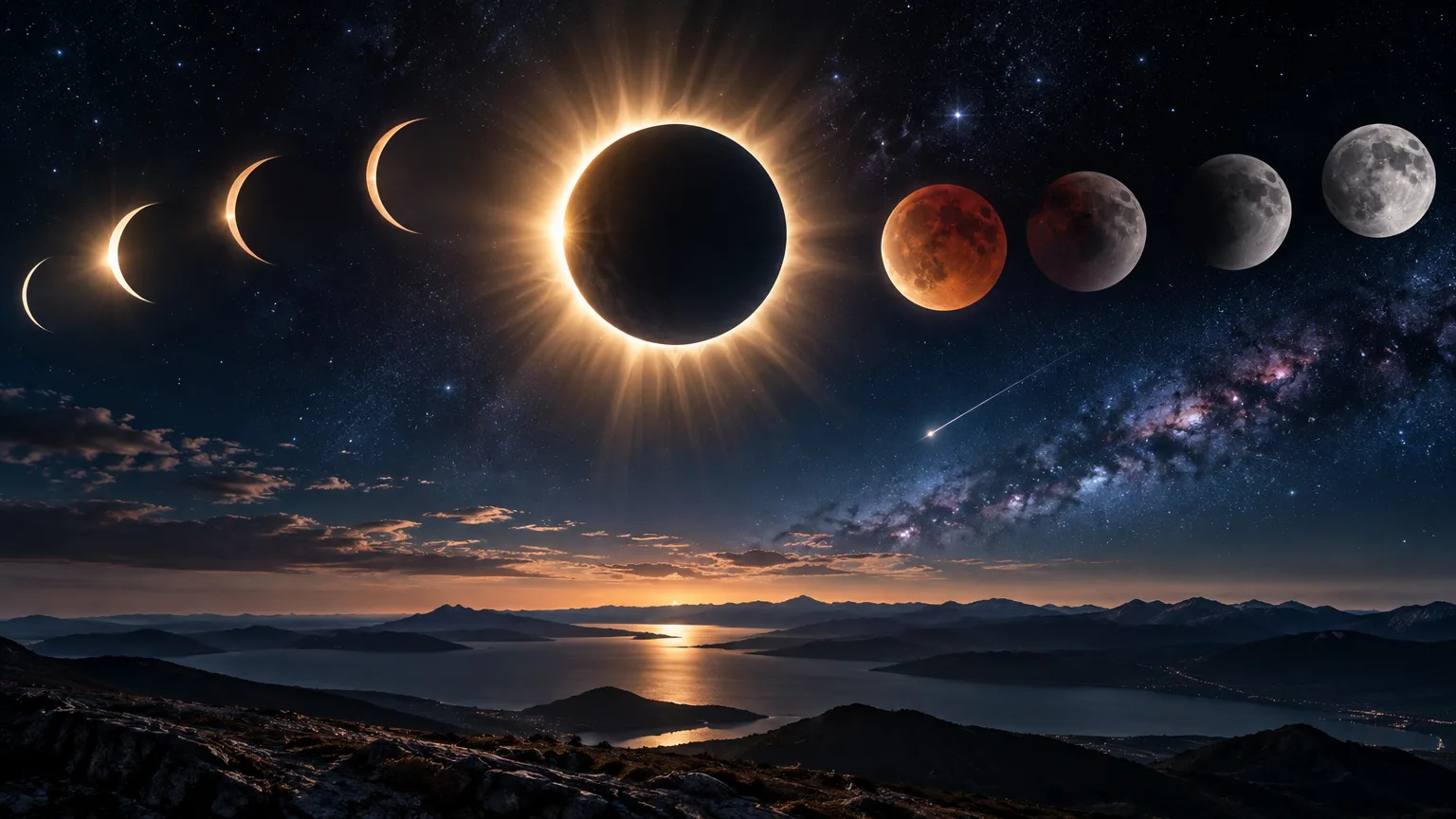
NASA’s page on 2026 eclipses lists two solar eclipses and two lunar eclipses during the year. The same source says that all of its dates and times are in Universal Time, or UT, an astronomical time system often called GMT. It is a shared reference for comparing events across countries, but it is not automatically each reader’s civil time.
A UT date must therefore be converted to local time before an observation is planned. Even after conversion, eclipse visibility depends on geographic position: inclusion in an annual calendar does not mean it can be seen from every region. The supplied evidence confirms the number of eclipses, but does not provide their individual dates, visibility bands, or local circumstances.
NASA’s monthly selections broaden the picture. Its April preview highlights Mercury at its brightest of the year, the peak of the Lyrid meteor shower, and a bright comet in the night sky. Its August summary brings together a solar eclipse, the Perseids, bright Venus after sunset, and a deep partial lunar eclipse. These references identify months of interest; they do not replace a detailed ephemeris.
April: Mercury, the Lyrids, and an announced comet
According to NASA’s April 2026 guide, Mercury will reach its greatest brightness of the year. Mercury is the planet closest to the Sun; because of that apparent proximity, observing it often requires attention to the exact time and direction in the sky. The source excerpt provides no date, time, or viewing location, so none should be inferred.
The same preview notes the Lyrids’ peak. A meteor shower is a period when more meteors than usual may be seen from a part of the sky associated, in perspective, with a constellation—in this case Lyra. “Peak” describes the expected high point of activity, not a guarantee of a particular meteor count for every observer. Cloud cover, light pollution, and the local horizon can strongly affect the experience, although the available evidence does not quantify those conditions.
NASA also announces the appearance of a bright comet in April’s night sky. “Bright” is the description in the preview, but the supplied material does not identify the object or establish its brightness, position, duration of visibility, or whether it can be seen without instruments. It should therefore be treated as something to follow through official updates, not as a promise of universal visibility.
June: the Moon and Venus, with a safety warning
NASA’s June guide says that, for viewers in the proper visibility path, Venus will appear to disappear behind the Moon and reappear later. The event will be visible from parts of the United States, Canada, Brazil, and Venezuela. Observationally, this is an apparent alignment: from certain parts of Earth, the Moon passes in front of Venus.
Outside the exact path, many skywatchers may still see a close apparent pairing of the Moon and Venus. That distinction matters: a close visual pairing is not necessarily the same as seeing Venus disappear and return. NASA accompanies the event with an important safety note. Since the supplied evidence does not reproduce its content, this guide must not replace the original source’s instructions or add undocumented rules.
August and September: a concentration of references
NASA’s August 2026 summary places a solar eclipse, the Perseids, bright Venus after sunset, and a deep partial lunar eclipse in the same month. The Perseids are a meteor shower; like any sky observation, the practical outcome will vary with location and actual sky conditions. The available text does not specify dates, times, viewing locations, or observing methods for these four items.
For September, NASA’s monthly page includes a sky chart looking east after sunset on September 26, 2026. That date describes the reference moment for the cited chart. Without more information in the evidence, it does not establish which objects the chart shows or extend that configuration to every latitude or time zone.
Using these references without confusing certainty and forecast
- Use UT as a starting point: NASA’s eclipse page gives dates and times in Universal Time; convert them to local time.
- Check geography: visibility may be limited to a path or to parts of countries, as with the June Moon-Venus event.
- Distinguish levels of detail: monthly summaries announce highlights, but the cited material does not contain every datum needed to plan each observation.
- Read the original warnings: especially when NASA explicitly flags a safety note.
The significance of 2026 is not limited to a list of events. NASA also notes that the Marshall Space Flight Center’s observatory marks 20 years in its modern era: the site began as an engine test facility in 1958, became a solar observatory in 1968, and was transformed into a lunar and meteor observatory in 2006. That history helps explain why observing calendars rely on institutions that study the sky continuously.