

Key facts
- The IPAC update of May 5, 2026, put launch no earlier than September 2027.
- NEO Surveyor will travel approximately 1.5 million kilometers toward the Sun to the Sun–Earth L1 point and is planned to survey large areas of the sky for at least five years.
- The camera will have two detector arrays; each can create a 16-megapixel mosaic. The instrument will observe in two infrared bands.
- Observations of the same region in both bands will allow the temperatures of asteroids and comets to be measured and their sizes estimated.
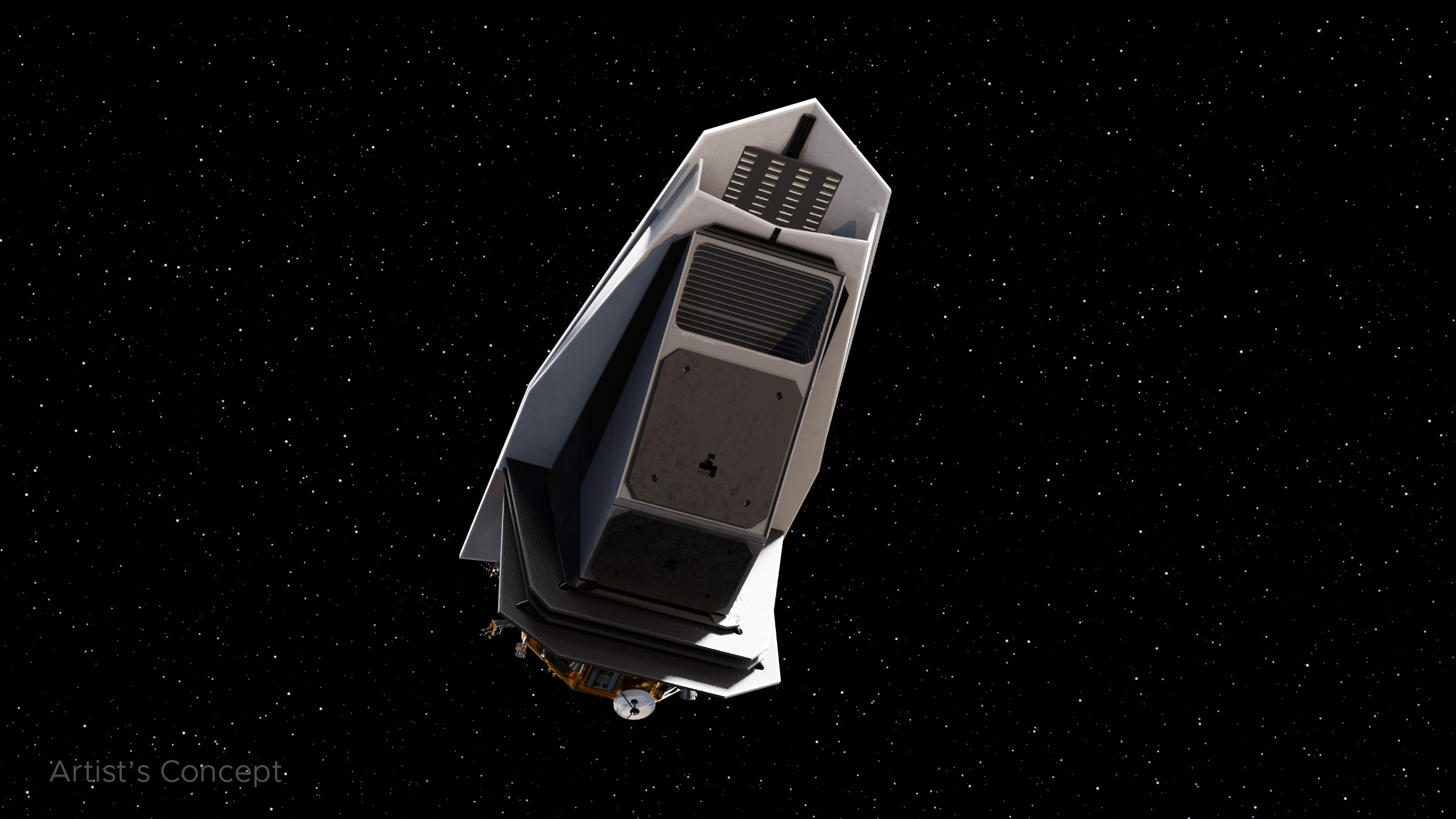
- The 3.7-meter instrument enclosure protects the telescope and removes heat. The six-meter sunshade will block sunlight glare, and its Sun-facing side will carry solar panels.
- IPAC will process and calibrate the observations and produce images and catalogs. After identifying moving objects, it will report the detections to the Minor Planet Center.
- UCLA will plan the survey and deliver measurements of the sizes and other physical properties of asteroids and comets to public archives every six months.
Related records
Near-Earth asteroids—called NEOs, short for near-Earth objects—and comets can be difficult to detect with ground-based optical telescopes. Some are small or dark; others lie in the Sun’s glare. NEO Surveyor, a NASA mission in development, is designed to search for them by observing the infrared radiation emitted by objects as they are warmed by sunlight. The IPAC update published May 5, 2026 reported that the mission was in the integration and testing phase, while teams prepared its science survey and data-processing software. Launch was planned for no earlier than September 2027.
Why observe in infrared
Ground-based optical surveys record sunlight reflected by celestial bodies. NEO Surveyor will use a different signal: the infrared glow of asteroids and comets warmed by the Sun. The mission was designed to search for objects that can be difficult to observe from Earth, including those that are dark or appear near the Sun’s glare. According to information from IPAC, in 2005 the U.S. Congress directed NASA to discover potentially hazardous near-Earth objects.
The camera will have two detector arrays, each capable of producing a 16-megapixel mosaic of the sky. The instrument will observe the same region in two infrared bands. Combining those observations will allow it to measure an asteroid’s or comet’s temperature and use that to estimate its size. These are properties the mission aims to obtain from the images, not measurements already made by NEO Surveyor.
Instruments and preflight testing
Heat control is part of the design because the telescope and its infrared detectors are sensitive to thermal conditions. The instrument enclosure, 3.7 meters long, protects the telescope and removes heat that could affect observations. According to the IPAC update, the telescope and enclosure, assembled at NASA’s Jet Propulsion Laboratory (JPL), were undergoing integration and testing at the Space Dynamics Laboratory (SDL) in Logan, Utah.
Engineers planned to test the camera’s focus at an SDL facility that simulates the extreme conditions of deep space. The tests were intended to verify that the instrument worked as designed and that the camera retained focus at very low temperatures and in zero gravity. The enclosure provides protection and thermal management; SDL is where tests reproducing those conditions are carried out.
The spacecraft will also have a six-meter sunshade. Its purpose is to block sunlight glare that would enter through the telescope aperture, allowing observations of regions near our star. The sunshade’s Sun-facing side will carry solar panels to generate electricity for the spacecraft’s systems. In the May 5, 2026, update, the sunshade was being tested alongside the main structure at BAE Systems Space & Mission Systems in Boulder, Colorado. IPAC said that, after testing at SDL, the integrated telescope and its enclosure were to be moved to BAE Systems to complete the spacecraft.
A multiyear survey from L1
After launch, NEO Surveyor will travel approximately 1.5 million kilometers from Earth toward the Sun, to the Sun–Earth Lagrange point L1. These points are regions associated with gravitational stability conditions between two bodies. From L1, the plan is to continuously survey large areas of the sky for at least five years, searching for NEOs that have not yet been discovered.
The spacecraft’s position and sunshade will allow it to observe regions near the Sun while the telescope searches for objects through their infrared radiation. As of May 2026, the science team was still working on the most efficient survey strategy. Amy Mainzer, the mission’s lead at the University of California, Los Angeles (UCLA), described a team whose members come from several institutions and have experience designing infrared missions. Science and observing plans were advancing alongside hardware integration and development of the processing software.
How the data will flow
After observations, the data will be sent to Earth through NASA’s Deep Space Network. They will reach the NEO Surveyor data center at IPAC, part of Caltech and located in Pasadena, California. There, the observations will be processed and calibrated, and images and source catalogs will be produced for archiving in the NASA/IPAC Infrared Science Archive.
Once moving objects have been identified in the data, IPAC will report the detections to the Minor Planet Center (MPC). This international center gathers position measurements of minor bodies in the solar system and assigns designations to new discoveries. The roles are therefore distinct: IPAC processes and calibrates the data and prepares images and catalogs; the MPC centralizes positions and designations for minor bodies.
The data may also support planetary defense groups such as JPL’s Center for Near Earth Object Studies (CNEOS). According to IPAC, CNEOS calculates the orbits of known asteroids and comets and estimates the long-term impact risk posed by hazardous objects. UCLA’s Department of Earth, Planetary, and Space Sciences will plan the survey and deliver measurements of the sizes and other physical properties of asteroids and comets to public archives every six months.
Schedule and reported status
Information released by IPAC on May 5, 2026, put launch at no earlier than September 2027. At that time, the telescope and its enclosure were undergoing integration and testing; the sunshade was being tested with the main structure, and the science team was still developing the observing strategy. The date gives the earliest planned start according to that update, not a specific launch day.
The mission plan combines observations in two infrared bands, thermal protection, and a process for turning observations into calibrated data, images, catalogs, and physical measurements. The survey strategy was still being developed in the May 2026 update. NEO Surveyor was therefore in a preparation phase in which both construction and testing of its components and planning for its science operations were progressing.