

Key facts
- NASA announced the finding on July 13, 2026, and said the results were published in The Astrophysical Journal Letters.
- According to the team, oMEGACat BH-2 is the first stellar-mass black hole detected in Omega Centauri.
- The black hole’s estimated mass is 4.46 solar masses; its companion star has 0.78 solar masses.
- The star completes an orbit every 94 years, the longest known period for a black-hole binary system, according to NASA.
- Omega Centauri contains about ten million stars; the roughly 10,000 black holes cited are a model estimate, not an observed count.
- The analysis combined more than twenty years of Hubble data, including measurements from 2002 to 2023, with Webb near-infrared data.
Related records
Omega Centauri is a globular cluster, a collection of stars held together by gravity. NASA says it contains about ten million stars. Although evidence for an intermediate-mass black hole had previously been found at its center, this result concerns a different object: a stellar-mass black hole accompanied by a visible star. The distinction matters for understanding what has—and has not—been detected.
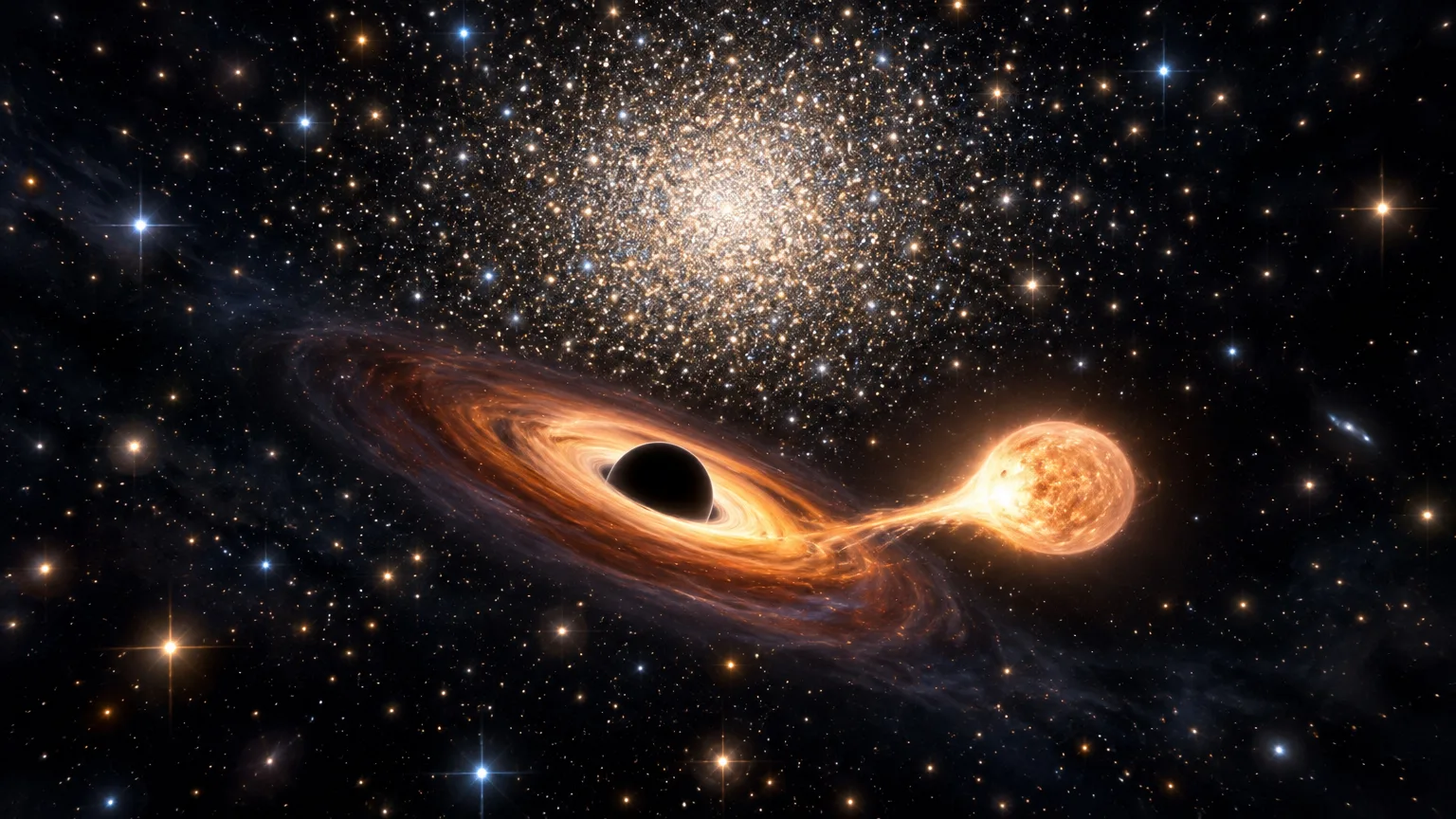
On July 13, 2026, NASA announced the finding, based on archival data from the Hubble Space Telescope and observations from the James Webb Space Telescope. The object was named oMEGACat BH-2 and is about 18,000 light-years away. NASA’s release says the team’s findings were published in The Astrophysical Journal Letters. The detection relies on the visible star’s motion, not a direct image of the black hole.
A search based on stellar motion
Black holes do not emit or reflect light and can therefore be invisible to telescopes. In some cases, material around them emits radiation; in others, astronomers can study them through their effects on their surroundings. For oMEGACat BH-2, the team used astrometry, which NASA describes as measuring very small movements of stars over time.
The researchers examined more than twenty years of Hubble archival data, including astrometric measurements taken between 2002 and 2023. They also incorporated Webb near-infrared data to improve precision. Together, these observations made it possible to track the visible star’s path in the cluster’s dense environment and determine that it orbited an object that cannot be seen directly.
The star has a mass of 0.78 solar masses. Using the expanded dataset, the team calculated that its dark companion has 4.46 solar masses. According to NASA’s release, this mass rules out the possibility that the object is a neutron star and supports its identification as a black hole. An earlier study had suggested that the system might include a neutron star; the new analysis refined the mass estimate and ruled out that interpretation.
A 94-year orbit and a possible dynamic origin
The star completes one orbit around oMEGACat BH-2 every 94 years. NASA describes this as the longest known period for a binary system containing a black hole. The data allowed the team to reconstruct the star’s path over more than two decades, including its closest approach to the black hole, when its apparent motion across the sky was fastest.
The long orbit offers a clue to how the system may have formed. The researchers consider a dynamic origin likely: the star and black hole may not have formed together, but may have encountered one another in the cluster. This is an explanation proposed from the system’s characteristics, not a direct observation of the encounter.
The team calculated that a system like this could survive for less than a billion years before encounters with nearby stars tear it apart. The estimate concerns the binary’s future lifetime; it does not set a specific date for its breakup. NASA compares this interval with Omega Centauri’s approximate age of 12 billion years.
A lower-than-expected mass
The release describes oMEGACat BH-2’s mass as lower than expected for an object in a metal-poor environment such as Omega Centauri. It also attributes to the team the conclusion that a metal-poor star can form a black hole of this mass. The researchers say they still need to determine how that process occurs; the observation provides data for models but does not, by itself, establish the formation mechanism.
NASA cites models suggesting that Omega Centauri could contain about 10,000 stellar-mass black holes. That figure is a theoretical estimate, not a count of observed objects. The discovery of oMEGACat BH-2 identifies one specific case; it does not establish how many black holes the cluster contains or how many exist in other clusters.
What the finding adds to black-hole research
Globular clusters are useful settings for studying black-hole formation and binary systems. NASA says environments such as Omega Centauri are considered important places where these pairs may merge and produce gravitational waves, ripples in spacetime that specialized instruments can detect. Understanding how black holes form and become paired helps researchers interpret such events. The finding does not, however, show that oMEGACat BH-2 will merge.
The team hopes to continue searching in Omega Centauri and extend the search to other clusters. NASA also points to the potential of the future Nancy Grace Roman Space Telescope: according to the release, it will regularly observe crowded regions such as the galactic bulge, with resolution comparable to Hubble’s and a wider field of view. The prospect that Roman may find similar binary systems is an expectation for future observations, not a result already produced by the mission at the time of the announcement.
What is known—and what remains open
The evidence described supports identifying oMEGACat BH-2 as a stellar-mass black hole with a visible star in orbit. The black hole’s estimated mass is 4.46 solar masses; its companion’s mass is 0.78 solar masses, and the orbital period is 94 years. The case shows how a star’s motion can reveal an invisible object without directly observing the black hole.
Questions remain about how the black hole formed, how the pair originated, and the full population of these objects in Omega Centauri. The possible dynamic origin and the lower-than-expected mass provide research directions, but not definitive answers. The figures and results presented here come from NASA’s report and the findings it attributes to the research team.