

Key facts
- Curiosity analyzed the Mary Anning 3 target in Glen Torridon, within Gale crater.
- The rock of the Knockfarrill Hill member is approximately 3.5 billion years old.
- SAM used 25% TMAH in methanol, hydrolysis, methylation and pyrolysis up to 550 °C to release volatile organic fragments.
- The study reports more than 20 organic molecules; seven were detected in the GC-MS data and were absent from cleaning analyses performed before and after the sample analysis. Among these assignments, methylnaphthalene remains tentative.
- The identification of methylnaphthalene is considered tentative; the study associates 30 chromatographic peaks with one or more molecules and does not confirm the identities of the remaining compounds using retention-time tests.
- The researchers consider the question of whether the compounds are exogenous or endogenous to be open; if endogenous, they may have formed through abiotic or biological processes.
Related records
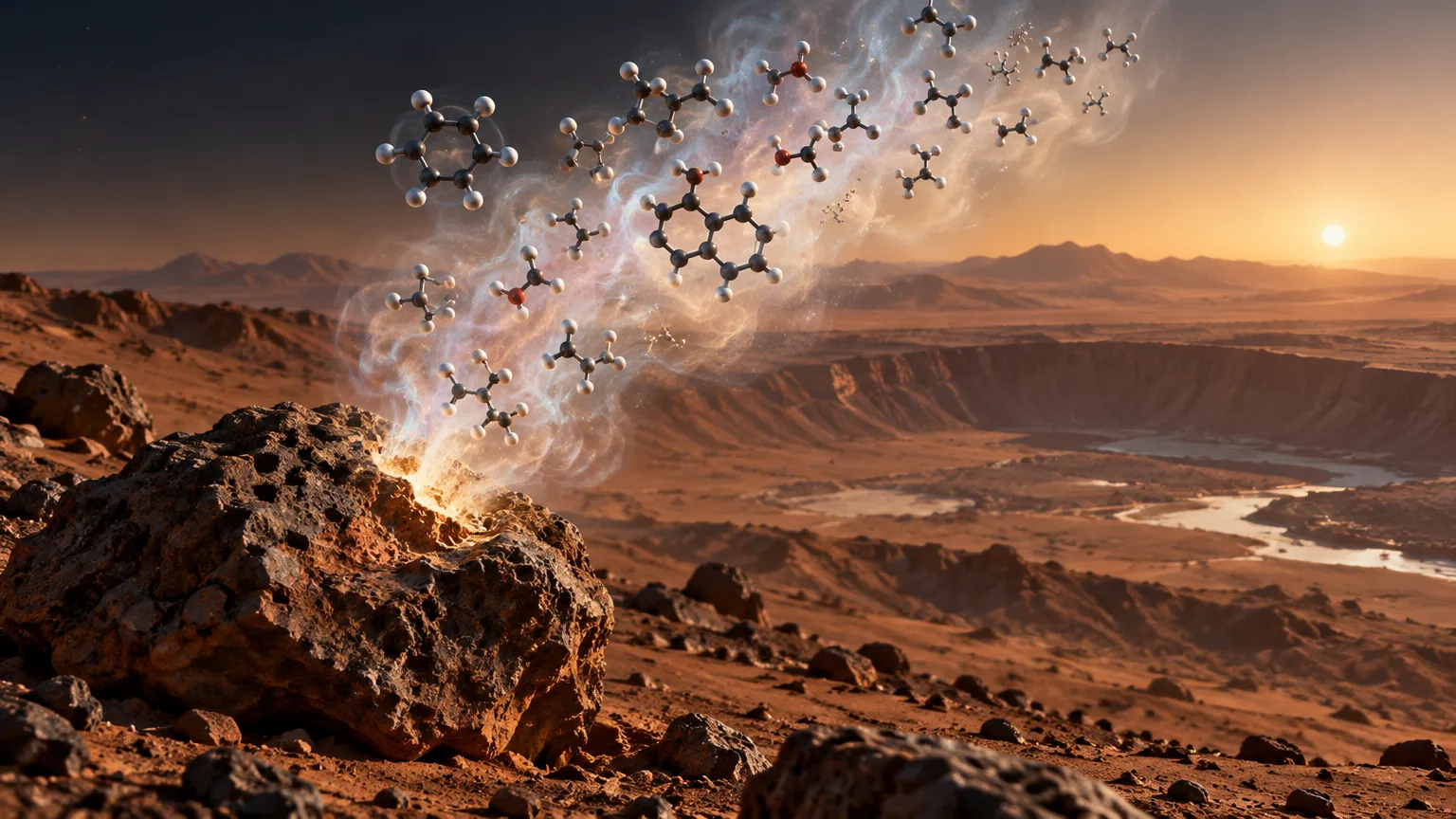
A chemical experiment carried out by the Curiosity rover released and analyzed organic molecules preserved in a roughly 3.5-billion-year-old Martian rock. The work, published on April 21, 2026, in Nature Communications, studied a sample from Gale crater with SAM, the instrument suite whose name stands for Sample Analysis at Mars. The technique used tetramethylammonium hydroxide (TMAH), an alkaline reagent, to make compounds accessible that would not otherwise be analyzed in the same way.
The study reports the in situ detection of more than 20 organic molecules. The identified products include benzothiophene and methyl benzoate, along with aromatic molecules with one and two rings. The result provides information about which compounds can be preserved in Martian rocks and how to analyze them. The detection, however, does not by itself determine where those molecules came from.
A sample from an ancient watery environment
Curiosity drilled and analyzed the target called Mary Anning 3, in the Glen Torridon region of Gale crater. The sample belongs to the Knockfarrill Hill member, made up of clay-bearing sandstones whose approximate age is 3.5 billion years. The study describes the clay-rich deposits of Glen Torridon as lacustrine facies; the cross-bedded sandstones also indicate a shift toward higher-energy fluvial environments.
The clay mineralogy is dominated mainly by dioctahedral smectites and iron-rich dioctahedral clays. The authors note that clay-rich environments, especially those containing smectite, are considered favorable for concentrating and preserving organic matter. This context helps explain why the sample was suitable for testing an extraction and analysis technique. It does not, by itself, identify the origin of the compounds.
What the TMAH reagent does
The experiment used 25% TMAH in methanol. According to the study’s description, the reagent hydrolyzed organic matter that was free or bound to mineral surfaces. The procedure also combined thermal fragmentation—with pyrolysis up to 550 °C—and methylation. This released volatile organic fragments that could be passed to the analytical instruments.
The SAM suite measured these products using evolved gas analysis and gas chromatography–mass spectrometry (GC-MS). SAM instrument documentation explains that the chromatograph separates gases and the mass spectrometer characterizes them by the ratio of their mass to their charge. The article presents this procedure as the first thermochemolysis carried out in situ on a planetary body: the analysis was performed on Mars with the rover’s instruments, rather than first bringing the sample to an Earth laboratory.
Which compounds were identified
In the GC-MS data from the TMAH experiment on Mary Anning 3, seven molecules appeared that were not present in cleaning analyses conducted before and after the sample analysis: trimethylbenzene, tetramethylbenzene, methyl benzoate, dihydronaphthalene, naphthalene, benzothiophene and methylnaphthalene. The study describes the identification of the last compound as tentative.
Those seven names do not account for all the products observed. The study reports 30 chromatographic peaks associated with one or more molecules. To identify compounds, the researchers compared mass spectra with those in the database of the U.S. National Institute of Standards and Technology (NIST) and, when possible, used retention-time tests on a laboratory instrument similar to SAM. The identities of the remaining compounds could not be confirmed through these tests, although the article offers possible interpretations based on their mass spectra.
Preservation and origin are different questions
The results indicate that the experiment succeeded in releasing molecules preserved in the rock as free or macromolecular organic matter, despite roughly 3.5 billion years of diagenesis—the changes that affect sediments after deposition—and radiation exposure. This demonstrates the usefulness of the method for accessing compounds preserved inside an ancient Martian rock.
But detecting organic matter and establishing how it formed are different problems. The study itself suggests that the origin may be exogenous, for example, delivered by meteorites, comets or interplanetary dust particles, or endogenous, produced on Mars by abiotic or biological processes. The result described here documents molecules and a technique for releasing and analyzing them; their origin remains an open question. Thus, preservation over long periods is a finding about the sample’s chemical history, not an identification of the process that produced its compounds.
A method to guide future analyses
The study describes how experience with TMAH can guide new analyses. The NASA notice of April 21, 2026 specifies that Curiosity had already used its second and final TMAH cup, and that its results would be analyzed for another paper. It also provides methodological information for future analyses: the article mentions the MOMA instrument, planned for the Rosalind Franklin Mars rover, and DrAMS, planned for the Dragonfly mission to Saturn’s moon Titan.
Curiosity’s central contribution is therefore twofold: the detection of more than 20 organic molecules in an ancient clay-rich sandstone and the demonstration that TMAH thermochemolysis can release detectable products directly on another world. Interpretation must preserve the distinction between identified compounds and peaks that remain unconfirmed, and between the possibility that organic matter can be preserved and the still-open question of its origin.