

Key facts
- Launched on October 13, 2026, at 6:33 a.m. EDT from Cape Canaveral.
- Total cargo: more than 6,300 pounds of supplies and hardware.
- Includes the final pair of IROSA solar arrays to complete the ISS power-system expansion.
- LambdaVision-1 studies the manufacture of artificial retinas in microgravity.
- Stellar Spheroids analyzes 3D models of human cardiac tissue.
- ELF-Unconventional Glass 2 investigates glass formation using nontraditional elements.
- MINDS studies brain organoids in relation to neurodegenerative diseases.
- Dragon will return in November with a failed Canadarm2 joint and other equipment.
Related records
The CRS-35 launch and cargo
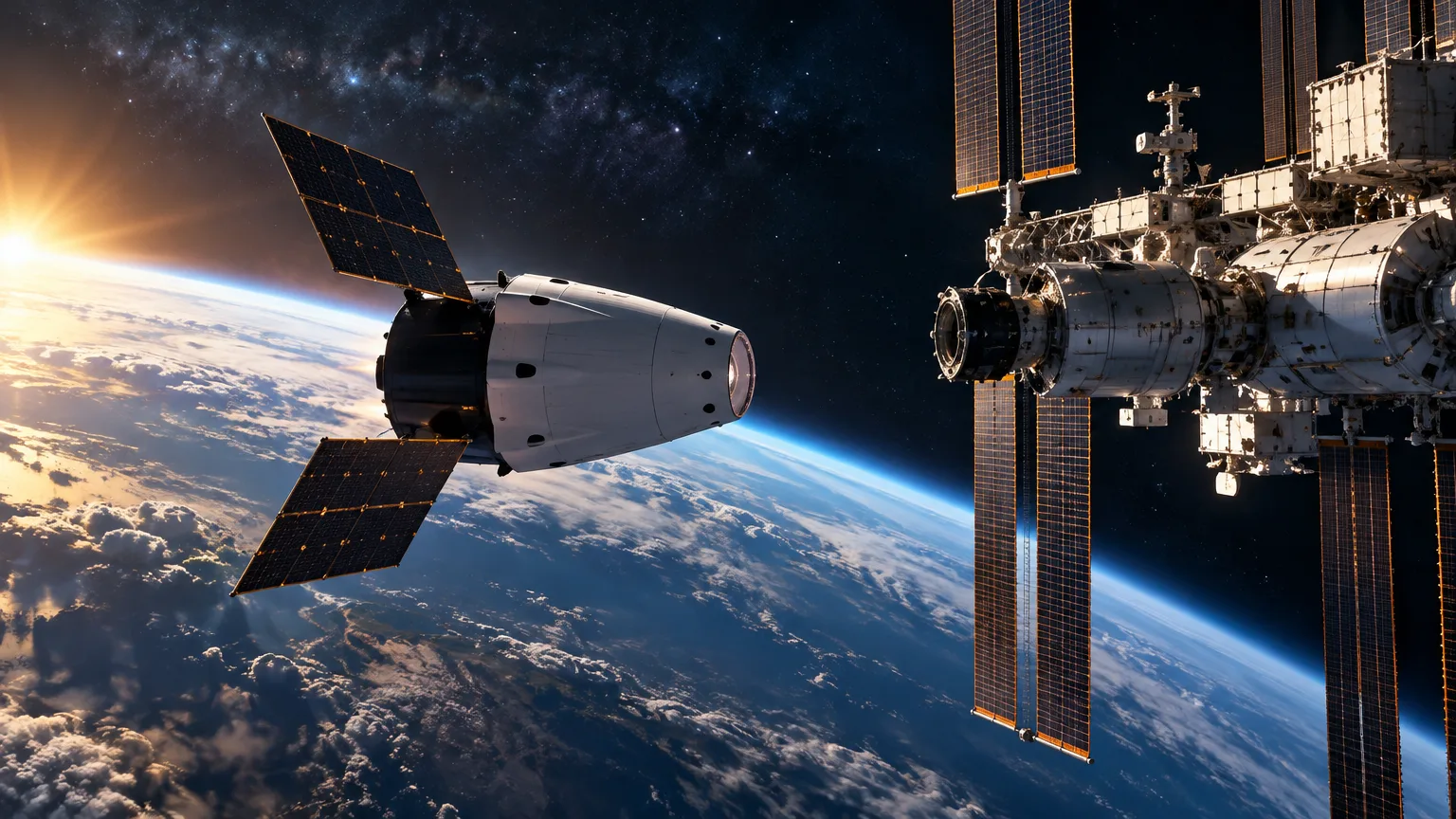
CRS-35 is SpaceX’s 35th commercial resupply flight for NASA. The launch vehicle was a Falcon 9, which lifted the Dragon spacecraft from Launch Complex 40 at Cape Canaveral. The total cargo exceeded 6,300 pounds (approximately 2,857 kg) of supplies and equipment. One of the cargo’s most notable items is the final pair of International Space Station (ISS) Roll-Out Solar Arrays (IROSA). According to NASA, installing these arrays will complete the expansion of the station’s power system, increasing the electricity available for research and daily operations and, crucially, helping ensure the ISS can be safely and controllably deorbited at the end of its service life. Astronauts will install the arrays during a series of spacewalks planned for fall 2026.
LambdaVision-1 experiment: artificial retinas in microgravity
One of the main scientific experiments aboard is LambdaVision-1. The study aims to test how to manufacture artificial retinas in microgravity. The process involves building the implants one thin layer at a time. NASA’s hypothesis is that reduced sedimentation in microgravity could produce more uniform and stable layers, potentially improving the performance of these implants. The long-term goal is to help restore vision for patients on Earth who have retinal diseases that are currently incurable. It is important to note that this is a potential benefit, not a confirmed clinical outcome at this time.
Stellar Spheroids: cardiac tissue and drug testing
The Stellar Spheroids experiment focuses on cardiovascular biology. Researchers will study how microgravity affects the growth and function of three-dimensional models of human cardiac tissue. One specific objective is to assess whether microgravity improves the formation of advanced vascular networks within these models. If the results are positive, they could help develop more realistic cardiac models for disease research and enable larger-scale drug testing on future space missions, reducing the need for animal testing or limited in vitro models.
ELF-Unconventional Glass 2: new materials for exploration
In materials science, the ELF-Unconventional Glass 2 experiment investigates how glass forms in microgravity when nontraditional elements are used. Researchers will observe the behavior of molten material in space and return solid samples to Earth for detailed analysis. NASA notes that these unconventional glasses could offer greater strength, improved optical capabilities, and greater durability—valuable properties for spacecraft, habitats, and other deep-space exploration technologies.
MINDS: brain organoids and neurodegenerative diseases
The MINDS experiment explores neuroscience by studying brain organoids to better understand inflammation associated with neurodegenerative diseases. A distinctive feature of the study is its use of “organoid villages,” which combine cells from several people to better represent patients’ genetic diversity. The results could help identify new therapeutic targets for diseases such as Alzheimer’s, Parkinson’s, and multiple sclerosis, contributing to the development of more effective treatments.
Return to Earth and equipment for analysis
The Dragon spacecraft is scheduled to remain docked to the station for approximately one month, until mid-November 2026. It will then depart the ISS and splash down in the Pacific Ocean off the coast of California. On its return, Dragon will bring back critical equipment for analysis and refurbishment on Earth. This includes a failed joint from the Canadarm2 robotic arm, a spacesuit for refurbishment, a urine processor fluid control and pump assembly, and a water processor filter unit. These items will allow NASA engineers to diagnose failures and improve the reliability of station systems.