

Key facts
- Hubble confirmed a dark vortex in Neptune’s southern hemisphere on May 16, 2016; it was the first observed there in the 21st century, following similar features detected in 1989 and 1994.
- In September 2015, OPAL detected a dark spot near bright clouds tracked from Earth; a later observation confirmed that it was a long-lived feature.
- Dark vortices are high-pressure systems, are usually accompanied by bright clouds, and are generally easier to distinguish at blue wavelengths.
- The hypothesis about the clouds proposes that disturbed air rises over the vortex and that the gases probably freeze into methane ice crystals.
- Images from 2015 to 2017 showed clouds in the region where a Great Dark Spot appeared in 2018. Their appearance two years earlier suggests a possible deeper origin, according to the researchers.
- A study cited by the AGU estimated that storms appear every four to six years and last up to six years, with two years considered the more likely duration.
- Winds inside the vortices had not been measured directly; the team cited by the AGU estimated speeds of around 100 meters per second.
Related records
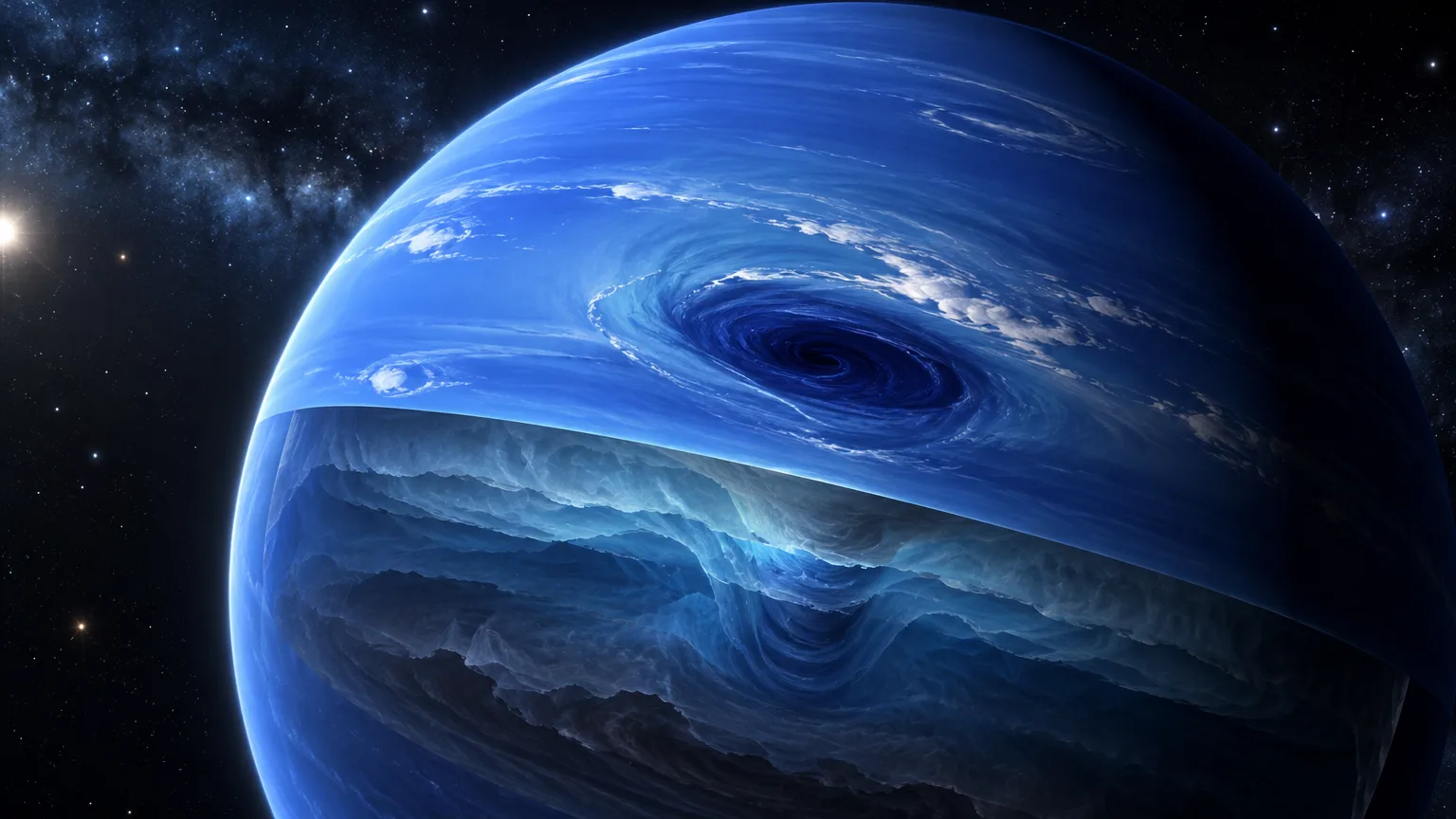
On Neptune, bright clouds can offer a clue to something that is harder to observe: the planet’s large, dark atmospheric vortices. In 2016, the Hubble Space Telescope confirmed the presence of one of these systems in the planet’s southern hemisphere. The observation provided a specific case for studying how dark spots relate to the clouds that accompany them, and what can be inferred from that relationship.
The clue is not the same as directly seeing how a storm forms. Researchers propose explanations for cloud formation and for the possible deep origin of vortices, but these processes were not directly observed in the images. Distinguishing what the photographs show from what they suggest is essential to understanding what is known about Neptune’s weather.
A vortex confirmed in the southern hemisphere
Images taken by Hubble on May 16, 2016, confirmed a dark vortex in Neptune’s atmosphere. According to NASA, it was the first observed on the planet during the 21st century. Similar features had been detected during the Voyager 2 spacecraft’s flyby in 1989 and by Hubble itself in 1994.
In the visible-light image, the spot appears near and below a patch of bright clouds in the southern hemisphere. Its location matters: it shows that the dark feature and the clouds can occur in the same region, although the image alone does not demonstrate how they formed or exactly what physical relationship exists between them.
The discovery was announced on May 17, 2016, in an electronic telegram from the Central Bureau for Astronomical Telegrams. Mike Wong, a research astronomer at the University of California, Berkeley, led the team that analyzed the Hubble data, according to NASA. NASA’s account of the observation explains that subsequent monitoring allowed researchers to confirm that the spot detected by the OPAL program was a long-lived feature.
Why clouds help reveal the storm
Neptune’s dark vortices are high-pressure systems and are usually accompanied by bright clouds. These clouds can be visible when the dark spot is not as easy to see. NASA notes that vortices are usually distinguishable at blue wavelengths and that Hubble has the resolution needed to observe these features on distant Neptune.
The proposed explanation for the clouds is that the surrounding airflow is disturbed and deflected upward as it passes over the vortex. The gases would rise and would probably freeze to form methane ice crystals, giving the clouds their bright appearance. Mike Wong compared the vortices to large gaseous mountains and their companion clouds to the orographic clouds that form over mountains on Earth. This is an analogy to help visualize the phenomenon, not a claim that the two processes are identical.
Bright clouds on Neptune had been observed from Earth beginning in July 2015 by a range of observers, from amateurs to astronomers at the W. M. Keck Observatory in Hawaii. Astronomers suspected they might be companion clouds associated with a dark vortex that was not yet visible. In September of that year, the Outer Planet Atmospheres Legacy (OPAL) program, a long-term project that uses Hubble to obtain annual global maps of the outer planets, detected a dark spot near the region containing those clouds. A new observation confirmed the feature and made it possible to produce a higher-quality map of the spot and its surroundings.
What later observations suggest
A different case provided clues about how these systems might develop. While studying Hubble images taken between 2015 and 2017, the team identified small white clouds in the region where a new Great Dark Spot would become visible in 2018. The clouds appeared two years before the spot; they also lost some of their brightness when it became visible.
Researchers interpreted this sequence as a sign that dark spots might originate deeper in Neptune’s atmosphere than previously thought. The wording is deliberately cautious: this is an interpretation supported by the timing of the observations and by atmospheric models, not a direct image of the storm’s birth beneath the clouds. The information released by the American Geophysical Union describes the analysis and distinguishes the record of the clouds from the conclusion about a possible deep origin.
Changing storms and outstanding measurements
Neptune’s dark spots do not all look or behave the same way: they vary in size, shape, and stability, can move in latitude, and sometimes speed up or slow down. According to NASA, they appear and disappear on much shorter timescales than comparable anticyclones on Jupiter, whose large storms evolve over decades.
An analysis of Hubble and Voyager 2 images cited by the AGU estimated that new storms might appear every four to six years. Each could last as long as six years, although a duration of two years was considered more likely. These are estimates of frequency and duration, not a schedule that makes it possible to predict when a particular spot will appear.
There are also limits to what is known about the winds. The team cited by the AGU said that it had not directly measured wind speed inside the dark vortices; its estimate was around 100 meters per second. The researchers noted that studying changes in shape and wind speeds would help improve understanding of how these storms evolve.
A clue, not a complete observation of storm formation
The vortex confirmed in 2016 shows how Hubble images can combine observations of a dark spot with those of nearby bright clouds. OPAL provided annual global maps, and follow-up observations made it possible to recognize the feature in more than one observation. The clouds, in turn, offer a possible signal to guide the search when the vortex is difficult to distinguish.
Together, the evidence supports a partial but useful picture: vortices are high-pressure systems, are often associated with bright clouds, and display varied behavior. Cloud formation and the possibility that storms originate deep in the atmosphere are explanations proposed on the basis of observations. Continued monitoring makes it possible to test these interpretations and describe in greater detail how Neptune’s weather changes.