

Key facts
- A 7 × 50 marking indicates seven-power magnification and 50-millimeter front lenses.
- A field of view of around 5–6 degrees lets you observe extended objects and find your way around the sky.
- The guide consulted says that 7 × 50 binoculars require a very dark sky; 10 × 50 binoculars reduce the exit pupil to about 5 mm.
- Most observers need a tripod to keep binoculars steady above ten power.
- The Pleiades and M44 are examples of clusters that can be observed with binoculars; visibility depends on sky conditions.
- For planetary or lunar detail and observing faint deep-sky objects, the guide recommends a telescope.
Related records
The binoculars you may already have at home can help you take your first steps in astronomy. Astronomer Chris Impey of the University of Arizona presents them as a practical option for observing the sky and explains that, in a dark location, they let you detect many more stars than the naked eye. You do not need complex accessories to begin: just learn what the numbers on the instrument mean and try objects that suit its field of view and magnification.
The experience, however, depends on the observing location. The portion of sky in view changes with latitude and location, and the darkness of the surroundings affects which objects can be distinguished. As a result, the same recommendation will not produce an identical view for everyone.
How to read the numbers on binoculars
A marking such as 7 × 50 gives two pieces of information: the first number indicates magnification, and the second, in millimeters, is the diameter of the front lenses. In this example, the instrument magnifies seven times and its lenses are 50 millimeters in diameter. A larger aperture can gather more light, but choosing binoculars is not simply a matter of looking for the highest numbers: magnification also affects how steady the image is when held in your hands.
Field of view is another important feature. A guide specializing in binocular observing puts the usual field of view at around 5–6 degrees and compares it with the 2 degrees a telescope can reach with a two-inch eyepiece. This wide field helps you see extended objects in their surroundings and move across the sky. The same guide notes that it lets you take in entire clusters such as the Pleiades or the Hyades.
There are practical advantages to viewing with both eyes, too: observing is more comfortable and the image is described as more natural. Binoculars also show an upright image, which can make it easier to find your way using a star chart than with the horizontal or vertical inversion that may occur in the image from some telescopes.
What to look for on your first night
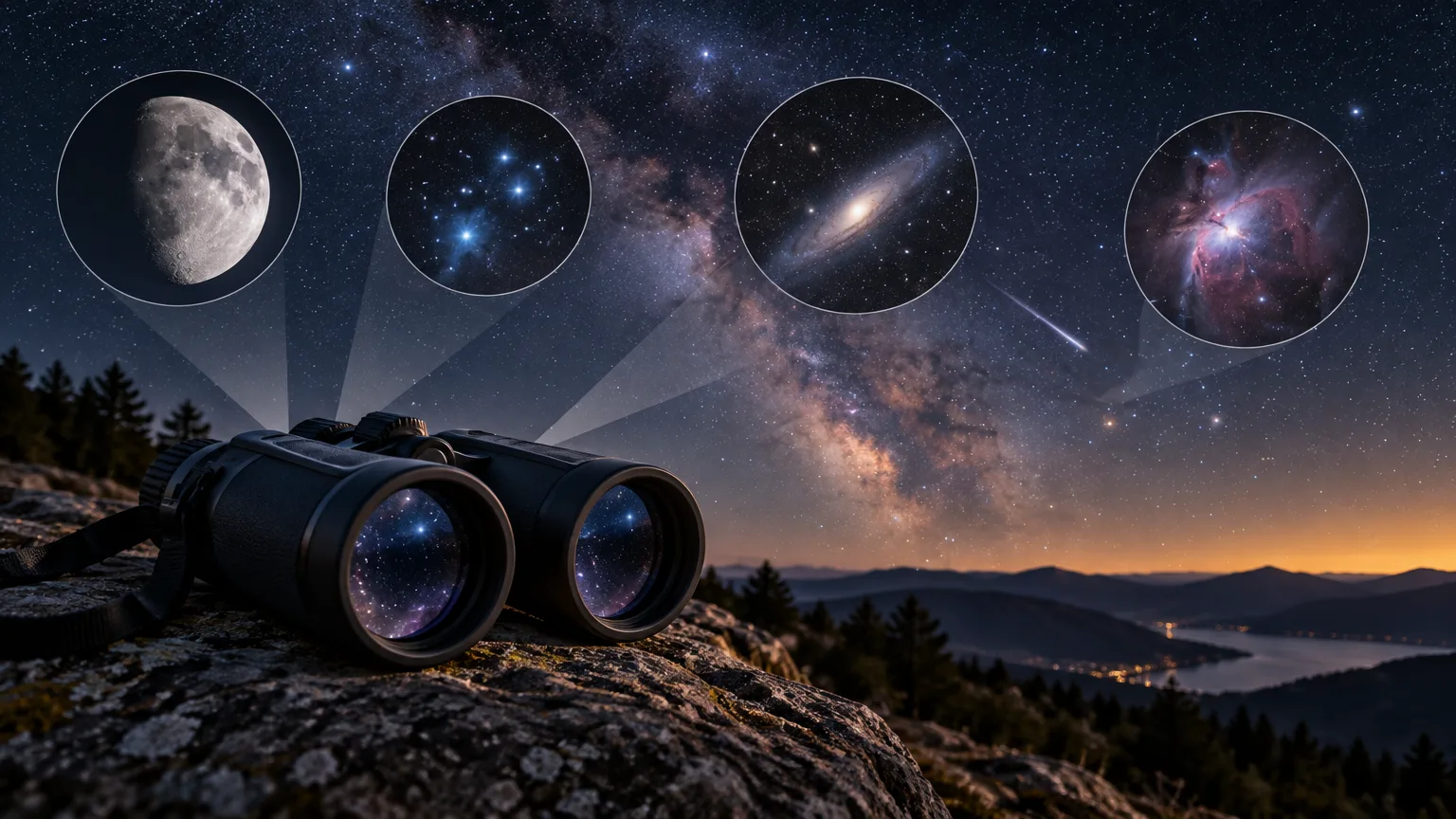
The Moon is a standout target: Impey’s guide describes it as spectacular through binoculars. It also suggests following its phases over the course of a month as a way to observe how its appearance changes. Binoculars let you enjoy the overall view of the disk; to study crater details at higher magnification, a binocular guide recommends using a telescope.
Among star clusters, the Pleiades are a particularly striking choice. According to the specialist guide, they are visible to the naked eye, and with ten-power binoculars you can distinguish numerous bright stars around the main ones. Another example is M44, also called the Beehive Cluster or Praesepe: in dark locations it can be seen with the naked eye, and binoculars can resolve its individual stars.
Binoculars can also show open clusters, bright nebulae, and some galaxies. One observing guide lists more than a hundred objects that may be worth viewing with this instrument. That wide range of options does not mean they are all equally easy to see: the guide itself distinguishes bright objects, which can be seen well, from faint deep-sky objects, for which it considers a larger-aperture telescope more suitable.
Magnification, darkness, and stability
The first number on the instrument matters just as much as the aperture. The Astroshop guide explains that 7 × 50 binoculars have a 7-millimeter exit pupil and require a very dark sky. In 10 × 50 binoculars, the higher magnification reduces the exit pupil to about 5 millimeters. The same source presents 8 × 42 binoculars, also with an exit pupil of approximately 5 millimeters, as an option suitable for observing under an illuminated urban sky. These are recommendations tied to the conditions described by that guide, not a guarantee that every object will be visible from every location.
As magnification increases, hand tremors become more noticeable, too. At ten power, it is still possible to observe without a tripod, although keeping the image steady is harder than at seven power. Above ten power, the guide considers that most people cannot hold binoculars steady enough by hand and recommends a tripod. Stabilizing them can help when viewing double stars and trying to see both components; the guide cites Mizar and Alcor as an example and mentions 20 × 80 binoculars for trying to distinguish Mizar’s secondary component.
The number of stars that can be seen also needs to be read in context. Impey’s article estimates that the naked eye can see around 3,000 in a dark location, and that binoculars can raise the figure to 100,000. Those numbers are the estimate given by that source and apply to the explicitly stated condition of a dark location; they do not describe what will be visible from every location.
When to choose a telescope and how to find your way around
Binoculars are especially useful when high magnification or a large aperture is not needed. To identify details on planets or lunar craters, the specialist guide recommends a telescope, which offers higher magnification. It also considers a telescope more suitable for faint deep-sky objects because of its larger aperture and light-gathering capacity. Binoculars, by contrast, retain the advantage of covering a wide area of the sky, which is useful for exploring bright clusters and finding your way around.
Because the stars and constellations in view change throughout the year as Earth moves around the Sun, it is a good idea to consult a sky map for the date and location. To improve night observing, Impey recommends using a red LED flashlight to preserve night vision and looking slightly to one side when trying to perceive faint objects.
In short, binoculars let you start with wide-field, bright targets, learn to recognize the sky, and decide later whether you need another instrument. The right choice depends on magnification, aperture, stability, and local conditions: a dark sky favors certain objects, while high magnification may make a tripod necessary.
Sources consulted: Chris Impey, The Conversation; Astroshop guide to astronomy with binoculars.