

Key facts
- NASA presented the three results on December 2, 2025; the studies appeared in Nature Geoscience and Nature Astronomy.
- OSIRIS-REx delivered 121.6 g of Bennu regolith to Earth on September 24, 2023.
- Analysis of a 603.4 mg portion identified six sugars, including ribose and glucose; according to NASA, glucose was identified for the first time in an extraterrestrial sample.
- The measured concentration was 0.097 ± 0.014 nmol g^-1 for ribose and 0.35 ± 0.05 nmol g^-1 for glucose.
- One study described nitrogen- and oxygen-rich polymeric organic matter in a carbonaceous vein and in multilayered organic sheets.
- According to NASA, the samples contain six times more supernova dust than any other astromaterial studied.
Related records
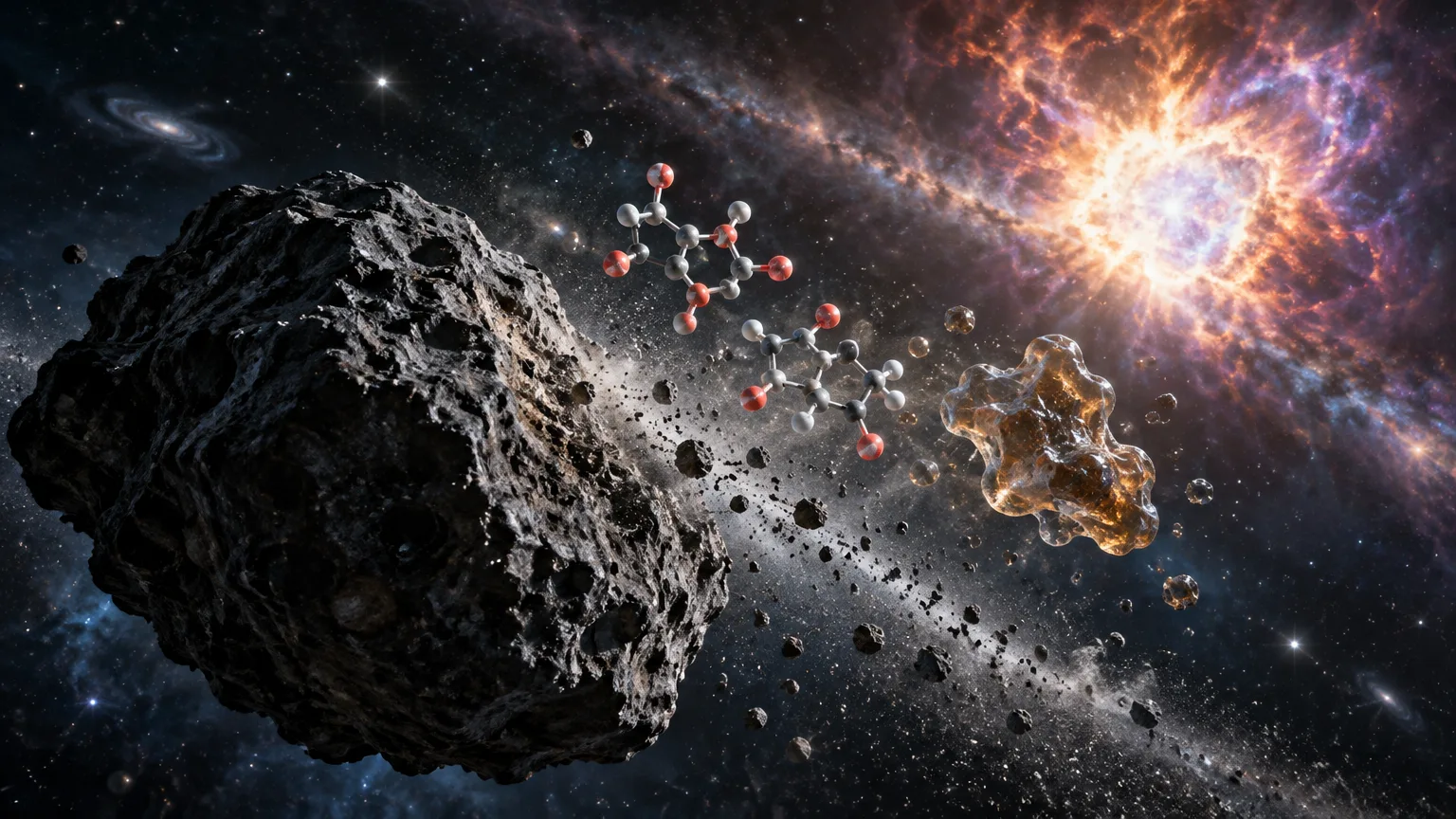
The Bennu samples brought to Earth by OSIRIS-REx make it possible to analyze in laboratories material collected directly from an asteroid. The mission delivered 121.6 grams of regolith—loose granular material—on September 24, 2023. On December 2, 2025, NASA announced three investigations of these fragments: one studied sugars, another described complex organic matter rich in nitrogen and oxygen, and the third examined presolar dust. The studies appeared in Nature Geoscience and Nature Astronomy.
The results add to earlier analyses of Bennu that had identified, among other organic compounds, amino acids, nucleobases and carboxylic acids. These substances help characterize the asteroid’s chemistry and that of its parent body. To understand the implications of the new findings, it is useful to distinguish between the identification of molecules and hypotheses about how they formed or their possible connection to processes that preceded life.
Sugars identified in the sample
The team led by Yoshihiro Furukawa of Tohoku University analyzed an extract from a 603.4-milligram portion of homogenized Bennu dust using gas chromatography and mass spectrometry. It identified six sugars: the pentoses ribose, lyxose, xylose and arabinose, and the hexoses glucose and galactose. NASA highlighted two of them for their biological relevance: ribose, a component of RNA, and glucose, used by life on Earth as an energy source. According to the agency, this is the first identification of glucose in an extraterrestrial sample.
The study quantified ribose at 0.097 ± 0.014 nmol g-1 and glucose at 0.35 ± 0.05 nmol g-1 in the sample analyzed. It also reported concentrations of 0.018 ± 0.007 nmol g-1 for lyxose, 0.11 ± 0.03 nmol g-1 for arabinose, 0.079 ± 0.033 nmol g-1 for xylose and 0.014 ± 0.004 nmol g-1 for galactose. These are quantities measured in the material studied, not estimates of the asteroid’s overall composition.
Ribose is part of RNA, while deoxyribose is a component of DNA. The team did not detect deoxyribose in the samples examined. Based on this combination, the researchers consider the results compatible with the “RNA world” hypothesis, according to which early forms of life may have used RNA to store information and facilitate chemical reactions. This hypothesis is an interpretation of the significance of the findings; identifying sugars does not in itself establish that life existed on Bennu or determine how life began on Earth.
A complex organic phase in the samples
Another investigation, led by Scott Sandford of NASA’s Ames Research Center and Zack Gainsforth of the University of California, Berkeley, described organic matter not previously observed in astromaterials. NASA informally called it “space gum” because of its behavior: the material was flexible and has hardened. The scientific characterization describes it as a polymeric organic phase exceptionally rich in nitrogen and oxygen, with chemical groups such as amines, amides and nitrogen-bearing heterocycles, as well as aliphatic and aromatic hydrocarbons.
The researchers observed the material in a carbonaceous vein with mineral inclusions and in multilayered organic sheets. NASA compares some of its chemical groups with those found in polyurethane, but explains that Bennu’s material is not simply polyurethane: it has more disordered connections and an elemental composition that varies between particles. The comparison describes chemical similarities, not an identity with a plastic manufactured on Earth.
The team proposes a possible formation process on Bennu’s parent asteroid. According to the model described by NASA, when that body began to warm due to natural radiation, a reaction involving ammonia and carbon dioxide may have produced carbamate. Although this compound is soluble in water, it may have polymerized and reacted with other molecules before the body became warm enough to develop a watery environment. The research interprets the morphology and composition as evidence of nitrogen-rich precursors that existed before alteration by water; it also points to later modifications associated with that alteration. This is a reconstruction proposed by the researchers.
Presolar grains and supernova dust
The third study, led by Ann Nguyen of NASA’s Johnson Space Center, examined presolar grains in two types of rock in the samples. Presolar particles are dust grains from stars that existed before the solar system formed. According to NASA, Bennu samples contain six times more supernova dust than any other astromaterial studied.
The authors suggest that Bennu’s parent body may have formed in a region of the protoplanetary disk enriched with dust from stars that exploded. That disk was the gas-and-dust environment from which the solar system formed. The observed abundance supports this possibility, but does not conclusively establish the parent body’s formation location.
The study also identified areas containing materials less altered by fluids, despite the extensive aqueous alteration experienced by the parent asteroid. These fragments preserve more organic matter and presolar silicate grains, materials that can be readily destroyed during aqueous alteration. Their preservation offers clues about the diversity of material incorporated as the parent body formed and about differences in the degree of alteration of its components.
What Bennu’s samples reveal
Together, the studies expand the inventory of organic substances and presolar materials found on Bennu. The identified sugars make it possible to study compounds important to terrestrial biology; the nitrogen- and oxygen-rich phase offers clues about chemical processes before and after the presence of water, while the stellar dust preserves information about materials that predate the solar system. Interpreting these results helps investigate the raw materials and chemical transformations that took place during asteroid formation.
Explanations for the origin of the sugars, the formation of the polymeric organic matter and the region where the parent body may have formed are hypotheses or interpretations proposed in the studies. In particular, the proposal that the sugars formed in formaldehyde-rich brines comes from the geochemistry study; the proposed origin of the polymeric material from nitrogen-rich precursors is based on its morphology and composition. The findings describe the chemistry preserved in the samples and provide evidence with which to assess these proposals.
NASA provides a summary of the three investigations in its report on sugars, organic matter and stardust in the Bennu samples. The sugar study was published in Nature Geoscience, and the study of nitrogen- and oxygen-rich organic matter in Nature Astronomy.