

Key facts
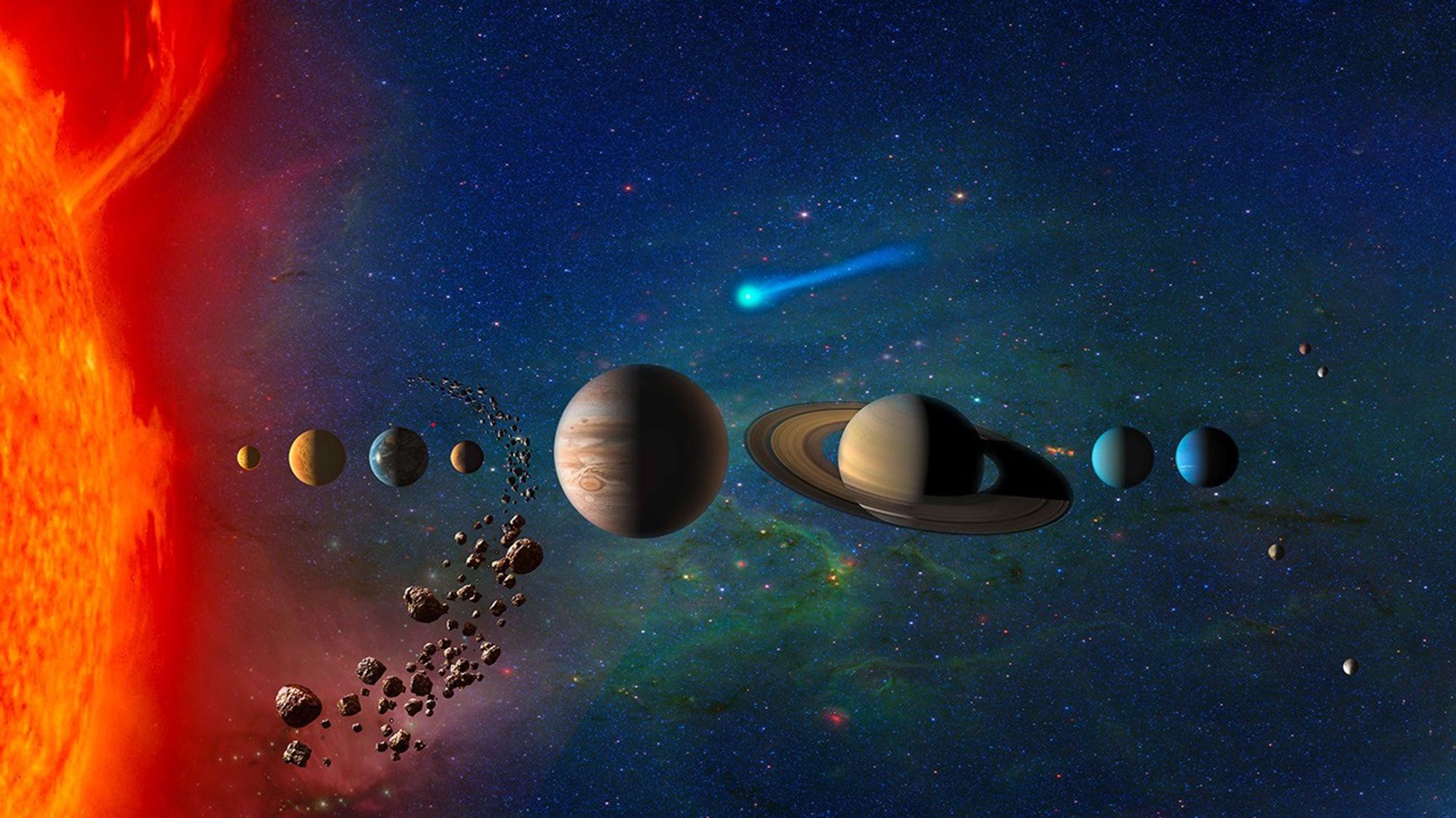
- The solar system has eight planets and five dwarf planets recognized by NASA.
- Mercury, Venus, Earth, and Mars are rocky planets; Jupiter and Saturn are gas giants, while Uranus and Neptune are ice giants.
- Earth is the only place where we know there are living things and the only planet in the solar system with liquid water on its surface.
- Stars are spheres of hot gas made mostly of hydrogen. They form in clouds of gas and dust and can produce energy through nuclear fusion.
- A star’s mass affects how quickly it uses up its fuel and the final stages of its life.
- Galaxies bring together stars, planets, and clouds of gas and dust held together by gravity; they can be spiral, elliptical, or irregular.
- The Milky Way is a spiral galaxy. From Earth, it appears as a faint, milky band.
- Earth’s rotation causes day and night; the tilt of its axis, together with its orbit around the Sun, causes the seasons.
Related records
The universe can seem enormous, but a few questions can help us begin to understand it: How many planets are in the solar system? How do stars form? What is a galaxy? Why do day and night alternate? This guide brings together answers for readers ages 8 to 12 about planets, stars, the Milky Way, and the seasons, based on NASA educational explanations.
Planets
How many planets are in the solar system?
There are eight planets: Mercury, Venus, Earth, Mars, Jupiter, Saturn, Uranus, and Neptune. NASA also recognizes five dwarf planets: Ceres, Pluto, Haumea, Makemake, and Eris.
What is a planet?
A brief description on NASA’s website comes from the Merriam-Webster dictionary: a large body that revolves around the Sun within the solar system. This is a dictionary description, not the formal definition adopted by the International Astronomical Union (IAU). Separately, NASA explains that in 2006 the IAU adopted a definition of a planet for our solar system; according to NASA, this change led to Pluto being reclassified as a dwarf planet and the number of planets changing from nine to eight. Beyond the solar system, planets are called exoplanets: most orbit other stars, although some, called rogue planets, drift without being bound to a star.
How are the inner and outer planets different?
The four planets closest to the Sun—Mercury, Venus, Earth, and Mars—are rocky and have solid surfaces. Jupiter and Saturn are gas giants; Uranus and Neptune are ice giants. These four outer planets do not have a hard surface: gases move above a core.
What makes Earth special?
Earth is the only place where we know there are living things. It is also the only planet in the solar system with liquid water on its surface.
Stars
What is a star?
A star is an enormous sphere of hot gas, made mostly of hydrogen, along with helium and small amounts of other elements. The Sun is the star closest to us and the one we have studied the most.
How does a star form?
Stars form in large clouds of gas and dust called molecular clouds. Cold temperatures cause the gas to clump together and form dense regions. Some gather more matter; their gravity grows stronger and eventually causes them to collapse. The material heats up, and a protostar—a star in its earliest stages—begins to form. Groups of newly formed stars are often called star clusters, and molecular clouds containing clusters are known as stellar nurseries.
Where does a star get its energy?
At first, much of a protostar’s energy comes from the heat released as it collapses. After millions of years, the pressure and temperature in its core can cause hydrogen nuclei to join together to form helium. This process is called nuclear fusion: it releases energy, heats the star, and helps prevent it from continuing to collapse under the force of gravity. Stars that steadily fuse hydrogen into helium are called main-sequence stars; this is the longest stage of their lives. The Sun is approximately halfway through this stage.
Do all stars live for the same amount of time?
No. Mass affects how quickly a star uses up its fuel: lower-mass stars can shine for longer, with less brightness and at lower temperatures; some live for trillions of years. By contrast, some very massive stars live for only a few million years. A star’s end also depends greatly on its mass. A low-mass star may cast off its outer layers, form a planetary nebula, and leave behind a white dwarf. A massive star may end in an explosion called a supernova, leaving behind a core that becomes either a neutron star or a black hole.
Galaxies
What is a galaxy?
A galaxy is a collection of stars, planets, and enormous clouds of gas and dust held together by gravity. Galaxies have different shapes: many are spiral or elliptical, while others have a less orderly appearance and are called irregular.
What is our galaxy called, and where is Earth?
Our galaxy is called the Milky Way, and it is a spiral galaxy. Earth is in one of its arms, about halfway between the center and the edge. From our planet, the Milky Way looks like a faint, milky band stretching across the sky: we see the galaxy’s central disk edge-on.
The Sky and Earth
Why do we have day and night?
Earth spins on an imaginary axis that passes through its center. The side facing the Sun has daytime; the side turned away from the Sun has nighttime. As Earth spins, places move from light into darkness and back again. One complete rotation takes about 23.9 hours.
Why do the seasons change?
Earth’s axis is tilted about 23.4 degrees relative to the plane of its orbit around the Sun. As Earth travels along that orbit, the tilt means that different parts of the planet receive the Sun’s most direct rays at different times of the year. When the Northern Hemisphere tilts toward the Sun, it receives more direct sunlight, and it is summer there; at the same time, it is winter in the Southern Hemisphere. About six months later, the situation is reversed. The seasons are not caused by Earth being closer to or farther from the Sun.