

Key facts
- NASA places the launch of Artemis II in April 2026 and describes a nearly ten-day journey around the Moon.
- The crew consisted of Reid Wiseman, Victor Glover, Christina Koch and Jeremy Hansen.
- NASA puts the distance traveled from Earth at 252,756 miles and describes it as a record for humans in space.
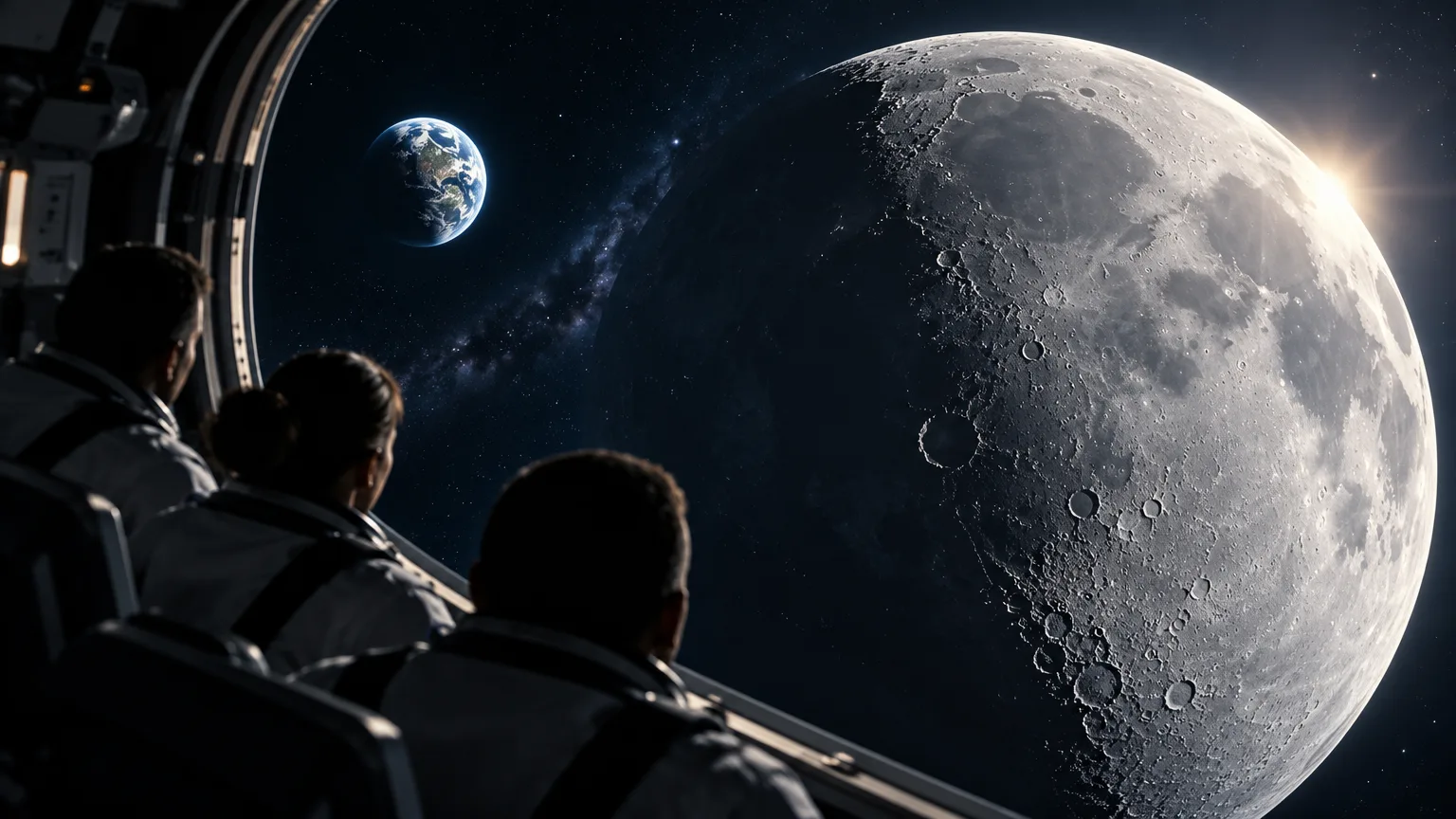
- Artemis II was Orion’s first crewed flight, and the crew observed the lunar surface.
- NASA plans Artemis III as a low Earth orbit demonstration in 2027 and maintains 2028 as the target for Artemis’s first lunar landing, planned for Artemis IV.
Related records
In April 2026, Artemis II set off on a nearly ten-day journey around the Moon. NASA described it as the first crewed flight of Orion, its exploration spacecraft. The crew consisted of NASA astronauts Reid Wiseman, Victor Glover and Christina Koch, together with Jeremy Hansen of the Canadian Space Agency. According to NASA, they traveled 252,756 miles from Earth, setting a record for the greatest distance humans have traveled in space, and observed the lunar surface.
The flight is part of the Artemis program, through which NASA plans to send astronauts on increasingly complex missions to explore the Moon and conduct scientific research. Artemis II is described as a journey around the satellite; the first lunar landing mission NASA plans in this sequence is scheduled for Artemis IV. Distinguishing these milestones helps clarify what happened during this flight and how it relates to the program’s next steps.
Orion, SLS and the Artemis flights
Orion is the vehicle NASA developed to transport and sustain crews on Artemis missions and return them safely to Earth. The spacecraft is launched by the Space Launch System (SLS), NASA’s heavy-lift rocket. According to the agency, SLS can send Orion, astronauts and cargo directly toward the Moon in a single launch.
Artemis II followed Artemis I, an uncrewed test flight that NASA completed in November 2022. That mission evaluated Orion’s systems without astronauts and without the critical life-support systems planned for future crewed missions. Artemis II was therefore Orion’s first flight with people on board. During the journey, the crew observed the lunar surface; NASA described the observations as being made “as never before.”
Lunar science is part of Artemis’s overall objectives. NASA says the program aims to explore more areas of the Moon to support scientific discoveries and address priority questions through human explorers on site and robotic systems on the surface and in orbit. This context helps place Artemis II’s lunar observations within a broader campaign without confusing them with the objectives of future surface missions.
What the Moon can tell us about the solar system
NASA presents the Moon as a 4.5-billion-year-old time capsule that preserves clues about the evolution of Earth, the planets and the Sun. Craters are part of that record: because there is no wind or liquid water on the Moon to erase traces of impacts, they can remain preserved for billions of years. NASA explains that lunar craters make it possible to study the history of both the Moon and other worlds.
The Moon has three main layers: crust, mantle and core. NASA’s account says that billions of years ago it was a molten world. As it solidified, heavier materials, such as iron metals, sank toward the center, while less dense rocks rose toward the surface. The resulting structure is described as a solid core, a mostly solid and partly liquid mantle, and a thin outer crust.
Regarding its origin, NASA says there are several theories and that almost all share the idea that the early solar system was shaped by violent collisions between bodies. The agency says the Moon formed in a huge collision. Thus, NASA’s account combines a general explanation of its formation with the existence of different theories.
Water and the lunar environment
NASA says water exists on the Moon in different forms and places: ancient ice hidden in craters that remain permanently shadowed, and H2O molecules on the sunlit surface. The agency also shows possible water-ice deposits in areas of the lunar south pole, on a map based on data from NASA’s Lunar Reconnaissance Orbiter. The reference to possible deposits describes the scope of that information without treating them as a general certainty for all lunar areas.
The Moon also has an exosphere, which NASA describes as extremely tenuous compared with Earth’s layers of air. The agency compares it to a haze made up of particles dislodged from the lunar surface by impacts and left in an almost empty environment. Dust is another subject of interest: NASA says studying it helps us learn about the Moon and that the powdery surface poses challenges for human and robotic explorers.
Surface exploration requires systems suited to that environment. NASA is developing next-generation spacesuits, crewed rovers, tools and support systems so astronauts can survive and work outside a spacecraft. In the program, these elements support plans for future lunar activities.
NASA’s planned upcoming milestones
NASA plans Artemis III for 2027 as a demonstration in low Earth orbit. The goal is to evaluate one or both commercial human landing systems being developed by SpaceX and Blue Origin, and to test rendezvous and docking operations between Orion and those vehicles. The agency identifies these capabilities as necessary for future lunar surface missions.
NASA maintains 2028 as the target for Artemis’s first lunar landing, planned for Artemis IV. Under the plan described, the crew would transfer from Orion to a commercial landing system that would take them to the lunar surface. The agency also plans Artemis V as another surface mission in 2028. These are dates and goals NASA has announced for future missions.
The program also includes Gateway, a small space station planned in orbit around the Moon to support surface missions, science in lunar orbit and exploration farther afield by humans. To deliver scientific and technological payloads to the Moon, NASA uses Commercial Lunar Payload Services (CLPS), an initiative that purchases delivery services from commercial providers. Commercial landers are designed to transport astronauts between lunar orbit and the surface.
Overall, NASA attributes to Artemis II a nearly ten-day journey around the Moon, Orion’s first crewed flight, observations of the surface and a record for the greatest distance humans have traveled from Earth. Lunar geology, water and the lunar environment provide the program’s scientific context; Artemis III, IV and V are planned steps to test systems and carry out surface missions. The dates for those missions are the agency’s published targets.
Sources: NASA, pages on the Artemis program and Earth’s Moon.