

Key facts
- On 9 July 2026, ESO reported that the FCC had authorized Reflect Orbital to deploy a demonstration satellite, not its full constellation.
- Reflect Orbital proposes a fleet of up to 50,000 mirror-like satellites by 2035; the effects described are simulations.
- For the SpaceX scenario, the simulation estimates field-of-view losses of up to 28% in VLT images taken two hours into the night.
- With Reflect Orbital’s full fleet, the sky could be up to three or four times brighter overall, according to ESO’s estimates.
- ESO reported more than 14,000 satellites in orbit, or 32,000 when dead satellites and debris are also counted.
Related records
The new information reported by the European Southern Observatory (ESO) on 9 July 2026 is specific: the U.S. Federal Communications Commission (FCC) authorized Reflect Orbital to deploy a demonstration satellite. ESO’s update does not describe that authorization as permission to deploy the company’s entire proposed constellation. That distinction matters because the study’s most striking figures concern scenarios in which proposed fleets would be deployed, not a complete constellation already observed in orbit.
The announcement updates the context of a study ESO released on 1 July 2026. Its author, Olivier Hainaut, an ESO astronomer, simulated the positions, movements, and brightness of existing and planned satellite constellations. ESO says the work was accepted for publication in Astronomy & Astrophysics and describes it as peer-reviewed. The estimates below are projections of those scenarios, not measurements of a complete Reflect Orbital constellation in operation.
What the FCC authorized and what the company proposes
Reflect Orbital, a U.S. start-up, proposes large, mirror-like satellites that would reflect sunlight toward Earth to provide illumination at night. According to ESO’s release, the company intends to begin with a prototype satellite in orbit and increase its fleet to 50,000 satellites by 2035. The permission mentioned in the 9 July update is for the demonstrator; it is not equivalent to approval of that full plan.
ESO also reported that Reflect Orbital and SpaceX had filed applications with the FCC for their projects. When ESO published its information on 1 July, the commission had received more than 1,800 comments about Reflect Orbital and nearly 1,500 about SpaceX’s application. The release said the FCC’s determinations on both filings were still awaited. The later update specifies a decision about Reflect Orbital’s demonstration satellite; it does not report authorization for the full constellation or an equivalent decision about SpaceX’s project.
Why trails and background brightness matter
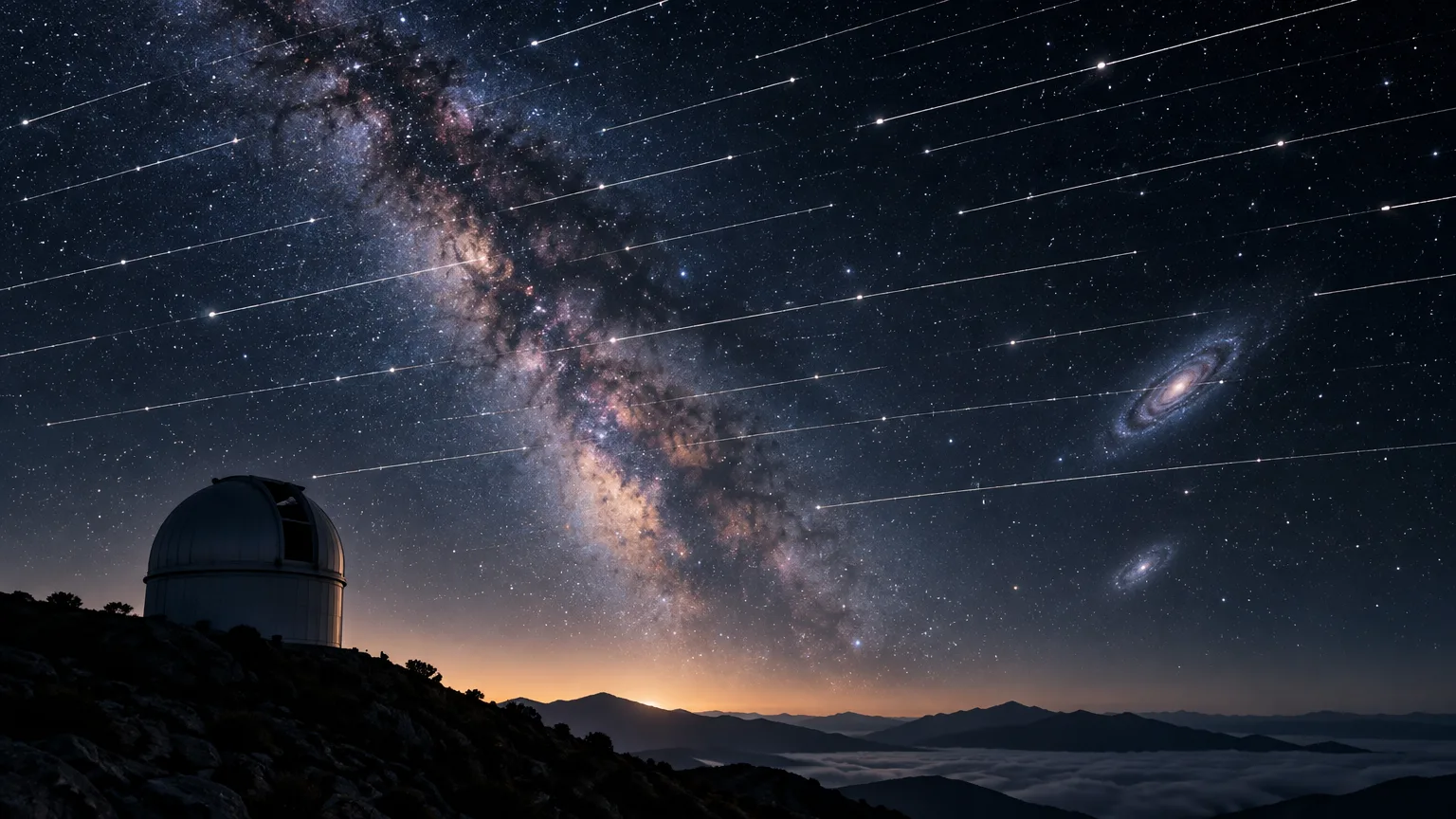
The study addresses two distinct effects on astronomical observing. The first is a trail in an image: a Sun-illuminated satellite crossing the observed field can leave a bright streak and affect what lies behind it. In complex electronic detectors, a sufficiently bright trail can saturate the detector and also produce ghost trails. The second effect does not require a prominent trail to cross a particular image: satellites too faint to be seen directly can contribute a diffuse veil, while light from brighter satellites can be scattered through the atmosphere. Both processes would increase the overall brightness of the night sky.
ESO says the study was the first to calculate specifically how the contribution of constellations to background sky brightness would affect astronomy. This distinction helps explain why counting streaks in images alone does not describe the full potential impact: the increase in background brightness also matters. The work focuses on astronomical effects and, according to ESO, does not itself quantify the environmental or biological consequences of launches and satellite re-entry.
What the simulations project
For a SpaceX mega-constellation scenario, Hainaut calculated that dozens of trails would appear in each image taken with ESO’s Very Large Telescope (VLT) at Paranal Observatory in Chile, two hours into the night. Field-of-view losses could reach 28%. The simulation assumes the satellites would be faint enough not to be visible to the naked eye in good conditions. ESO adds that if they were somewhat brighter, some instruments would be more affected: a camera like that of the U.S. National Science Foundation’s Vera C. Rubin Observatory could have most of its images rendered unusable for several hours each night.
The Reflect Orbital scenario is also a simulation, not an observed result for the complete fleet. Hainaut assumed that none of its satellites would point a beam directly at or near an observatory; even so, the trail from a single mirror satellite could spoil an observation with a camera like Rubin’s. With the full fleet in orbit and illuminated by the Sun, the study projects that every image from a camera of that kind would be lost. Within a reflected beam, the satellite producing it would appear four times brighter than the full Moon; even without aiming the beam at an observer, each satellite would be as bright as Venus. With all 50,000 satellites deployed, the sky could be up to three or four times brighter overall.
The study’s context and limits
ESO’s release put the number of satellites in orbit at more than 14,000 when the information was published in July 2026. Including dead satellites and debris raises the figure to 32,000. The study considers proposals to launch more than 1.7 million new satellites, including plans from SpaceX, E-Space, and China. These are counts of objects or proposals considered, not a claim that every project has been authorized or will be launched.
Hainaut recommends limiting the total number of current and future satellites to 100,000, on the condition that they are fainter than visual magnitude 7. ESO clarifies that this is not a rigid threshold that automatically separates an acceptable number from an unacceptable one: Hainaut would prefer a lower total, and the limit would need to be reduced if some satellites were too bright. The magnitude condition means they would be too faint to see with the naked eye even under very dark skies; it does not guarantee that they would have no effect on telescope detectors.
The decision reported on 9 July adds a specific regulatory development to the debate, but it does not by itself settle the scale of Reflect Orbital’s plans or the consequences of possible complete fleets. The simulations describe how satellite numbers, brightness, and positions could affect observations. The actual scale of the effect will depend on which proposals are carried out and what mitigation measures are adopted. For now, the new fact is limited and precise: the FCC authorized a demonstration satellite, while the impacts of a complete constellation remain estimates from ESO’s study.
Primary source: ESO release of 1 July 2026, updated on 9 July.