

Key facts
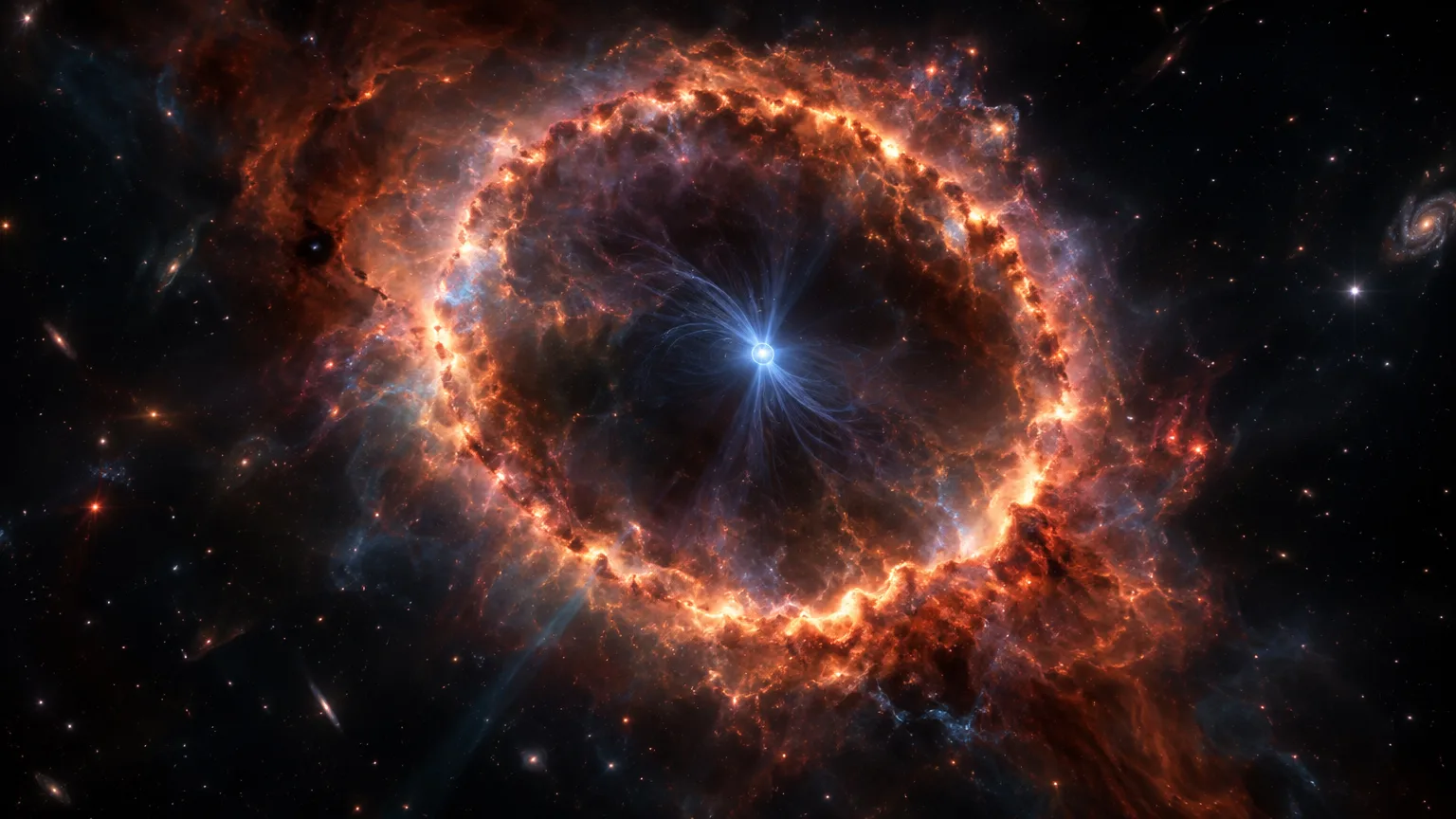
- Webb has found the strongest evidence yet for emission from a neutron star at the site of SN 1987A.
- SN 1987A is a core-collapse supernova in the Large Magellanic Cloud, about 160,000 light-years from Earth.
- NASA JPL describes the evidence as indirect; the cited material does not confirm a direct, indisputable detection.
- JPL says observations of much older remnants, such as the Crab Nebula, confirm that neutron stars are present in many supernova remnants.
Related records
The James Webb Space Telescope has found the strongest evidence yet for emission from a neutron star at the site of SN 1987A. Information released by NASA and the European Space Agency (ESA) does not describe the object as directly observed or confirmed without qualification: it reports evidence of emission that supports its possible presence. That distinction matters because the center of a supernova remnant is a complex environment, and a signal can support an interpretation without amounting to a definitive detection of the object that would produce it.
A supernova and what remains
SN 1987A is a supernova, or stellar explosion. According to NASA, it belongs to the class of core-collapse supernovae: the explosion is associated with the collapse of the star’s central region. The source describes compacted remains associated with this process. A neutron star is one of the possibilities astronomers consider when looking for the compact object that may have been left at the site of an explosion of this kind.
The explosion also leaves material that expands to form a supernova remnant. The remnant of SN 1987A is the environment in which the signal is being sought. The remnant—the material left by the explosion—should not be confused with a possible neutron star located inside it. The report concerns the search for emission associated with that central object, not the identification of the entire remnant as a neutron star.
According to ESA, SN 1987A is about 160,000 light-years from Earth, in the Large Magellanic Cloud. That galaxy is the astronomical setting for the event described in the announcements. The distance and location help put the finding in context, but do not by themselves determine what object lies at the center of the remnant.
What Webb adds
The central result is that Webb has detected the strongest evidence yet for emission from a neutron star at the site of SN 1987A. NASA and ESA describe the signal as evidence of emission, not as a direct image of the star or as independent, definitive proof of its existence. The most precise wording, therefore, is that the observations support the presence of a neutron star.
NASA’s Jet Propulsion Laboratory (JPL) characterizes the evidence as indirect and notes that indications of the possible presence had been reported in recent years. The information provided does not detail which specific characteristics of the emission support attributing it to a neutron star, or specify here the instruments or analysis that led to the conclusion. It is therefore not possible to add a more precise technical explanation without going beyond the available evidence.
Webb is a space mission developed by NASA, ESA, and the Canadian Space Agency (CSA), according to the name used by ESA. In this case, its role is to provide observations of the remnant that strengthen the interpretation of a possible emission source at its center. The finding does not mean that Webb directly observed the surface or structure of the candidate star.
Why the evidence matters
A possible identification matters because it could connect a specific stellar explosion with the type of compact object that may remain after core collapse. The context provided by JPL is that observations of much older remnants—including the Crab Nebula—confirm that neutron stars are found in many supernova remnants. That precedent makes the search in SN 1987A plausible, but does not by itself prove what lies at the center of this young remnant.
The comparison also helps distinguish two levels of evidence. Finding neutron stars in many old remnants is a general fact about those objects; the claim that SN 1987A hosts one is the specific interpretation supported by Webb’s observations. Evidence from one case should not be turned into automatic confirmation of the other.
What is known and what remains open
What can be stated from the published information is limited: SN 1987A is a core-collapse supernova in the Large Magellanic Cloud, about 160,000 light-years away; Webb has found the strongest evidence yet of emission attributable to a neutron star at the explosion site; and NASA JPL describes that evidence as indirect. What the available material does not confirm is a direct, indisputable detection of the star.
The sources summarized here also do not specify the announcement’s publication date, the exact nature of the emission, a quantitative confidence level, or what further observations would settle the question. Those gaps prevent the finding from being presented as a closed identification or the analysis from being independently assessed in detail. The cautious conclusion is that Webb has substantially strengthened a hypothesis: a neutron star may lie at the heart of the SN 1987A remnant.
Sources: NASA Science, ESA, and NASA JPL.