

Key facts
- NASA lists one star, eight planets and five officially named dwarf planets.
- The Solar System Exploration page gives at least 290 moons, more than 1.3 million asteroids and about 3,900 comets.
- NASA describes the heliosphere as a large bubble created by the Sun.
- IMAP launched on September 24, 2025; its stated goal is to help study the heliosphere’s boundary.
- SDO studies the solar atmosphere to understand the Sun’s influence on Earth and near-Earth space.
- Webb studies phases of the universe’s history, including the formation of solar systems.
Related records
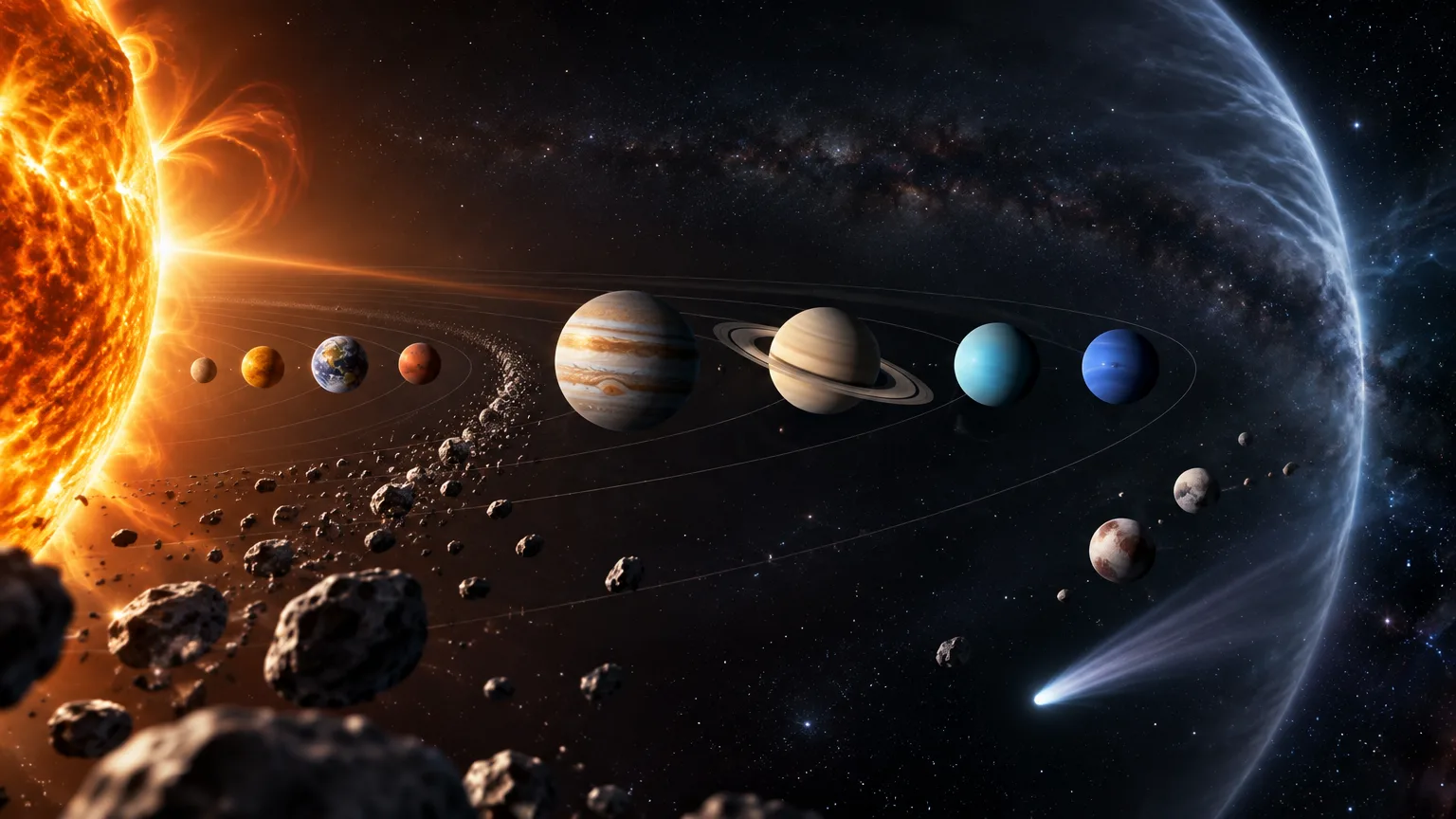
The Solar System is the space environment organized around the Sun. According to NASA’s Solar System Exploration page, it contains one star, eight planets, five dwarf planets, at least 290 moons, more than 1.3 million asteroids and about 3,900 comets. These figures convey the scale of a system much larger than the planet list often memorized at school.
The same agency’s Solar System facts page summarizes some groups less precisely, referring to hundreds of moons and thousands of asteroids and comets. These two formulations need not be read as a contradiction: one gives more specific quantities, while the other offers a broad summary. In either case, the qualifiers “at least,” “more than” and “about” matter. The material consulted does not present these as exact counts tied to a stated cutoff date and detailed methodology.
More than eight planets
The eight planets are only part of the objects in the system. NASA also lists five officially named dwarf planets and numerous moons, asteroids and comets. The distinction between categories is useful for describing the inventory, but the available evidence does not provide a technical explanation here of the criteria separating a planet from a dwarf planet, so it would be unwise to invent one.
NASA’s figures should not be mistaken for an unchanging catalogue of every body that exists. The page offers an overview of objects counted in current knowledge, while its qualifying language shows that some quantities are estimates or open-ended counts. The information provided does not say when each figure was updated or how each object was verified. The prudent way to read them is therefore as a general institutional reference, not as a simultaneous, exhaustive measurement of every part of the Solar System.
The heliosphere and the IMAP mission
The Sun is not only the central star of the system; it also creates a large-scale space environment. NASA describes the heliosphere as a huge bubble created by the Sun. The IMAP mission launched on September 24, 2025, and, according to the available institutional description, will help researchers better understand the boundary of that bubble.
This goal places IMAP in the study of the frontier of the solar environment, rather than in counting planets or observing just one world. The source consulted does not specify instruments, results already obtained, an observing schedule or scientific conclusions here. The launch is therefore a concrete fact, while improving understanding of the heliosphere’s boundary is described as the mission’s purpose—not as a result already demonstrated by this material.
Observing the Sun and studying other systems
NASA’s Solar Dynamics Observatory (SDO) is another mission focused on our star. It was designed to help researchers understand the Sun’s influence on Earth and near-Earth space by studying the solar atmosphere on small spatial and time scales. This description explains the observatory’s focus, but does not report a particular measurement or recent discovery.
The James Webb Space Telescope has a different and broader reach: it studies phases of the universe’s history, from the first luminous glows after the Big Bang to the formation of solar systems capable of hosting planets. Including Webb places the study of our own system within a wider astronomical investigation. The institutional description does not say Webb is devoted exclusively to the Solar System, nor does the evidence here provide a specific result about it.
What these sources support
Together, the cited pages provide two kinds of information: an approximate inventory of Solar System bodies and descriptions of mission science goals. The evidence supports saying that NASA assigns IMAP the task of studying the heliosphere’s boundary, that SDO was designed to investigate the Sun’s influence on Earth’s environment, and that Webb studies a cosmic history that includes the formation of solar systems. It does not support attributing unmentioned results to those missions.
The material also contains no dated announcement of a new discovery, no statistic accompanied by an original source, measurement date and comparable units, and no scientific paper whose findings could be assessed. IMAP’s launch date is specified; the inventory figures have no cutoff date in the material here. That distinction should be preserved when reporting the information.
The strongest conclusion is straightforward: the Solar System contains far more than its eight planets, and exploring it means studying both its constituent objects and the space shaped by the Sun’s activity. IMAP, SDO and Webb address different questions. The institutional pages allow those questions and their context to be described, but they do not justify turning a mission’s goals into a confirmed discovery.